


Jessica Winter on how, since COVID, many professors have become more flexible about due dates, and why others think that students need more deadlines, not fewer.
Such behavior—at once self-indulgent and masochistic, and as common as it is ostensibly irrational—“is basically a nonadaptive coping mechanism for the pressure and the stress that you are experiencing,” Jan Dirk Capelle, a psychologist who studies motivation, told me recently.
These patterns may seem timeless, but in recent years many higher-learning institutions in the United States have felt the need to intervene. Since the onset of the coronavirus crisis, in the spring of 2020, educators have seen a significant decline in virtually every metric of student performance: attendance, class participation, completed coursework, test scores. According to survey data collected during the 2022-23 school year by the Center for Collegiate Mental Health, at Penn State, students’ self-reported levels of generalized anxiety, along with anxiety related directly to academics, family, and social life, still had not returned to pre-pandemic rates—and, in fact, social anxiety had continued to rise slightly. Students’ use of psychotropic medications was at its highest rate since the center began collecting such data, more than a decade ago. The responses from colleges and universities to these worrying trends have run the gamut, from enhancing mental-health services on campus to incorporating more hands-on and student-directed learning. But there’s one lever that educators have pulled again and again: the deadline. Schools began hitting pause on strict due dates not long after the pandemic forced classes to move online. In 2022, The Chronicle of Higher Education reported that faculty members from a range of colleges and universities had embraced more “fluid” and “flexible” policies on granting extensions on papers or arranging makeup exams. A writing professor at the University of Alaska Anchorage, went so far as to let his students set their own deadlines. This softened stance reached younger students, too: in some public-school districts—including those in Los Angeles, San Diego, and Shaker Heights, Ohio—teachers were instructed not to dock the grades of students who turned in work late. When I spoke with professors at a range of colleges and universities about their approach to deadline protocols, a sense of empathy and patience prevailed on behalf of their students, who have been forced to navigate rapid technological change and a global pandemic at critical moments of their emotional, psychological, and neurological development. As an English professor at a private liberal-arts college put it to me in an e-mail, “Maybe I feel for them too much, but I just don’t think they need to wreck themselves with all-nighters just to meet my arbitrary deadline.” And there is evidence that some degree of controlled flexibility with deadlines can have salutary effects. This past spring, two Cornell researchers published the results of an experiment in which hundreds of students in an introductory biology class were offered a two-tier framework: “ideal” and “extension without penalty,” or E.W.P. More than three-quarters of these students chose the E.W.P. option at least once, and, the authors wrote, “reported benefits in stress reduction, handling of sickness and emergencies, and improved performance in other courses.” Some positive effects, they went on, were most pronounced among first-generation college students. But professors may have other, more vexing reasons for showing leniency toward late-coming students. Some faculty brought up the spectre of student evaluations, which has been cited as a prime mover behind grade inflation and can also factor into decisions about tenure and contract renewals. Online course listings enable faculty, students, and administrators to see which classes fill up the fastest and, by implication, which professors are perceived as benevolent and easygoing. A professor of sociology at a large public university told me that these pressures on faculty are symptomatic of a transactional model of higher education. “Broadly speaking, there are students and administrators who treat higher education as a service industry: students are the customers, faculty are the service providers, admin are the managers,” he said. As educational costs continue to rise, he went on, “I can understand why students or their parents approach college with the attitude of ‘I’m not getting my money’s worth,’ like they’re dining at a restaurant and unhappy about the quality of food or service.” In this analogy, he added, “Rate My Professor is like Yelp.” Any faculty member who is tolerant of extensions and makeup tests—who, in other words, gives the customer what she asks for—will earn more rave reviews than a less indulgent colleague. Sometimes, though, you lose customers and you don’t know why. The sociology professor said that, during the spring 2024 semester, he saw more “ghosting” than ever before—referring to students who fade out of a class altogether, but who do not formally withdraw, and receive a failing grade by default. Anything that keeps students in class, where they are at least potentially learning something, would be preferable. Several professors in the arts and humanities pointed out that their fields are in steep decline, and there’s “an implicit sense that we need to do whatever we can to hang on to these students and work around their challenges,” a film professor at a private college told me. One of her classes is a screenwriting workshop, which is devoted entirely to reading and discussing student work. On any given day that a student is scheduled to workshop, there is a roughly fifty-fifty chance that they do not turn in anything before the deadline. The uncertainty is “a bit of a nightmare,” she said. “It has meant that I always have to have some sort of backup plan—some film I can show, some random lesson I’ve fabricated at the last minute—in case we end up with nothing to do.” Missed and deferred deadlines can also interfere with the intellectual and creative dynamics of a course. Students are “losing the opportunity to get feedback from their classmates, which is the basic function of the class,” the film professor said. Seen in this light, it’s unclear whether deadline extensions actually alleviate pressure on students or if they merely defer and prolong it. “By setting deadlines, we’re basically controlling people’s behavior,” Capelle told me. He went on, “On the one hand, I am convinced that deadlines are necessary to activate any kind of study or writing behavior at all.” On the other hand, he said, “they are also the bad kind of motivation.” A hallmark of procrastination is a measure of executive function known as temporal discounting, or the tendency to value a smaller, immediate reward over a larger reward that awaits in the future. This human weakness helps to support a notion that may seem paradoxical: that the solution to the scourge of the deadline is more deadlines. “In most of my courses, my approach was to use quite a few deadlines,” Capelle said. Instead of a single due date for project-based assignments, for example, Capelle’s students were given a series of smaller deadlines, for pitching the project, for completing an outline, and so forth—an example of the educational strategy known as scaffolding. “Or it could be just a ten-item, multiple-choice quiz that isn’t graded,” Capelle went on. “I was trying to motivate a kind of incremental learning—to train them to see the deadline they were facing as an opportunity to check their knowledge and engage with the material, rather than as an opportunity to fail.” Some faculty take a holistic perspective on the deadline question, viewing it within an over-all context of rising student disengagement. This disconnect is elsewhere embodied in the widespread use of ChatGPT to crank out term papers. A philosophy professor at a public university told me that, as ChatGPT started to become ubiquitous, he significantly overhauled his syllabus to favor more frequent, lower-stakes deadlines. Now, instead of turning in several long papers in the course of a semester, his students take in-class exams, writing longhand. “I don’t allow them to use the Internet or any notes,” he explained in an e-mail. “Students tend to collaborate on WhatsApp groups so if they were allowed to use any resources besides pencil and paper the exams would all look the same.” The final term paper is also generated largely within his sight. “I had the students work up their own paper topics in class and transform them step-by-step into finished papers,” he said. “I am an easy grader; I just want to make sure they are doing their own work.” Steven Rogers, a political-science professor at Saint Louis University, relies on a unique variation of scaffolding to insure that his students complete the reading on time for class. In years past, Rogers told me, “by the fourth week they’d stop reading. I’d give them a pop quiz and the average would be, like, two out of ten, and they’d all panic, and I’d tell them that I had empirical evidence they weren’t doing the reading.” For the rest of the term, in most of his classes, Rogers would ask a student to roll a die; he’d play an instrumental version of the Kenny Rogers song “The Gambler” over the classroom speakers. “A one or a two gets a quiz; a three or a four, small-group discussion; five or six, class discussion,” Rogers said. “The threat of the quiz alone makes them all read.” At the same time, he went on, the casino-table whimsy “relaxes the atmosphere. It becomes a shtick and they get into it.” Arguably, this gimmick is just a more assertive form of “controlling people’s behavior,” to borrow Capelle’s phrase, than setting a couple of blowout deadlines and leaving it to students to figure it out. “It’s a big question for higher ed: when does a student become an adult?” Rogers said. “How much accommodation and hand-holding should there be? When does school become a job, where, if you don’t do it, you get the F, and you move on?” For now, Rogers has his answer. This semester, he told me, “I didn’t even wait to introduce the dice. In evaluations, the students say, ‘I don’t like the dice, but it makes class a lot better.’ So it’s, like, O.K., we’ll keep rolling the dice.” ♦
Universities Professors Deadlines Mental Health Students Anxiety Coronavirus
United States Latest News, United States Headlines
Similar News:You can also read news stories similar to this one that we have collected from other news sources.
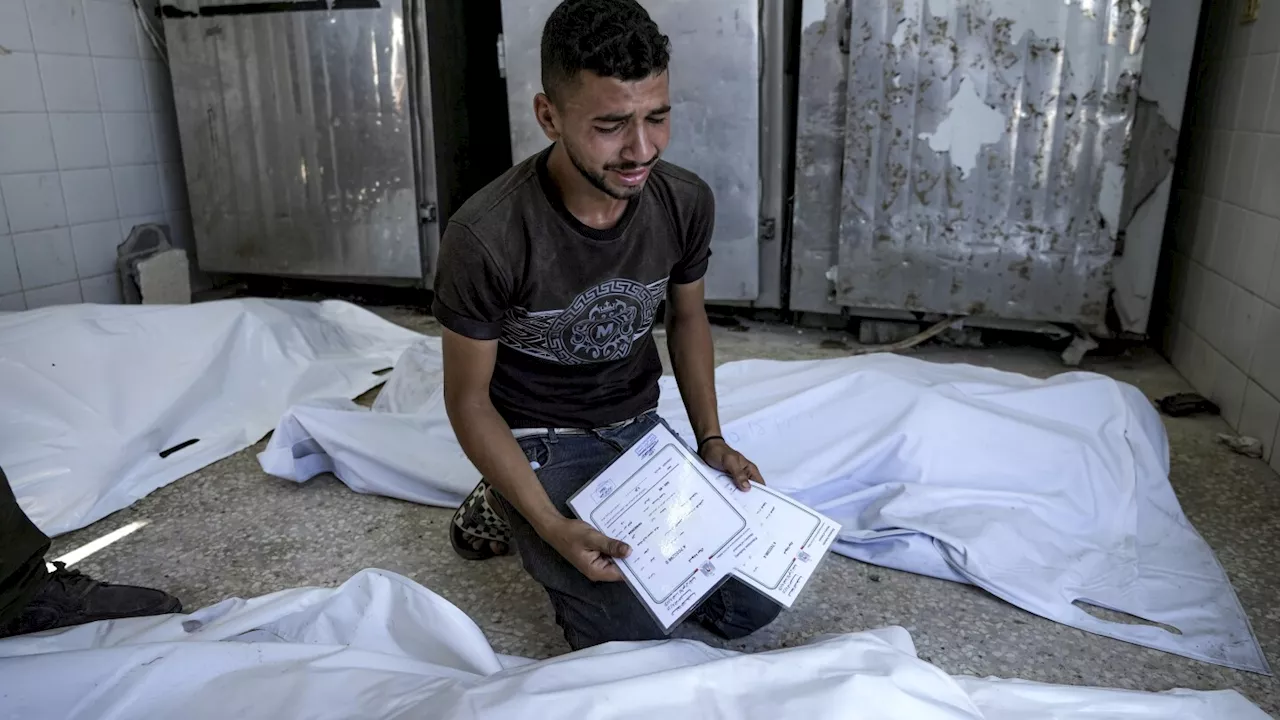 Israeli strikes on Gaza leave children without parents and parents without childrenA 3-month-old infant was the only member of her family to survive an Israeli airstrike in the Gaza Strip late Monday. A few miles (kilometers) to the north, a man lost his wife and their twin newborns in another strike.
Read more »
 Israeli strikes on Gaza leave children without parents and parents without childrenA 3-month-old infant was the only member of her family to survive an Israeli airstrike in the Gaza Strip late Monday.
Read more »
 Israeli strikes on Gaza leave children without parents and parents without childrenA 3-month-old infant was the only member of her family to survive an Israeli airstrike in the Gaza Strip late Monday.
Read more »
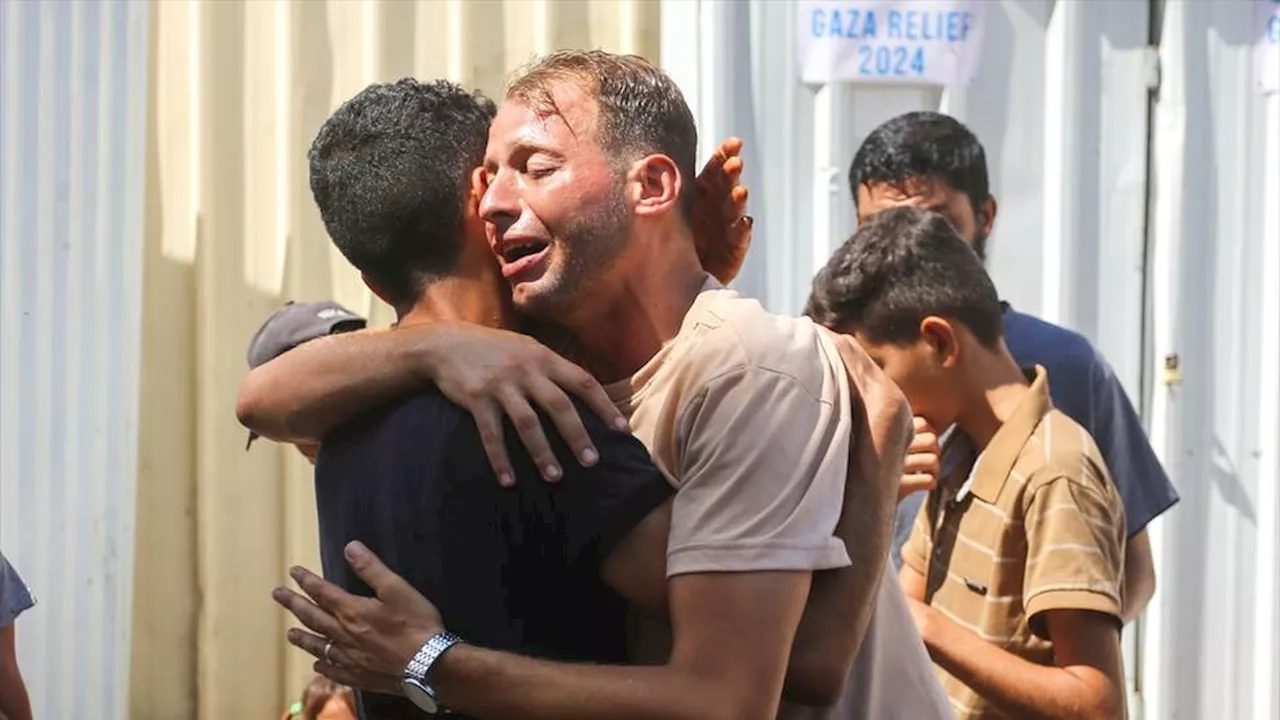 Gaza's tragedy: Children without parents, parents without childrenIsrael's assault on Gaza leaves thousands of orphans — so many that local doctors employ an acronym when registering them: WCNSF, or 'wounded child, no surviving family'.
Read more »
 Israeli strikes on Gaza leave children without parents and parents without childrenMore than 10 months into its war with Hamas, Israel’s relentless bombardment of the isolated territory has wiped out extended Palestinian families.
Read more »
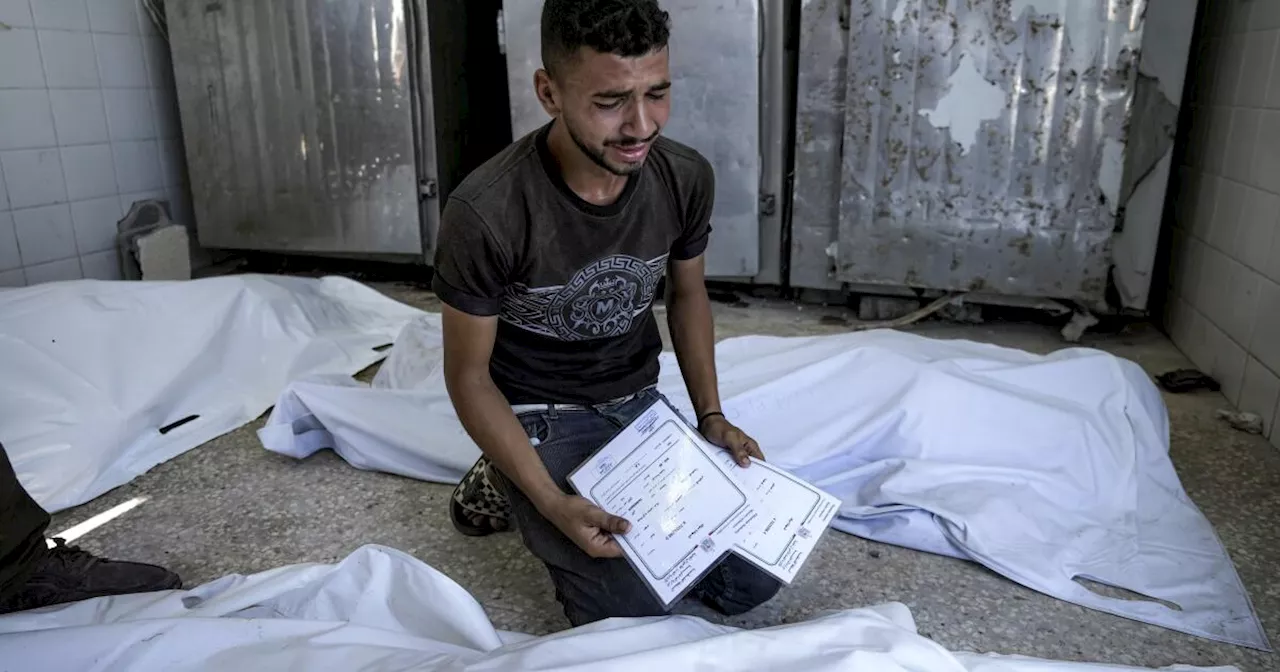 Israeli strikes on Gaza leave children without parents and parents without childrenA 3-month-old infant was the only member of her family to survive an Israeli airstrike in Gaza. A mother and 4-day-old twins were killed in another.
Read more »