


From the Star Gate to a time-traveling bedroom, there's a lot to unpack in the ambiguous ending of Stanley Kubrick's 2001: A Space Odyssey.
Summary SCREENRANT VIDEO OF THE DAY SCROLL TO CONTINUE WITH CONTENT The ambiguous ending of Stanley Kubrick’s sci-fi epic 2001: A Space Odyssey continues to befuddle audiences, but many elements and the core message of the ending can be explained.
Some of Kubrick’s movies have straightforward endings, like the nuclear annihilation of Earth in Dr. Strangelove, but most of them end on an ambiguous note, like The Shining and A Clockwork Orange. The ending of 2001: A Space Odyssey is particularly confusing because the movie takes a surreal, psychedelic turn in its last half-hour, and the complex science fiction narrative doesn't make the 2001: A Space Odyssey ending any clearer. The film ends with Dave Bowman going through the Star Gate, watching himself age into death from the comfort of a neoclassical bedroom, and getting reborn as a fetus floating above Earth in an orb. The symbols, messages, and hidden meanings in this ending are open to interpretation, and there might not even be a definitive answer even despite the 2001: A Space Odyssey ending explained by Kubrick himself. However, there are some elements of Kubrick's ambitious space-faring tale that can be objectively explained.What Do 2001: A Space Odyssey’s Monoliths Actually Do? The mythology of 2001: A Space Odyssey, which is a classic example of hard sci-fi, revolves around the mystery of the monoliths. According to Arthur C. Clarke’s Space Odyssey novels, the monoliths were built by an unseen ancient alien civilization. Called “The Firstborn,” they were the first intelligent species to evolve in the Milky Way. Every time a monolith pops up, it encourages humanity to make a technological advancement. When the apes find the first monolith in the opening sequence, they learn to use tools. When astronauts find another monolith under the Moon’s surface sending radio waves to Jupiter, it encourages them to launch a mission to the planet. When he gets to Jupiter, Dr. David Bowman finds an even bigger monolith orbiting the planet. Considering Stanley Kubrick created 2001’s effects without CGI, this scene is truly impressive. Not only is it a staggering spectacle, but it also sets up the resolution of the film’s themes. After David departs from the Discovery in an EVA pod to get a closer look at the monolith, it sucks him into the “Star Gate.” What Is The Star Gate? After encountering the final monolith, David is drawn into the Star Gate, a vortex of colored light, bizarre landscapes, and inexplicable cosmic events. The Star Gate sequence only lasts a few minutes, but at the end of it, when Dave is spat out into a big, fancy bedroom with his own rapidly aging self, nine years have passed. The space effects in 2001: A Space Odyssey were so mind-blowing that they sparked a conspiracy theory that Kubrick faked the Moon landing, and the Star Gate sequence is by far the most mesmerizing stretch of the entire movie. The Star Gate is more than just a thrilling set piece in the 2001: A Space Odyssey ending; it launches Dave into the final leg of his interstellar journey. As it turns out, getting to Jupiter was the easy part. The last monolith acts as a kind of wormhole that chooses Dave to catapult humanity into the next step in its evolution.What Is The Bedroom Dave Bowman Ends Up In? Human Zoo Explained By Kubrick Stanley Kubrick tended to avoid explaining his movies, instead leaving it up to the audience to determine their own meaning. Yet he made an exception in the case of 2001: A Space Odyssey, which is frequently ranked among Stanley Kubrick’s best movies. In an interview that resurfaced from an unreleased 1980 documentary by filmmaker Jun’ichi Yaoi, Kubrick explained : I’ve tried to avoid doing this ever since the picture came out. When you just say the ideas they sound foolish, whereas if they’re dramatized one feels it, but I'll try. The idea was supposed to be that he is taken in by god-like entities, creatures of pure energy and intelligence with no shape or form. They put him in what I suppose you could describe as a human zoo to study him, and his whole life passes from that point on in that room. And he has no sense of time. It just seems to happen as it does in the film. They choose this room, which is a very inaccurate replica of French architecture because one was suggesting that they had some idea of something that he might think was pretty, but wasn’t quite sure. Just as we’re not quite sure what do in zoos with animals to try to give them what we think is their natural environment. Anyway, when they get finished with him, as happens in so many myths of all cultures in the world, he is transformed into some kind of super being and sent back to Earth, transformed and made into some sort of superman. We have to only guess what happens when he goes back. It is the pattern of a great deal of mythology, and that is what we were trying to suggest. The 2001: A Space Odyssey ending explained by Kubrick reveals that the neoclassical bedroom that Dave finds himself in is an enclosure. The enclosure was built by the god-like aliens that captured him thought he'd like. In the Yaoi interview, Kubrick compared the bedroom’s “inaccurate replica of French architecture” to the unnatural recreations of animals’ natural habitats in zoo enclosures. This seems to confirm the religious interpretation that 2001: A Space Odyssey is about the search for God. The plot of the movie is driven by scientific innovation, but Dave’s transformation into the Star Child defies scientific explanation and suggests spiritual intervention. The 2001: A Space Odyssey ending explained by Kubrick also detailed Dave's future, as he revealed to Yaoi, “When get finished... sent back to Earth, transformed, and made into some sort of superman.” Dave Becomes The Star Child: Friedrich Nietzsche’s Übermensch The iconic final shot of 2001: A Space Odyssey – featuring Dave as the Star Child, floating in Earth’s orbit – is deliberately enigmatic to leave viewers scrambling for meaning. This closing image is one of the reasons 2001: A Space Odyssey needs multiple viewings to be understood. The ending brings the overarching narrative full circle with the next stage of human evolution. The movie begins with apes evolving into humans when they realize they can use violence to get what they want in the opening “Dawn of Man” sequence, and it ends with its central human character transcending his own biology to become a new life form altogether.From this perspective, 2001: A Space Odyssey visualizes Friedrich Nietzsche’s philosophical belief that the human race is a bridge between the ape and the Übermensch. The Star Child, an advanced form of human being that flies across the galaxy in an orb, can be interpreted as Stanley Kubrick’s vision of the Übermensch. 2001: A Space Odyssey was one of the earliest sci-fi movies to comment on evolution, followed by the replicant evolution in Blade Runner. The True Meaning Of The Ending It’s easy for an interpretation of the 2001: A Space Odyssey ending to get lost in the specifics of how the monolith opened the Star Gate and what turned Dave into the Star Child. But, broadly, the 2001: A Space Odyssey ending explained the message that the universe is out of humanity’s control. There are forces in the cosmos much greater than the human race, and most of them have yet to be discovered by man – and if they were to be discovered, they might be beyond human comprehension, much like this movie.
United States Latest News, United States Headlines
Similar News:You can also read news stories similar to this one that we have collected from other news sources.
 NASA astronaut snaps photo of solar eclipse from the space stationMichael Wall is a Senior Space Writer with Space.com and joined the team in 2010. He primarily covers exoplanets, spaceflight and military space, but has been known to dabble in the space art beat. His book about the search for alien life, 'Out There,' was published on Nov. 13, 2018.
Read more »
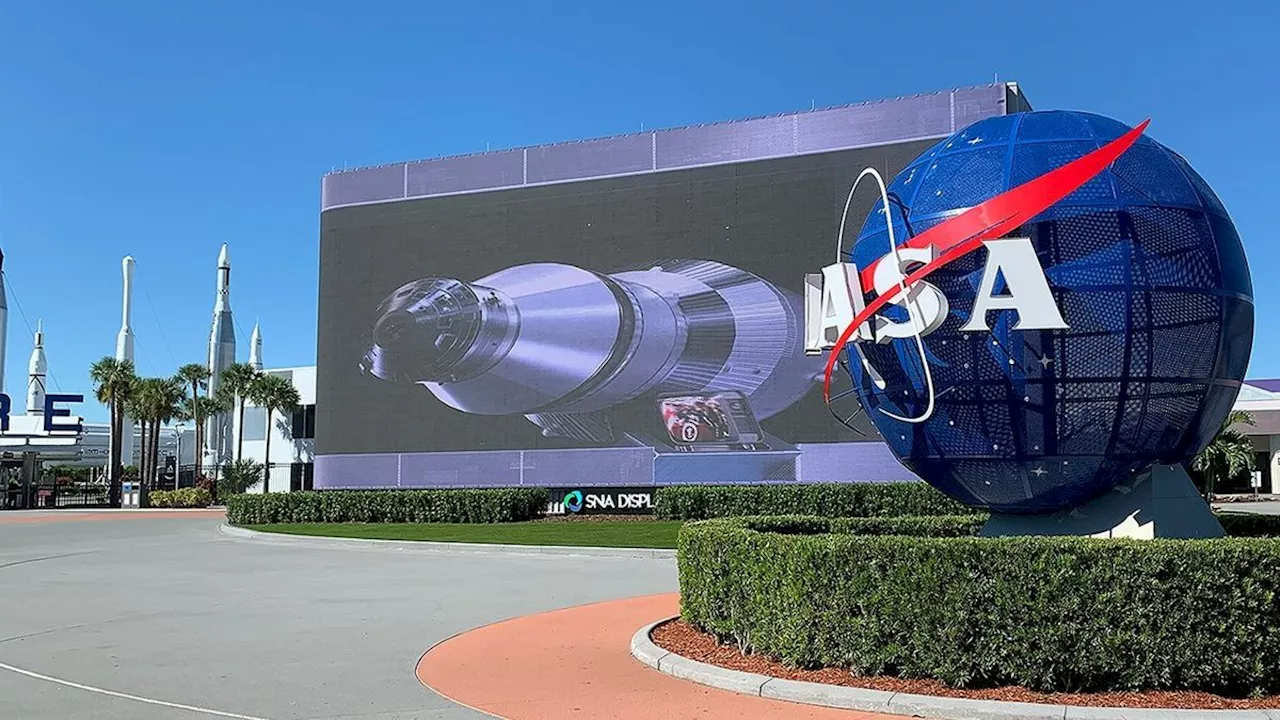 Space history and future leap off the screen at NASA's Kennedy Space CenterRobert Pearlman is a space historian, journalist and the founder and editor of collectSPACE.com, an online publication and community devoted to space history with a particular focus on how and where space exploration intersects with pop culture. Pearlman is also a contributing writer for Space.
Read more »
 5 things to do this weekend, including the Blue Man Group and Boston Asian American Film FestivalPlus, a reading of 'The Odyssey' and 'Inventing Isabella' at the Isabella Stewart Gardner Museum.
Read more »
 Erin Foster Says Chad Michael Murphy Cheated on Her With Sophia Bush While They Lived TogetherErin Foster and Chad Michael Murray dated from 2001 to 2002.
Read more »
 Erin Foster Says Chad Michael Murray Cheated on Her With Sophia Bush While They Lived TogetherErin Foster and Chad Michael Murray dated from 2001 to 2002.
Read more »