


Dr. Mirkouei is an Associate Professor at University of Idaho (UI), Forbes sustainability contributor, certified Professional Engineer (PE), and experienced Technologist.
Mining minerals from natural deposits is costly in both economic and environmental aspects. The key competitive advantage of local mining and extraction is its ability to produce high-concentration intermediate sources in close proximity to raw minerals, like rare earth elements .
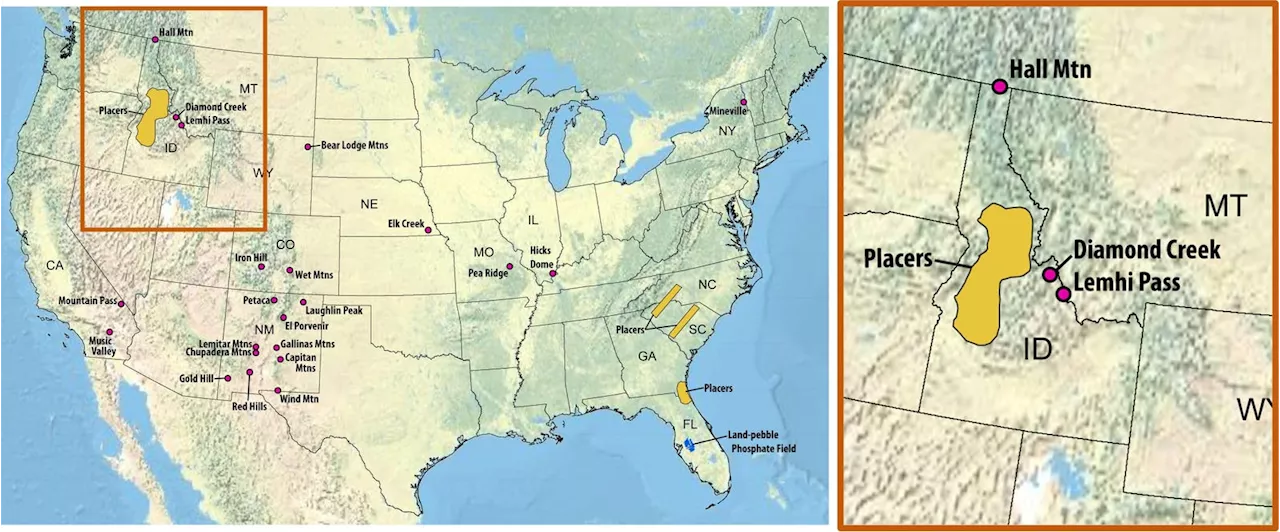
This alleviates transferring low-concentration REE hard rocks to centralized refineries, which can improve the economic and environmental performance of rare earth metals manufacturing by reducing transportation, handling, and storage costs. Besides, local REE extraction can significantly reduce the number of steps involved in processing REE ores, including the steps in producing hazardous waste chemicals, such as floatation and hazardous solvent extraction. The conventional extractive metallurgy route generates about 2,000 tons of waste for every ton of REE produced. Domestic mining and extraction of REE can result in less than 100 tons of chemical waste for every ton of REE . Idaho is endowed with an abundance of critical minerals, especially REEs. Still, many of these mineral occurrences have not yet been developed into economic deposits that the United States can reliably count on. Most of Idaho’s REE occurrences lie along a northwest-trending line, extending more than 70 miles across central Idaho from Lemhi Pass, through Diamond Creek, to the Mineral Hill district before crossing the Idaho-Montana state line. The Diamond Creek prospect area sits eight miles northwest of Salmon, Idaho, and is estimated to hold about 75,500 tons of total rare earth oxides . The latest exploration results in Lemhi Pass sites by Idaho Strategic Resources Inc. have revealed rare earth grades up to 4.26% TREO, in which 2.56% of TREO is solely neodymium.Rare earth metals are the primary commercial form of REEs that power our everyday lives. For example, neodymium is known as the strongest permanent magnet material and is used in many products, including medical devices, wind turbines, electric vehicles, and more. Praseodymium can be used to make strong metals for aircraft engines. Dysprosium and yttrium are heavy REEs that are used as additives in different products to improve their strength. Rhodium is earth’s most valuable precious metal due to its chemical resistance and thermal properties .of the rare earth metals that the company extracts from the rusty colored rock. With names that are foreign to most consumers, the metals are components in products that will define the future of industrial society. REEs can be recovered from primary sources or secondary sources . They are known as “rare” not because they are uncommon but because they are dispersed in the earth’s crust at low concentrations and rarely found as concentrated ore deposits that can be economically extractable using traditional methods. There are few studies of biological processes for REE extraction from ore deposits. Biological processes have already been widely used in the mining and refinery industry to extract precious metals from both primary and secondary sources.Trump Trial Prosecutor Ends Closing Argument After Nearly 5 Hours—Jury Instructions Set For Wednesday Bioleaching is the process of solubilizing metals using organic acids or the metabolic/enzymatic activity of microorganisms. Bioleaching has been studied extensively for extracting precious metals and has been used successfully in the mining industry. Although laboratory studies have applied various bioleaching techniques to extract and separate REEs, none of these methods have been commercially utilized in producing REMs. Earlier studies at Idaho National Laboratory utilized gluconic acid producing organisms to leach REEs from waste phosphors and fluid catalytic cracking catalysts. They concluded that microorganisms producing gluconic acid can effectively leach REEs from these materials. They used potato waste as a nutrient source for the microorganisms and were able to lower bioleaching costs by 17% compared to using refined glucose. Also, ore deposits contain higher amounts of REEs, enabling high yield and low processing costs. Compared to traditional solvent extraction for REE separation, which can require hundreds of mixing and settling steps and create a large amount of acid and base waste, the bioleaching process to produce a mixed REE requires a single extraction stage, producing no acid waste. The solid byproducts of the leaching process can be used as a substrate for phytomining, minimizing the overall waste production. Phytomining process uses hyperaccumulator plants that can accumulate vast quantities of REEs in their aerial parts without substantial adverse effects.The growing demand for advancing technologies made from REEs is predicted to reach $2.5 trillion worldwide by 2030. The United States currently relies heavily on foreign sources for these elements. Usually, they are mined by digging vast open pits in the ground. When poorly regulated, mining can produce wastewater ponds filled with acids, heavy metals, and radioactive materials that might leak into groundwater. A “low-emission” and socially responsible future will not be possible without a reliable and mineable domestic supply of critical materials like REEs. Careful extraction and processing of REEs is critical to minimize the United States’ dependency on foreign countries for necessary materials, especially in renewable energy security applications. Sustainable and locally sourced extraction pathways aim to enhance national security and environmental responsibility. Bioleaching of REE can potentially provide a sustainable alternative to traditional, chemical-intensive methods. Also, bioleaching could be applied to recycling REEs from old electronics , contributing to a more circular and environmentally conscious approach to these critical materials. Additionally, coupling bioleaching with phytomining can both increase process yields and minimize waste generation.Our community is about connecting people through open and thoughtful conversations. We want our readers to share their views and exchange ideas and facts in a safe space.Insults, profanity, incoherent, obscene or inflammatory language or threats of any kindContinuous attempts to re-post comments that have been previously moderated/rejectedAttempts or tactics that put the site security at riskProtect your community.
United States Idaho Rare Earth Elements Organic Acid Leaching Bioleaching Phytomining Sustainable Low Emission Rare Earth Metals
United States Latest News, United States Headlines
Similar News:You can also read news stories similar to this one that we have collected from other news sources.
 Promethium bound: New study uncovers rare earth element's propertiesScientists have uncovered the properties of a rare earth element that was first discovered 80 years ago at the very same laboratory, opening a new pathway for the exploration of elements critical in modern technology, from medicine to space travel.
Read more »
 Rare earth element studied in solution to advance space exploration techScientists made discoveries about the properties of promethium by successfully characterizing chemical complexities in solution for the first time since its discovery.
Read more »
 Promethium bound: Rare earth element's secrets exposedScientists have uncovered the properties of a rare earth element that was first discovered 80 years ago at the very same laboratory, opening a new pathway for the exploration of elements critical in modern technology, from medicine to space travel.
Read more »
 Extreme complexity in formation of rare earth mineral vital for tech industryResearchers have unveiled that myriad, intricate factors influence the genesis and chemistry of bastnasite and rare earth carbonates, which are critically needed for today's tech industry and its hardware outputs. Their work unveils a newly acquired depth of understanding that had previously been unexplored in this field.
Read more »
 Can coal mines be tapped for rare earth elements?A team of geologists analyzed 3,500 samples taken in and around coal mines in Utah and Colorado. Their findings open the possibility that these mines could see a secondary resource stream in the form of rare earth metals used in renewable energy and numerous other high-tech applications.
Read more »
 Secrets of radioactive 'promethium' — a rare earth element with mysterious applications — uncovered after 80-year searchVictoria Atkinson is a freelance science journalist, specializing in chemistry and its interface with the natural and human-made worlds. Currently based in York (UK), she formerly worked as a science content developer at the University of Oxford, and later as a member of the Chemistry World editorial team.
Read more »