


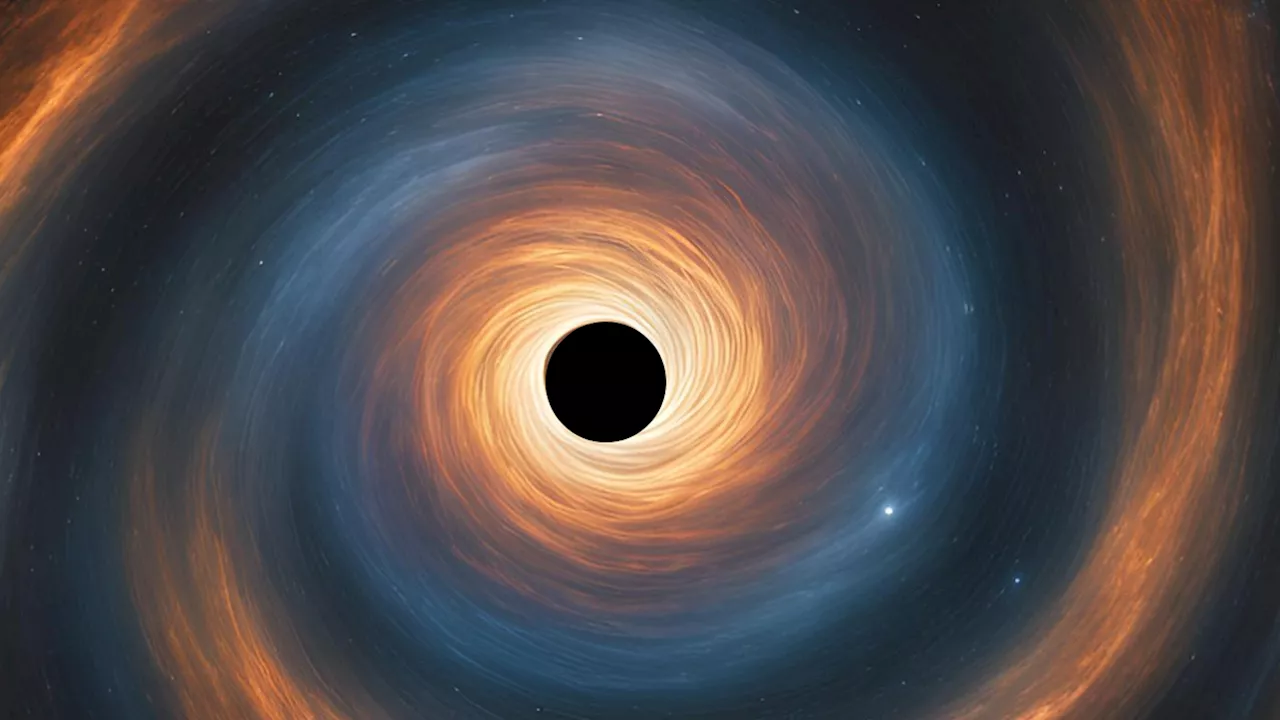
A new study explores the possibility of death from a primordial black hole, focusing on the critical mass needed to cause fatal damage through tidal forces and shockwaves. While a black hole the size of a hydrogen atom wouldn't pose a threat, a larger one, akin to an asteroid, could potentially be lethal.
In 1974, science fiction author Larry Niven wrote a murder mystery with an interesting premise: could you kill a man with a tiny black hole? I won’t spoil the story, though I’m willing to bet most people would argue the answer is clearly yes.
Intense gravity, tidal forces, and the event horizon would surely lead to a messy end. But it turns out the scientific answer is a bit more interesting. On the one hand, it’s clear that a large enough black hole could kill you. On the other hand, a black hole with the mass of a single hydrogen atom is clearly too small to be noticed. The real question is the critical mass. At what minimum size would a black hole become deadly? That’s the focus of a new paper on theThe study begins with primordial black holes. These are theoretical bodies that may have formed in the earliest moments of the Universe and would be much smaller than stellar-mass black holes. Anywhere from atom-massed to a mass several times that of Earth. Although astronomers have never found any primordial black holes, observations do rule out several mass ranges. For example, any primordial black hole smaller than 10kg would gravitationally lens stars in the Milky Way. Since we haven’t detected these lensing effects, they must at the very least be exceedingly rare. If they exist at all. Some theoretical models argue that primordial black holes could be the source of dark matter. If that’s the case, observational limits constrain their masses to the 10kg range, which is similar to the mass range for asteroids. Therefore, the study focuses on this range and looks at two effects: tidal forces and shock waves. Tidal forces occur because the closer you get to a mass, the stronger its gravity. This means a black hole exerts a force differential on you as it gets near. So the question is whether this force differential is strong enough to tear flesh. Asteroid-mass black holes are less than a micrometer across, so even the tidal forces would cover a tiny area. If one passed through your midsection or one of your limbs, there might be some local damage, but nothing fatal. It would be similar to a needle passing through you. But if the black hole passed through your head, that would be a different story. Tidal forces could tear apart brain cells, which would be much more serious. Since brain cells are delicate, even a force differential of 10 – 100 nanonewtons might kill you. But that would take a black hole at the highest end of our mass range. Shockwaves would be much more dangerous. In this case, as a black hole entered your body, it would create a density wave that would ripple through you. These shockwaves would physically damage cells and transfer heat energy that would do further damage. To create a shockwave of energy similar to that of a 22-caliber bullet, the black hole would only need a mass of 1.4 x 10So yes, a primordial black holeWhile that makes for a great story, it would never happen in real life. Even if asteroid-mass primordial black holes exist, the number of them out there compared to the vastness of space means that the odds of it happening to anyone in their lifetime are less than one in 10 trillion.Reference: Robert J. Scherrer. “Gravitational Effects of a Small Primordial Black Hole Passing Through the Human Body.”
BLACK HOLES PRIYODIAL BLACK HOLES GRAVITY TIDES SHOCKWAVES
United States Latest News, United States Headlines
Similar News:You can also read news stories similar to this one that we have collected from other news sources.
 Black Hole Archaeology: Unraveling the Past Through SpinA new study using the Sloan Digital Sky Survey reveals that supermassive black holes spin faster than predicted by galaxy mergers alone, suggesting a significant role for smooth accretion in their formation.
Read more »
 Supermassive Black Hole Caught Doing Something Never Seen BeforeThe Best in Science News and Amazing Breakthroughs
Read more »
 Astronomers Witness Real-Time Formation of Plasma Jets from a Supermassive Black HoleFor the first time, scientists have directly observed the real-time formation of plasma jets emanating from a supermassive black hole. This groundbreaking observation, made using the Very Long Baseline Array (VLBA), provides valuable insights into the behavior of these enigmatic objects and the processes that drive the launch of relativistic jets.
Read more »
 Astronomers watch monster black hole spit out a light-year-long jetRobert Lea is a science journalist in the U.K. whose articles have been published in Physics World, New Scientist, Astronomy Magazine, All About Space, Newsweek and ZME Science. He also writes about science communication for Elsevier and the European Journal of Physics. Rob holds a bachelor of science degree in physics and astronomy from the U.K.
Read more »
 Faster Than Expected: Supermassive Black Holes Spin at Surprising SpeedsScientists have discovered that supermassive black holes rotate much faster than predicted. Using a new technique called 'black hole archaeology,' researchers linked black hole spins to the gas and dust they consumed over billions of years. This discovery suggests that black hole spins build gradually over time through the accumulation of angular momentum from accreted material.
Read more »
 Patrick Reed makes hole in one at famed Watering Hole at LIV Golf AdelaidePatrick Reed set off a celebration in Friday’s opening round at LIV Golf Adelaide with an ace at the famed Watering Hole.
Read more »