
The STS-63 mission marked a significant milestone in space exploration as the first shuttle rendezvous with the Mir space station. The mission featured several historic firsts, including the spacewalks of the first African American and British-born astronauts. The crew also conducted numerous science experiments aboard the Spacehab module.
The first shuttle mission of 1995, STS-63 , was notable for several historic firsts. As part of Phase 1 of the International Space Station program, space shuttle Discovery, on its 20th flight, conducted the first shuttle rendezvous with the Mir space station, paving the way for future dockings. This six-person crew included Commander James Wetherbee and cosmonaut Vladimir Titov.
The mission featured the first African American and the first British-born astronauts to venture into space during a spacewalk. The crew diligently carried out 20 science and technology experiments aboard the Spacehab module, marking its third flight. The STS-63 crew, comprised of Janice Voss, Eileen Collins, James Wetherbee, and Vladimir Titov; Bernard Harris, and Michael Foale, was announced by NASA in September 1993 for a mission initially planned for May 1994. This mission marked several milestones. Wetherbee, as the first woman shuttle pilot, embarked on her maiden spaceflight. Harris, selected in 1990, and Voss, selected in the same year, had both previously flown on STS-55 and STS-57, respectively. Foale, chosen as an astronaut in 1987, had prior experience on STS-45 and STS-56. Titov, selected as a cosmonaut in 1976, had two previous spaceflights under his belt – a two-day aborted docking mission to Salyut-7 and the pioneering year-long mission to Mir – and had even survived a launch pad abort. He served as backup to Sergei Krikalev during the STS-63 crew's participation in the Terminal Countdown Demonstration Test in the White Room of Launch Pad 39B.Following its previous mission in California, Space shuttle Discovery returned to NASA's Kennedy Space Center in Florida on September 27, 1994, after a ferry flight. Workers then transported it to the Orbiter Processing Facility the next day. After the installation of the Spacehab, SPARTAN, and other payloads on January 5, 1995, workers moved Discovery from the processing facility to the Vehicle Assembly Building for mating with an external tank and twin solid rocket boosters. Rollout to Launch Pad 39B took place on January 10. From January 17-18, teams conducted the Terminal Countdown Demonstration Test, a practice run for the countdown to launch scheduled for February 2, with the astronaut crew participating in the final hours as they would on launch day. They returned to Kennedy on January 29 for final pre-launch preparations. On February 2, launch teams opted for a 24-hour scrub to allow time for the replacement of a malfunctioning inertial measurement unit aboard Discovery. STS-63 Commander James Wetherbee on Discovery’s flight deck. On February 3, Discovery and its six-person crew lifted off from Launch Pad 39B at 12:22 a.m. EST, a time dictated by orbital mechanics – Discovery needed to launch into the plane of Mir's orbit. Within 8.5 minutes, Discovery had reached orbit, for the first time in shuttle history at an inclination of 51.6 degrees, aligning with Mir's trajectory. Early in the mission, one of Discovery's 44 attitude control thrusters failed, and two others developed minor but persistent leaks, posing a threat to the Mir rendezvous. The SPARTAN-204 satellite was attached to the remote manipulator system or robotic arm during the flight day two operations. On the mission's first day in space, Harris and Titov activated the Spacehab module and several of its experiments. Wetherbee and Collins performed the first of five maneuvers to bring Discovery within 46 miles of Mir for the final rendezvous on flight day four. Teams on the ground worked with the astronauts to resolve the troublesome thruster problems, ensuring a safe approach to the planned 33 feet.On flight day 2, as these activities continued, Titov grappled the SPARTAN satellite with the shuttle's robotic arm and lifted it out of the payload bay. Scientists utilized the ultraviolet instrument aboard SPARTAN to investigate the ultraviolet glow around the orbiter and the aftereffects of thruster firings. After the tests were completed, Titov placed SPARTAN back in the payload bay. On flight day three, the astronauts continued their work on science experiments while Wetherbee and Collins completed several more burns for the rendezvous on flight day four, the thruster issues resolved to allow the close approach of 33 feet. Flying Discovery manually from the aft flight deck, assisted by his crewmates, Wetherbee slowly maneuvered the shuttle to within 33 feet of the Kristall module of the space station. The STS-63 crew communicated with the Mir-17 crew of Aleksandr Viktorenko, Elena Kondakova, and Valeri Polyakov via VHF radio, and the crews could see each other through their respective spacecraft windows. After station-keeping for about 10 minutes, Wetherbee slowly backed Discovery away from Mir to a distance of 450 feet. He then flew a complete circle around Mir before conducting a final separation maneuver. STS-63 crew member Vladimir Titov worked on an experiment in the Spacehab module.
STS-63 Space Shuttle Discovery Mir Space Station International Space Station Spacewalk Space Exploration Science Experiments Spacehab Module Firsts In Space
United States Latest News, United States Headlines
Similar News:You can also read news stories similar to this one that we have collected from other news sources.
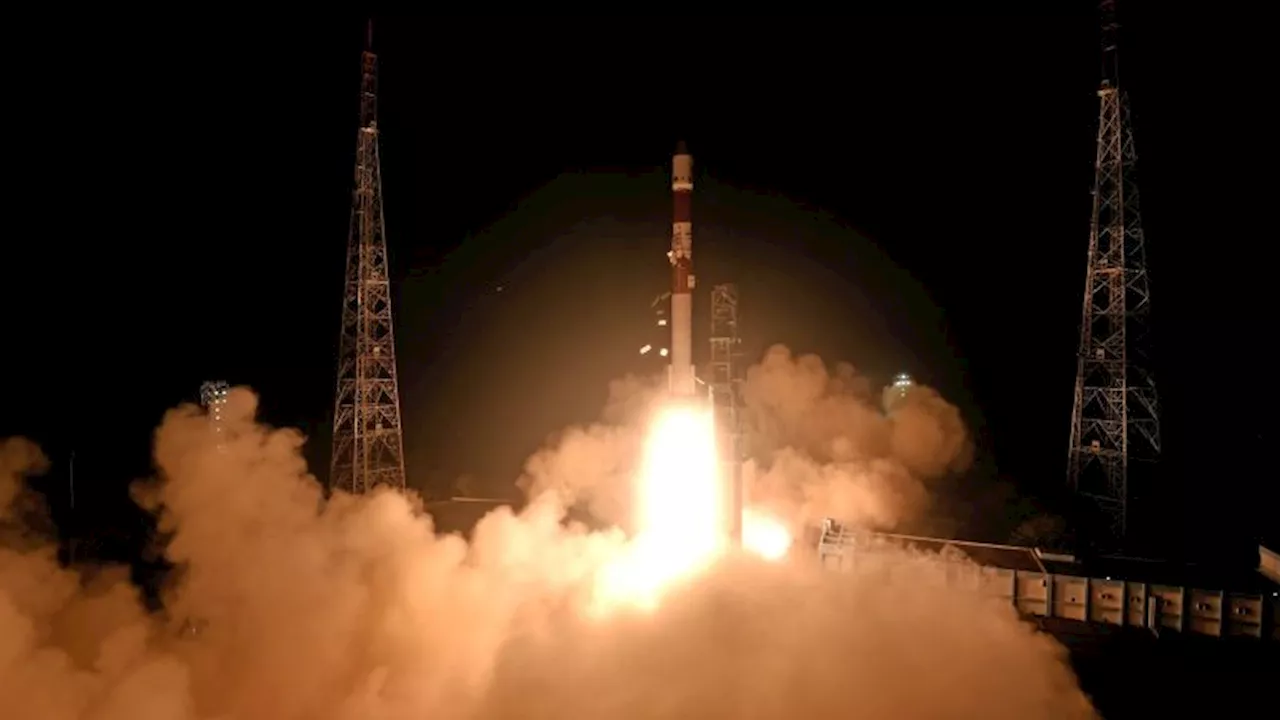 India Achieves Historic Unmanned Docking in SpaceIndia successfully completed an unmanned docking in space, making it the fourth country to achieve this feat after the US, Russia, and China. The Space Docking Experiment (SpaDex) involved two small spacecraft, Target and Chaser, docking together in low-earth orbit. This milestone is crucial for future space endeavors like satellite servicing, lunar missions, and building a space station.
Read more »
 India Achieves Historic Space DockingIndia's space agency, ISRO, successfully docked two spacecraft in orbit, making India the fourth country to accomplish this feat. The docking, which occurred after a slight delay, is a significant milestone for India's ambitious space program and paves the way for future missions like the Bharatiya Antariksha Station and Chandrayaan 4.
Read more »
 India Achieves Historic In-Space Docking MilestoneIndia successfully conducted its first in-space docking, joining an elite group of nations with this capability. The achievement involved two satellites, 'Target' and 'Chaser,' which maneuvered into close proximity and successfully docked. This marks a significant step forward for India's ambitious space program.
Read more »
 40 Years Ago: STS-51C, the First Dedicated Department of Defense Shuttle MissionOn Jan. 24, 1985, space shuttle Discovery took off from NASA’s Kennedy Space Center (KSC) in Florida on STS-51C, the first space shuttle mission entirely
Read more »
 Ax-4 Crew Selected for Historic Mission to International Space StationNASA and its international partners have approved the crew for Axiom Space’s fourth private astronaut mission to the International Space Station, launching no earlier than spring 2025. The mission will send the first ISRO astronaut to the station and marks the first time astronauts from Poland and Hungary will stay aboard the space station.
Read more »
 Vodafone Makes Historic Space Mobile Video Call from WalesVodafone announces a groundbreaking mobile video call from a remote area in Wales, connecting satellites to its terrestrial network. This marks the first time a satellite service offers mobile broadband directly to standard 4G or 5G phones. The service is expected to launch commercially in Europe by late 2025 or 2026, eliminating the need for specialized equipment like satellite dishes or phones.
Read more »