
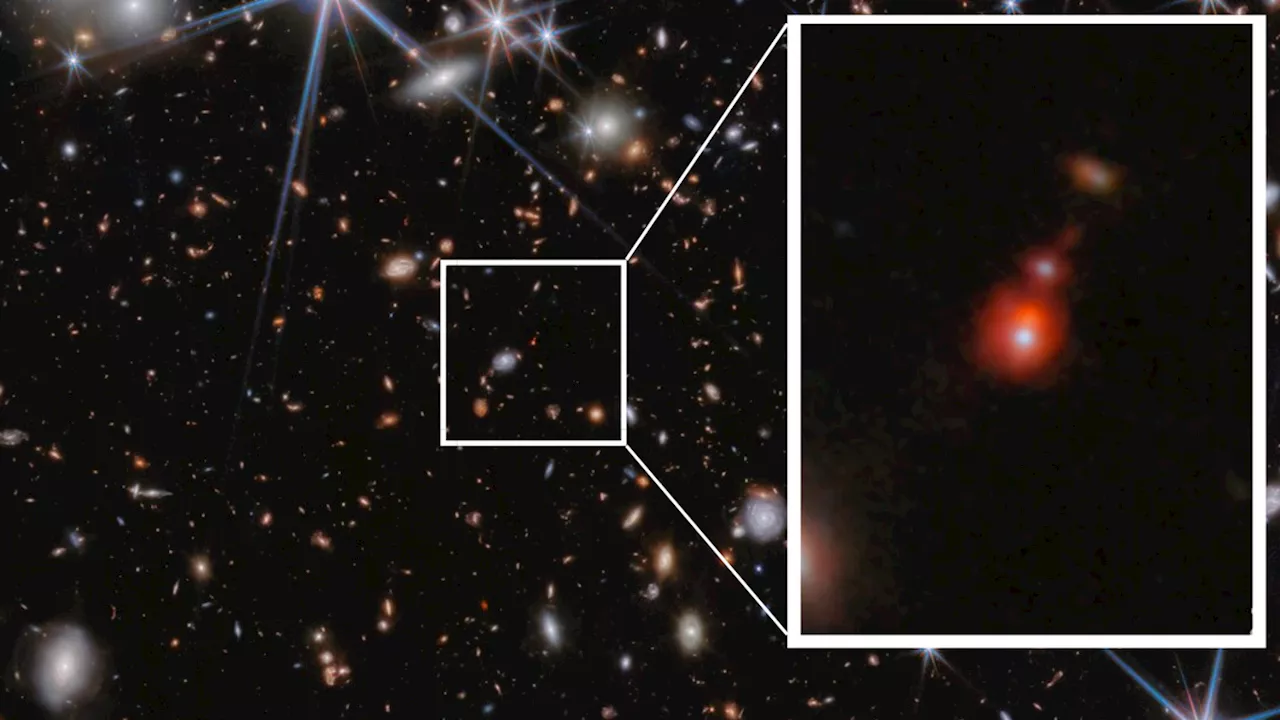
The freshly spotted galaxy offers a rare glimpse of our universe when it was young, less than 300 million years after the Big Bang.
Researchers recently observed a record-breaking galaxy beaming with young stars, which existed only 290 million years after the universe came into existence, challenging our view of the Cosmic Dawn with its unexpected luminosity.
On Thursday, a team of astronomers announced the discovery of the most distant and earliest galaxy ever seen, observed at a time less than 300 million years after the Big Bang. That may not seem like a short period of time but considering that the Big Bang likely took place 13.7 billion years ago, we’re looking at the cosmos during its infancy. This period, known as the Cosmic Dawn, spans from about 50 million to one billion years after the Big Bang, when the first stars, black holes, and galaxies formed in the universe. Using the Webb Space Telescope, scientists have captured deep field images that reveal ancient galaxies. As the light from these distant galaxies travels through space, it is stretched to longer wavelengths due to the expansion of the universe, shifting it to infrared light. The Webb Telescope is specifically designed to observe this infrared light. This latest discovery was initially made in October 2023. A team of scientists discovered the galaxy, designated JADES-GS-z14-0, in the data that corresponded to a redshift of about 14, which is a measure of how much a galaxy’s light is stretched by the expansion of the universe. Although the team was initially excited by the discovery, “there were some properties of the source that made us wary,” Stefano Carniani, an assistant professor at Scuola Normale Superiore in Italy, and Kevin Hainline, an associate research professor at the Steward Observatory, University of Arizona, said in a shared statement. “The source was surprisingly bright, which we wouldn’t expect for such a distant galaxy, and it was very close to another galaxy such that the two appeared to be part of one larger object.” Using Webb’s NIRSpec , team members carried out follow-up observations of the galaxy in January, confirming that JADES-GS-z14-0 was indeed at a redshift of 14.32. That meant the newly discovered galaxy had officially dethroned JADES-GS-z13-0, a galaxy also discovered by Webb in 2022 with a redshift of 13.2. The new record-holder is impressive not only for its distance but also for its remarkable luminosity. The galaxy spans over 1,600 light-years, suggesting that the observed light predominantly comes from young stars; this indicates that the light is less likely to be from material falling into a supermassive black hole at the galaxy’s center. This degree of starlight suggests that the galaxy is several hundreds of millions of times the mass of the Sun, according to the researchers. “It is stunning that the universe can make such a galaxy in only 300 million years,” Carniani, lead author of the paper detailing the discovery, said in a statement. It’s important to point out that the new paper has not yet gone through a peer-review process. Over the past two years, Webb has repeatedly observed ancient galaxies that are unexpectedly bright for their age, challenging previous theories of galaxy formation. “JADES-GS-z14-0 now becomes the archetype of this phenomenon,” Carniani said. More: See Webb Telescope’s ‘Mind-Blowing’ Collection of Spiral Galaxy Images
Ursa Major Edwin Hubble Boötes Dwarf Galaxies Galaxies Technology Internet Stefano Carniani Spiral Galaxy F200DB-045 Kevin Hainline GN-Z11 Galaxy Formation And Evolution Gizmodo
United States Latest News, United States Headlines
Similar News:You can also read news stories similar to this one that we have collected from other news sources.
 James Webb telescope detects 1-of-a-kind atmosphere around 'Hell Planet' in distant star systemJoanna Thompson is a science journalist and runner based in New York. She holds a B.S. in Zoology and a B.A. in Creative Writing from North Carolina State University, as well as a Master's in Science Journalism from NYU's Science, Health and Environmental Reporting Program.
Read more »
 Webb detects most distant black hole merger to dateAn international team of astronomers have used the NASA/ESA/CSA James Webb Space Telescope to find evidence for an ongoing merger of two galaxies and their massive black holes when the universe was only 740 million years old.
Read more »
 James Webb Space Telescope spots most distant and oldest black hole collision ever seen (video)Robert Lea is a science journalist in the U.K. whose articles have been published in Physics World, New Scientist, Astronomy Magazine, All About Space, Newsweek and ZME Science. He also writes about science communication for Elsevier and the European Journal of Physics. Rob holds a bachelor of science degree in physics and astronomy from the U.K.
Read more »
 Webb Space Telescope spots most distant, oldest black hole collision everJames Webb Telescope finds farthest black hole merger, revealing rapid growth just 740 million years after the Big Bang.
Read more »
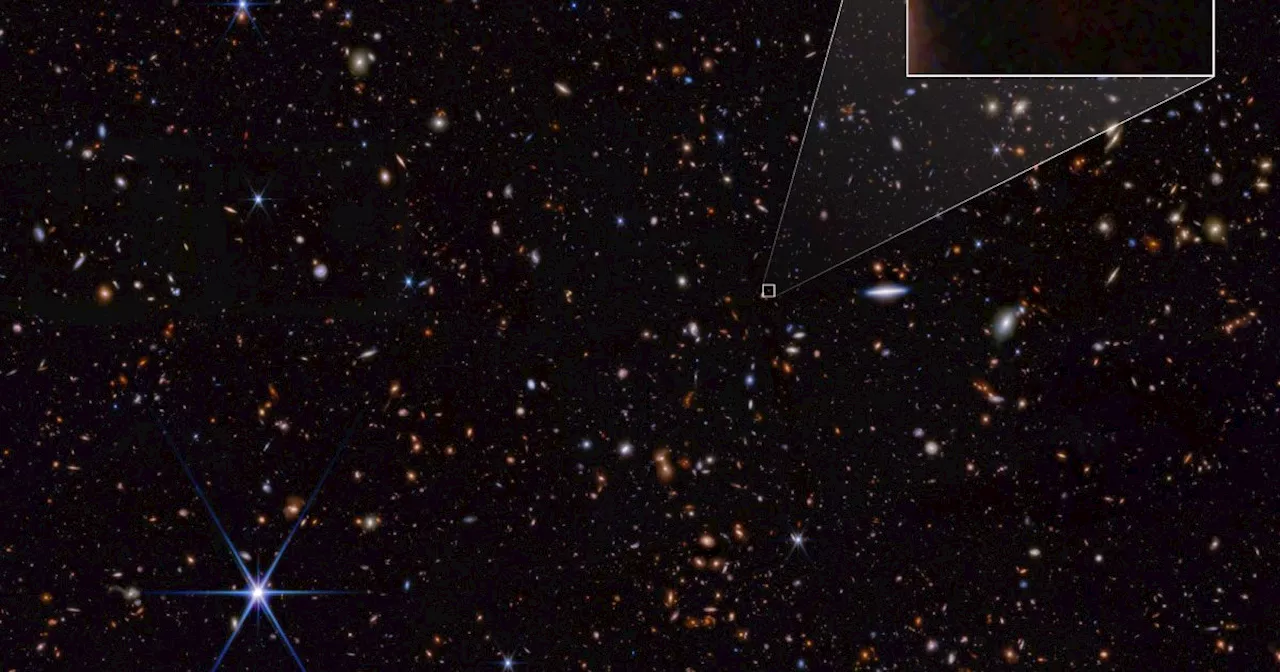
 Astronomers help find most distant galaxy using James Webb Space TelescopeAn international team of astronomers today announced the discovery of the two earliest and most distant galaxies ever seen, dating back to only 300 million years after the Big Bang. These results, using NASA's James Webb Space Telescope (JWST), mark a major milestone in the study of the early universe.
Read more »
 James Webb discovers the most distant galaxy ever observedResearchers using James Webb have discovered the most distant known galaxy to date. It existed just a few hundred million years after the Big Bang.
Read more »