


View the San Francisco for Wednesday, October 2, 2024
FCC Chairwoman Jessica Rosenworcel: “We’re going to need new airwaves for 6G and what comes beyond. And it takes some time to plan for those airwaves, repurpose them for commercial use.” As chairwoman of the Federal Communications Commission, Jessica Rosenworcel plays a huge, if largely hidden, role in the vast majority of Americans’ daily lives.
The FCC oversees wireless and wireline communications networks and how the electromagnetic spectrum in the United States is divvied up between government, corporate and public users. Established during the Franklin Roosevelt administration to regulate the nation’s telephone and broadcast networks, the agency now plays a key role in determining how you connect to the internet, and how many and what kind of providers you can choose from to make that connection. Rosenworcel, who has been an FCC commissioner off and on since 2012 and chairwoman since 2021, said she believes the agency also has an important role to play in the dawning artificial-intelligence age. At a recent event in Berkeley sponsored by the UC Berkeley School of Law, she discussed how the agency is using its continuing oversight of the nation’s telephone and broadcast networks to fight deepfakes.against a political operative who allegedly commissioned a series of robocalls in New Hampshire in which an AI-generated simulation of President Joe Biden’s voice urged people not to vote. The Examiner spoke with Rosenworcel about the agency’s approach to deepfakes, the state of broadband competition, the rollout of 5G wireless services and modernizing the laws undergirding the agency’s authority. This interview has been edited for length and clarity. Federal Communications Commission Chairwoman Jessica Rosenworcel in the International House at UC Berkeley on Friday, Sept. 27, 2024. You were just talking about what the FCC can do about AI and deepfakes. What are the limits of the FCC’s authority? What are the boundaries of that? Well, the boundaries are always the law itself. And as we deal with this new technology, there’s a lot of ways in which we’re going to have to figure out how old laws apply. In this context, our first real episode was We worked with a bunch of state attorneys general to conclude the Telephone Consumer Protection Act applies. It’s a law from 1991, but it deals with artificial and prerecorded voices, and AI voice-cloning technology is an artificial and pre-recorded voice. We also decided to have a broader rulemaking to suggest that if you’re using AI technology in robocalls or robotext, you’re going to have to disclose it. And then we moved on to think about campaign advertisements, which the Communications Act has overseen through our authority over broadcasting. So many campaign advertisements are still on radio and television. And every single campaign advertisement gets memorialized in a broadcaster’s public file, identifying who paid for it and when it ran. So if we can add to that information about whether voice cloning, video or image manipulation is used, I think that’s a good thing. What we’re really trying to do is develop a legal and social norm that when this technology is being used, you should expect to be told. But if, instead of using the phone networks, they had used Zoom, say, or put videos on YouTube, would the FCC have authority? When it comes to campaign advertisements, there’s a whole world online that’s outside of our purview. But my thinking about it is this: Waiting for a law that’s perfect, that captures every platform and venue is waiting too long. So let’s start with the laws we have, and with a principle we can organize around. And to me, that principle is transparency. Over the last 20 years, so much of our communications has shifted online. Does the Communications Act need to be revised to reflect that?When I look at the Communications Act, I see principles of competition, universal access, public safety and consumer protection. Those values have stood the test of time. So how do we take this law and make sure it meets this moment?Broadband is no longer nice to have. It’s a need-to-have for everyone everywhere. And every community is stronger if we connect every household, and the economies in those communities are often stronger when they have broadband choice. Some of that choice is going to come from networks that are in the ground. Some of it could come from fixed-wireless services. Some of it might come from satellites in the skies. I think we have to look to a multimodal world of competition in the future. It’s starting to develop. For instance, the emergence of fixed-wireless systems, I think, is providing some real competitive pressure on a lot of incumbent broadband providers today.Federal Communications Commission Chairwoman Jessica Rosenworcel speaking at the 7th Annual Berkeley Law School AI Institute, in the International House, UC Berkeley on Friday, Sept. 27, 2024. How would you assess the state of the 5G rollout, and where are we in thinking about and preparing for the 6G rollout? I think that we’re doing terrific in the United States when it comes to 5G rollout. We made extraordinary progress, and at the FCC, we started something called the 5G Fund to make sure that this infrastructure gets to rural areas where the economics are harder, so that we can support its deployment everywhere. That being said, we need some new use cases for 5G. Having higher speeds and lower latencies is terrific. The question is, what more can we do with wireless besides send it to our smartphones?I think we’re going to see more activities in the Internet of Things, more monitoring of industrial equipment, opportunities for smarter cities and smarter services. But those business models are still developing — not just here, but around the world. There’s a lot of conversations I’m in about 6G, but to me, 6G is really not about the next generation of technology. It’s when we get to a point where we’re capacity constrained on 5G and need to start thinking about what new technologies can assist us with the new loads.If you go back and look at history, you’ll find that about every 10 years, we get a new generational wireless service. It’s a model that almost holds. So, I would say by 2030.One of the challenges of what you’re talking about is something you might not be aware of. The FCC had, for 30 years, auction authority, which allowed us to repurpose airwaves from federal use for new mobile-commercial use and hold auctions. A tremendous tool. Over 30 years, we raised like $233 billion for the U.S. Treasury. It helped us really lead the world in 4G and 5G wireless services. It’s not an accident that our wireless networks are strong and that the application economy developed here on our shores and the smartphone universe., which is a challenge, because we’re going to need new airwaves for 6G and what comes beyond. And it takes some time to plan for those airwaves, repurpose them for commercial use. We’re going to need Congress to reinstate that authority. So that’s a challenge that’s coming; it informs everything you just asked about.Let’s see how the election goes.From left: Supervisor Matt Dorsey, Mayor London Breed, and CEO Richard Hannum of Forge Development Partners are seen in front of the Humboldt Bank building at 785 Market St. San Francisco Mayor London Breed and a developer of housing for middle-income people celebrated the launch Monday of the construction-design phase of a project to convert the historic Humboldt Bank Building at Fourth and Market streets from an underutilized office property into 124 apartments. The Humboldt Bank project, which was initially unveiled in January and has now secured financing, is a rare example of an advancing office-to-residential conversion effort in The City, despite official support from local government and voter approval in March of a tax-break measure for transfers involving such projects. “We’re launching the construction-design phase with the expectation of delivering housing in a year,” said Richard Hannum, founding partner of Forge Development Partners, which is redeveloping the 116-year-old Humboldt Bank building, with Gensler doing design.could be a harbinger of similar projects to come as a result of a series of new and proposed city and state tax and regulatory incentives aimed at stimulating such developments as an antidote to a record-high office-vacancy rate of 37.3% in the third quarter and a downtown economy that has been sluggish amid the post-pandemic rise of remote work and fewer people commuting to offices. “I am so excited, because this is one of the first but it won’t be the last,” said Breed, who talked at a ceremony inside the old bank of the need to “deconstruct city bureaucracy.” She said she wants to see “We have other buildings that we have identified, and we want to make it easier to get to this point,” she said. To help make that a reality, Breed and Supervisor Matt Dorsey have introduced a proposed ordinance that would waive development-impact fees and inclusionary-housing requirements for such downtown developments to eliminate costs that typically amount to between $70,000 and $90,000 per housing unit. Dorsey said the redevelopment of the Humboldt Bank building is richly symbolic, given its origin. The building rose soon after the destruction caused by the 1906 earthquake and fire. “This is a building that symbolizes another kind of comeback in reinventing what downtown can be as a residential space,” he said. Hannum said his Humboldt Bank plans assume that the fee waivers Breed and Dorsey proposed will be enacted, but he declined to say what would happen if they do not pass the Board of Supervisors.Douglas Zucker, a principal at Gensler, said the Humboldt Bank building is particularly well-suited to a conversion because it is long and narrow, has plentiful windows and light, is eligible for historic-building tax credits, and has a prime location on Market Street. Gensler has been a vigorous advocate for the idea of reusing office buildings in San Francisco and other cities, arguing that among other things, mixed-use downtowns are more resilient to economic changes. Hannum said he is “guardedly optimistic” that The City is adopting policies that will encourage more developments like what he has proposed. He said he has identified 10 buildings appropriate for office-to-housing conversions and is in negotiations on several for possible developments.in two buildings in the Tenderloin. The firm, which has emphasized efficient use of space and environmentally conscious building practices that promote clean-energy use and keep costs down, is now pursuing two more apartment projects in the Tenderloin. Hannum called the experience of working with The City bureaucracy on the Humboldt Bank project his best in 40 years of working in San Francisco. He credited Breed for setting the tone to make that happen and promoting an environment that could make investors less hesitant to support projects in The City. “This was the most collegial engagement of the bureaucrats and development and architecture teams that I’ve ever experienced,” Hannum said. He also tipped his hat to PG&E for agreeing to leave existing building systems in place, thus saving millions in conversion costs.Starting next year, Ting’s legislation, which was backed by the Bay Area Council, will empower city leaders to establish downtown-revitalization and economic-recovery financing districts, through which developers could get some property taxes returned to them for 30 years. Breed and Dorsey’s fee-cut legislation would build on the waiver of real-estate transfer taxes for conversion projects that Breed placed on the ballot and voters approved in March. That followed The City’s July 2023 waiving of certain planning-code requirements for commercial-to-residential projects, which Hannum said was also instrumental to advancing the Humboldt Bank project. In August, Breed also signed an ordinance introduced by Board of Supervisors President Aaron Peskin — one of her rivals in the current mayor’s race — that allows for public bonds to finance the acquisition, development, rehabilitation, or construction of housing for middle-income people who earn too much to qualify for publicly subsidized housing programs but not enough to pay for market-rate housing. Peskin issued a statement Monday applauding Forge Development for its progress on the Humboldt Bank project and saying he is exploring ways to use the bonds his ordinance authorized for various types of projects, including for office-to-residential conversions. Hannum said his firm’s approach is to develop without government money, an approach that he believes lends itself to being repeatable and scalable. “I don’t need money from a government to build, and I’m proving that with what we’re doing,” Hannum said.This story has been updated to reflect that the San Francisco Emergency Medical Services Agency, which is a part of the Department of Emergency Management, conducted the aforementioned investigation. A previous version of this story misidentified the investigating agency. The updated story is as follows. A San Francisco Emergency Medical Services Agency investigation determined that four emergency medical technicians working for a drug-treatment program operated by a health nonprofit did so while circumventing state regulations.Center at 1076 Howard St., which is operated by nonprofit HealthRight 360, “knowingly worked” without EMT certification, and three others worked at the site despite state law barring EMTs from working in hospitals, clinics or shelter settings. A COVID-19-era executive order provided an exemption that has since expired. “An individual certified as an EMT may be able to deliver care while not under the medical control of a medical director, so long as they have another form of healthcare license or certificate,” the Department of Emergency Management said in a statement to The Examiner. “However, the EMT Certificate cannot be the sole authority to deliver care under EMT scope of practice in a fixed facility. SFEMSA, within its scope pertaining to EMS oversight, is working with and providing information to HealthRight 360 to ensure compliance with state EMS laws and regulations, which is the goal of enforcement.” The Mayor’s Office said the Department of Public Health “has also put in place a corrective action” to ensure the nonprofit’s compliance with the Department of Emergency Management directive. Department of Public Health spokesperson Tal Quetone told The Examiner that the lack of compliance in this case did not lead to any negative consequences for the intoxicated clients — many of whom are unhoused — in the program, which opened in 2021 in an effort to addressThe three employed EMTs were put on administrative leave by HealthRight 360, according to a Sept. 10 letter that the San Francisco Department of Public Health shared with The Examiner. “ must ensure our service providers adhere to state regulations so successful programs, such as SoMa RISE, can remain focused on providing critical services for some of the City’s most vulnerable,” Quetone said. The Department of Public Health directed HealthRight 360 to review staffing at SoMa RISE to ensure all state requirements are met and all workers are properly credentialed. Earlier this summer, public-health officials asked the Controller’s Office to bring in an independent expert to assess oversight of the nonprofit. “We are confident SoMa RISE will continue serving clients, getting them connected to treatment, and on a pathway to ongoing care,” Quetone said. Gary McCoy, a HealthRight 360 spokesperson, told The Examiner the nonprofit supports The City’s oversight of health-care providers, which ensures their services are the best possible they can provide to clients. The investigation, however, “came out of left field,” in contrast to the typical level of open dialogue between the nonprofit and public officials. McCoy said the San Francisco Emergency Medical Services Agency — which operates under the Department of Emergency Management —didn’t communicate with HealthRight 360 before sending a Sept. 6 letter, which Mayor London Breed’s office later shared with The Examiner. “We have a great working relationship with all of our city departments, and agencies — an open-door policy,” he said. “So to find out that there was an investigation taking place that we weren’t aware of, threatening to impact the livelihood of our workers, it was bizarre and hurtful.” In the letter, EMS Director Andrew Holcomb wrote that a SoMa RISE employee worked at the facility as “an EMT” but “did not have an EMT Certificate in the State of California.” The employee “knowingly worked as an EMT without a certificate,” having applied in February without required documentation, Holcomb wrote. State officials closed the application in May after it “was deemed nonresponsive.” Emergency officials found three other EMTs were hired to work at SoMa RISE, alleging that each of them “perform skills under EMT scope of practice” that, according to state law, they are only cleared to use “during training, while at the scene of an emergency, during transport of the sick or injured, or during an interfacility transfer.”“They were not acting as EMTs on site,” he said. “We thought in terms of communication, that skill set would be great because of the work that they do in relation to dispatchers.” “When we do have instances where we have to call 911, they’re not performing EMT duties,” McCoy said. “But they’re able to relay information to the actual dispatch sending EMTs to the site for whatever that issue might be.” HealthRight 360 officials wrote back to EMS on Sept. 12 that the employees’ responsibilities, which also included taking vital signs and administering the overdose-reversal drug naloxone, are not duties only authorized for EMT certificate holders. “We take a visitor’s vital signs upon entering the facility, to ensure they are safe, and this work is and can be done by any of the staff with the training and protocols we provide,” the letter said. “If a visitor is found to have overdosed, in conjunction with our organizational policies and training, all staff are trained and ready to administer life-saving naloxone the same way that any individual can by picking up Narcan over the counter.” “An EMT cannot simply become a non-EMT even though a non-EMT performs those skills as a layperson,” the San Francisco Department of Emergency Management wrote in response on Sept. 18. The letter said that EMTs are held to a different standard because of their certification, and it doesn’t matter if they are using their skills outside of official EMT roles.Both former President Donald Trump, left, and incumbent Joe Biden would be too old to serve in the White House if Marc Sandalow’s students had their way.Click and hold your mouse button on the page to select the area you wish to save or print. You can click and drag the clipping box to move it or click and drag in the bottom right corner to resize it. When you're happy with your selection, click the checkmark icon next to the clipping area to continue.This is the name that will be displayed next to your photo for comments, blog posts, and more. Choose wisely!Create a password that only you will remember. If you forget it, you'll be able to recover it using your email address.Forgot Password An email message containing instructions on how to reset your password has been sent to the email address listed on your account.
United States Latest News, United States Headlines
Similar News:You can also read news stories similar to this one that we have collected from other news sources.
 49ers' Ricky Pearsall to miss at least 4 games after being shot in attempted robberySan Francisco 49ers rookie Ricky Pearsall was shot in an attempted robbery in San Francisco.
Read more »
 California Henge: Here's how to catch the best view in San FranciscoArticles and videos about California Henge: Here's how to catch the best view in San Francisco on FOX 11 Los Angeles.
Read more »
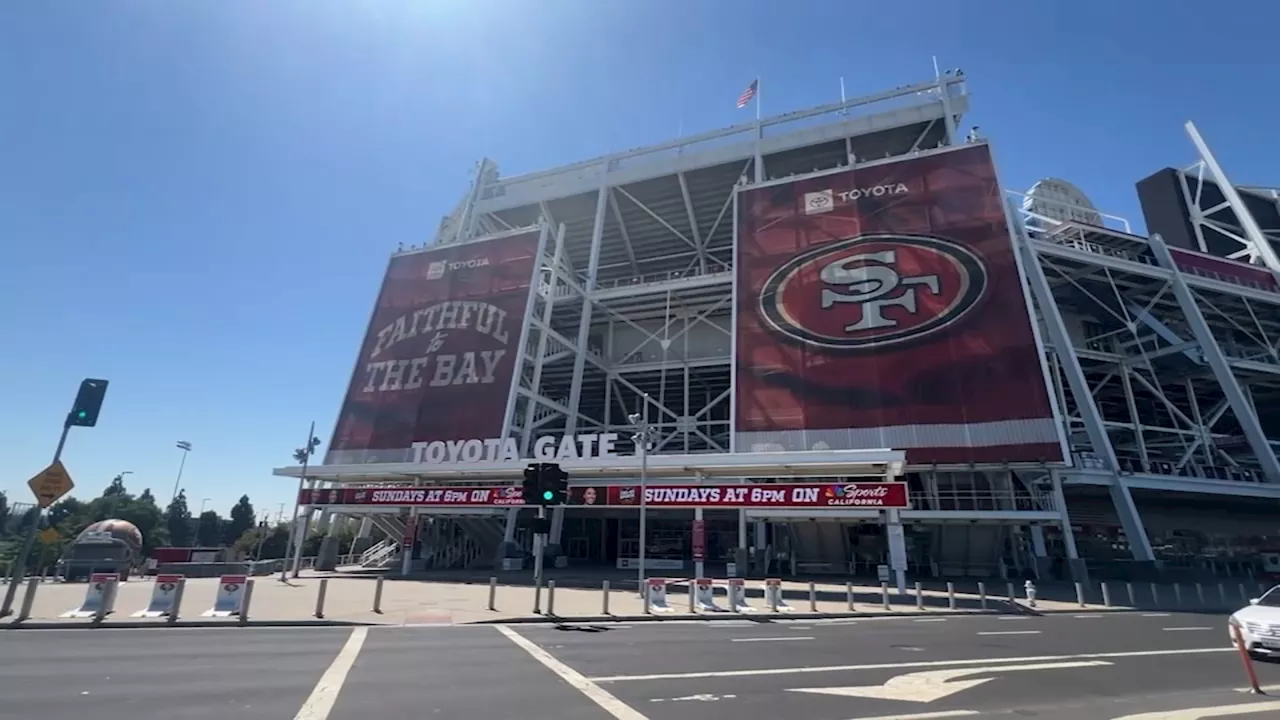 San Francisco 49ers, fans ready to turn the page on unsettled offseasonFrom a close Super Bowl loss, to two major contract disputes and now mix in the shooting of a young star. It's been a lot to take in for the Faithful, but everyone is ready to turn the page.
Read more »
 Page A1View the San Francisco for Sunday, September 8, 2024
Read more »
 Page A1View the San Francisco for Thursday, September 19, 2024
Read more »
 Page A1View the San Francisco for Sunday, September 29, 2024
Read more »