Ruling in favor of a San Marcos couple, a federal court says U.S. cities don't have the authority to dictate aesthetic standards on private property.
Do Texas cities have the power to regulate the design of private homes and other buildings, purely to enforce aesthetic standards? In a ruling involving a San Marcos case, the U.S. Fifth Circuit Court of Appeals said they do not – a decision that could affect the design review processes in municipalities across the Lone Star State, if not the entire country.
ALSO READ: Get a text message claiming you owe a TxTag late fee? It's a scam. The legal fight began with the desire of a San Marcos couple, Kristy Money and Rolf Straubhaar, to remove a balcony with a wrought-iron 'Z' on it from their Depression-era home in the city's Burleson Historic District. That 'Z' is a reference to Frank Zimmerman, a theater owner and former mayor of San Marcos who built the home – and who was a supporter of the Ku Klux Klan. In April 2023, the couple submitted an application to the city's Historic Preservation Commission asking for permission to remove the balcony, with Money writing that the presence of Zimmerman's initial 'does not conform with my family's values.' After the commission denied the request, the couple filed a federal civil rights lawsuit against the city and Amanda Hernandez, its director of planning and development services. The lawsuit argued that the city's decision bar them from making changes to their home violated the Fifth and Fourteenth amendments of the U.S. Constitution. The Fifth Amendment forbids governments from taking private property 'for public use, without just compensation.' A U.S. district court judge dismissed the lawsuit, saying Money and Rolf Straubhaar hadn't followed the city's review process to its conclusion because they hadn't appealed to the city's Zoning Board. But on Feb. 7, the U.S. Fifth Circuit reversed that decision, ruling that 'regulations of property for purely aesthetic purposes have violated the Texas Constitution for over 100 years and still do.' Many cities across the state and the nation have ordinances in place setting aesthetic standards, meaning they have enacted rules guiding the design of buildings and streets and the size and appearance of signs. Christian Townsend, an attorney with the Texas Public Policy Foundation who helped represent Money and Straubhaar, said he believes the appeals court has set a precedent 'that we intend to follow in this case and other cases.' The foundation, a nonprofit think tank which describes its mission as promoting 'liberty, personal responsibility and free enterprise,' defended the couple at no cost. The nonprofit was interested in the case because of its potential to expand the rights of property owners, Townsend said. 'The fact that the city wouldn't allow to remove something that is so contrary to her family values really shows the absurdity of the ordinance,' Townsend said. Nadine Cesak, a spokesperson for the city of San Marcos, said the city does not comment on pending litigation. Three judges on the Fifth Circuit – Kurt Engelhardt, Leslie Southwick and James Dennis – ruled to reverse the district court's decision, Townsend said. The city of San Marcos now has the option of appealing the decision to the U.S. Supreme Court, he said. Otherwise, now that the Fifth Circuit has reversed the district court's finding that the couple hadn't completed the city's appeals process, the two sides will return to the district court to present arguments, he said. In their ruling, the Fifth Crcuit judges cited a 1921 case, Spann v. City of Dallas, in which the Supreme Court of Texas determined that an ordinance prohibiting construction of commercial buildings in a residential neighborhood, except in limited circumstances, was an 'unconstitutional exercise of the police power.' In deciding that case, the Texas Supreme Court stated that 'purely aesthetic considerations' were not valid justifications for use of the state's regulatory power, according to the ruling. 'It is not the law of this land that a man may be deprived of the lawful use of his property because his tastes are not in accord with those of his neighbor,' the Texas Supreme Court decided in 1921. The Fifth Circuit ruling specified that a zoning ordinance can include aesthetic considerations as one of many factors to be taken into consideration without violating the state constitution. Its its decision, the district court had written that the Spann case to be 'generations out of date,' citing U.S. Supreme Court precedent indicating that aesthetic considerations 'may be sufficient in themselves' to justify regulation. The Fifth Circuit, however, described that reasoning as erroneous because the Supreme Court of Texas is not bound by precedents set by the U.S. Supreme Court. The Fifth Circuit ruling also pointed to a 1982 case, Loretto v. Teleprompter Manhattan CATV Corp., in which the U.S. Supreme Court declared unconstitutional a New York law that required landlords to allow cable television equipment to be installed at their properties, because it qualified as an unlawful 'taking' under the Fifth and Fourteenth amendments. If the case returns to district court, Money and Straubhaar's legal team plan to argue that the Loretto ruling applies, Townsend said. He expressed hope that Loretto will be cited more often in cases seeking to expand the rights of property owners. 'We think it has been clear in Texas for 100 years that these kinds of purely design review boards have not been allowed under Texas state law,' he said.
U.S. Supreme Court Supreme Court Of Texas Historic Preservation Commission Texas Constitution Ku Klux Klan Texas Public Policy Foundation Zoning Board Rolf Straubhaar Frank Zimmerman Townsend Amanda Hernandez Nadine Cesak Christian James Dennis Leslie Southwick Kurt Engelhardt Spann San Marcos U.S. Hill Country Texas Fifth Burleson Historic District Loretto Spann V. City Of Dallas New York Kristy Money Loretto V. Teleprompter Manhattan CATV Corp. Fourteenth Txtag Fifth Crcuit U.S. Constitution Fifth Amendment
United States Latest News, United States Headlines
Similar News:You can also read news stories similar to this one that we have collected from other news sources.
3,300-acre Hill Country ranch hits market for $65 millionThe expansive property is embedded in the heart of the Hill Country, southwest of Kerrville.
Read more »
Texas spends $35M on 2,000 acres for new Hill Country state parkAdditional land purchases are expected for the planned new park, which will be near Colorado Bend State Park.
Read more »
 Texas Parks and Wildlife Department Acquires 2,000+ Acre Hill Country Tract for New State ParkThe Texas Parks and Wildlife Department has acquired a 2,000-acre tract of land in the Hill Country, with plans to develop it into a new state park. The acquisition, costing $35 million, is part of the department's effort to expand the Texas state park system. The new park will offer scenic views, access to the Colorado River for activities like fishing and hiking, and developed camping areas.
Read more »
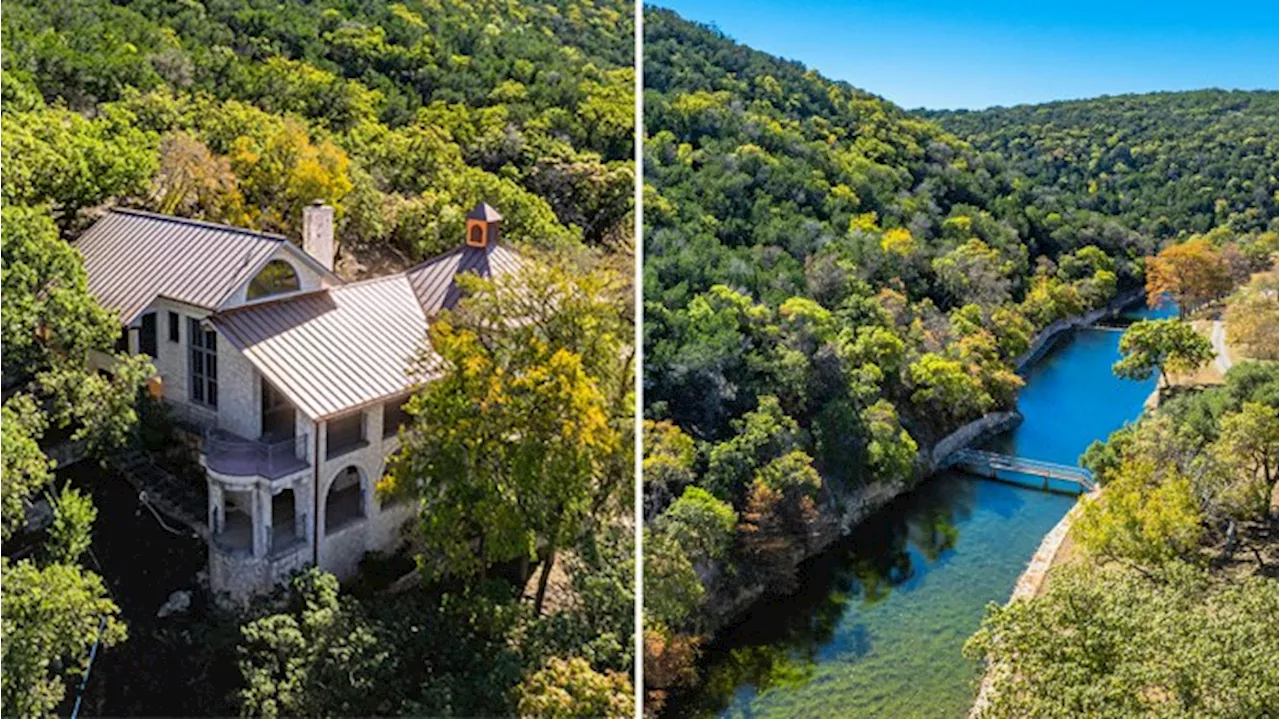 Hidden Valley Ranch: A Texas Hill Country Retreat With Three Miles of Live WaterHidden Valley Ranch, a sprawling Texas Hill Country property, is listed for $18.6 million. This expansive ranch boasts three miles of live water, including hidden springs and waterfalls, along with 12 lakes perfect for swimming or fishing.
Read more »
$2 million-plus Hill Country house checks all the boxesThe contemporary modern residence, constructed by Boerne-based Garner Homes, includes a wine room, hidden doors and food-service window for entertaining.
Read more »
 San Marcos police identify suspect in connection with homicide near Hill Country parkIn a social media post, the San Marcos Police Department identified a suspect in connection with a Friday afternoon homicide.
Read more »