
Brett Wilkins is a staff writer for Common Dreams.
The nation's largest egg producers would have American consumers believe that avian flu and inflation are behind soaring prices, but a report published Tuesday shows corporate price gouging is the real culprit driving the record cost of the dietary staple.
The fourth installment of Food & Water Watch's Economic Cost of Food Monopolies series—titled The Rotten Egg Oligarchy—reports that the average price of a dozen eggs in the United States hit an all-time high of $4.95 in January 2025. That's more than two-and-a-half times the average price from three years ago. 'While egg prices spiral out of reach, making eggs a luxury item, Big Ag is profiting hand over fist,' FWW research director Amanda Starbuck said in a statement. 'But make no mistake—today's high prices are built on a foundation of corporate price gouging. Our research shows how corporations use the worsening bird flu crisis to jack up egg prices, even as their own factory farms fuel the spread of disease.' FWW found that 'egg prices were already rising before the current outbreak hit U.S. commercial poultry flocks in February 2022, and have never returned to pre-outbreak levels.' Furthermore, 'egg price spikes hit regions that were bird flu-free until recently,' the report states. 'The U.S. Southeast remained free of bird flu in its table egg flocks until January 2025, and actually increased egg production in 2022 and 2023 over 2021 levels. Nevertheless, retail egg prices in the Southeast rose alongside January 2023's national price spikes.' 'The corporate food system is to blame for exacerbating the scale of the outbreak as well as the high cost of eggs,' the publication continues. 'Factory farms are virus incubators, with the movement of animals, machines, and workers between operations helping to spread the virus.' 'Meanwhile, just a handful of companies produce the majority of our eggs, giving them outsized control over the prices paid by retailers, who often pass on rising costs to consumers,' the paper adds. 'This highly consolidated food system also enables companies to leverage a temporary shortage in one region to raise prices across the entire country.' Cal-Maine, the nation's top egg producer, enjoyed a more than 600% increase in gross profits between fiscal years 2021-23, according to FWW. The Mississippi-based company did not suffer any avian flu outbreaks in fiscal year 2023, during which it sold more eggs than during the previous two years. Yet it still sold conventional eggs at nearly three times the price as in 2021, amounting to over $1 billion in windfall profits. Meanwhile Cal-Maine paid shareholders dividends totaling $250 million in 2023, 40 times more during the previous fiscal year. The report highlights how factory farming creates ideal conditions for the spread of avian flu, a single case of which requires the extermination of the entire flock at the affected facility, under federal regulations. 'These impacts cannot be understated,' FWW stressed. 'Today's average factory egg farm confines over 800,000 birds, with some operations confining several million. This magnifies the scale of animal suffering and death, as well as the enormous environmental and safety burden of disposing of a million or more infected bird carcasses.' Citing U.S. Department of Agriculture figures, The Guardian reported Tuesday that more than 54 million birds have been affected in the past three months alone. Egg producers know precisely how the supply-and-demand implications of these outbreaks and subsequent culls can boost their bottom lines. Meanwhile, they play a dangerous game as epidemiologists widely view a potential avian flu mutation that can be transmitted from birds to humans as the next major pandemic threat—one that's exacerbated by the Trump administration's withdrawal from the World Health Organization and cuts to federal agencies focused on averting the next pandemic. 'We cannot afford to place our food system in the hands of a few corporations that put corporate profit above all else.' So far, 70 avian flu cases—one of them fatal—have been reported in the United States, according to the U.S. Centers for Disease Control and Prevention. However, under Trump, the CDC has stopped publishing regular reports on its avian flu response plans and activities. The USDA, meanwhile, said it 'accidentally' terminated staffers working on avian flu response during the firing flurry under Elon Musk's Department of Government Efficiency. The agency is scrambling to reverse the move. 'We cannot afford to place our food system in the hands of a few corporations that put corporate profit above all else,' the FWW report argues. 'Nor can we allow the factory farm system to continue polluting our environment and serving as the breeding ground for the next human pandemic.' 'We need to enforce our nation's antitrust laws to go after corporate price fixing and collusion,' the publication adds. 'We also need a national ban on new and expanding factory farms, while transitioning to smaller, regional food systems that are more resilient to disruptions.' That is highly unlikely under Trump, whose policies—from taxation to regulation and beyond—have overwhelmingly favored the ultrawealthy and corporations over working Americans. Meanwhile, one of the president's signature campaign promises, to lower food prices 'on day one,' has evaporated amid ever-rising consumer costs. According to the USDA's latest Food Price Outlook, overall food prices are projected to rise 3.4% in 2025. Eggs, however, are forecast to soar a staggering 41.1% this year—and possibly by as much as 74.9%. 'If President Trump has any interest in fulfilling his campaign pledge to lower food prices,' Starbuck stressed, 'he must begin by taking on the food monopolies exploiting pandemic threat for profit.'
Bird Flu Cal-Maine Foods Cdc Corporate Greed Donald Trump Egg Prices Factory Farms Food & Water Watch Food Prices Food System Industrial Agriculture Inflation Pandemics Price Gouging U.S. Department Of Agriculture Usda
United States Latest News, United States Headlines
Similar News:You can also read news stories similar to this one that we have collected from other news sources.
 Celebrity Chef Recommends Exploring Non-Egg Breakfasts Amid High Egg PricesCelebrity chef Andrew Zimmern suggests looking to foreign breakfast menus for inspiration and recommends swapping out the traditional American egg-heavy breakfast for alternatives found in cultures that don't rely on eggs as a staple. He cites Japan and Italy as examples, highlighting their focus on grilled fish, rice, pickles, soup, meat, cheese, and toast. While acknowledging the rising cost of plant-based egg substitutes, Zimmern believes exploring egg-less diets can alleviate pressure on the egg market.
Read more »
 Waffle House Adds 50-Cent Egg Surcharge Amidst Ongoing Egg ShortageWaffle House implements a temporary surcharge on eggs due to the rising cost of eggs caused by the ongoing bird flu outbreak.
Read more »
 Waffle House Adds 50-Cent Egg Surcharge Amid Bird Flu-Driven Egg Price CrisisWaffle House is battling rising egg costs caused by the bird flu by adding a 50-cent surcharge to all egg menu items.
Read more »
 With egg prices rising and shortages in stores, these egg substitutes can help in the kitchenChefs say there are some easy swaps home cooks can make as bird flu causes egg shortages at grocery stores around the country.
Read more »
 Egg Prices Are Scrambling Wallets—Here Are 5 Egg-cellent AlternativesWell, folks, it’s happened. Waffle House—yes, the 24/7, always-reliable, we-survived-the-apocalypse Waffle House—just slapped a 50-cent surcharge on eggs because of the ongoing bird flu crisis. That’s right.
Read more »
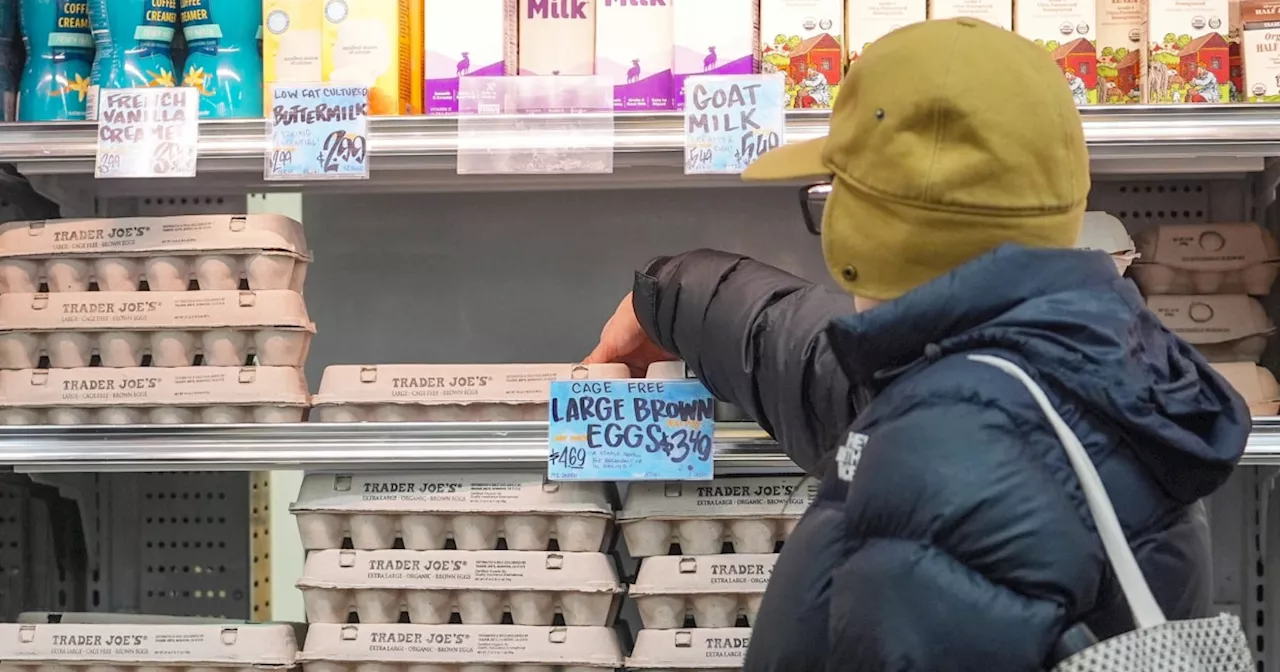 Trader Joe's Offers Affordable Egg Prices Amid National Egg ShortageTrader Joe's has emerged as a haven for budget-conscious shoppers seeking affordable eggs amidst a nationwide egg price surge. While prices have skyrocketed to over $10 a dozen in some areas, Trader Joe's is offering eggs at an average price of $3.49 per dozen, significantly below the national average. The grocery chain attributes its ability to maintain lower prices to several strategies, including direct sourcing from suppliers, a smaller product selection, and the use of private-label brands.
Read more »