Science, Space and Technology News 2024
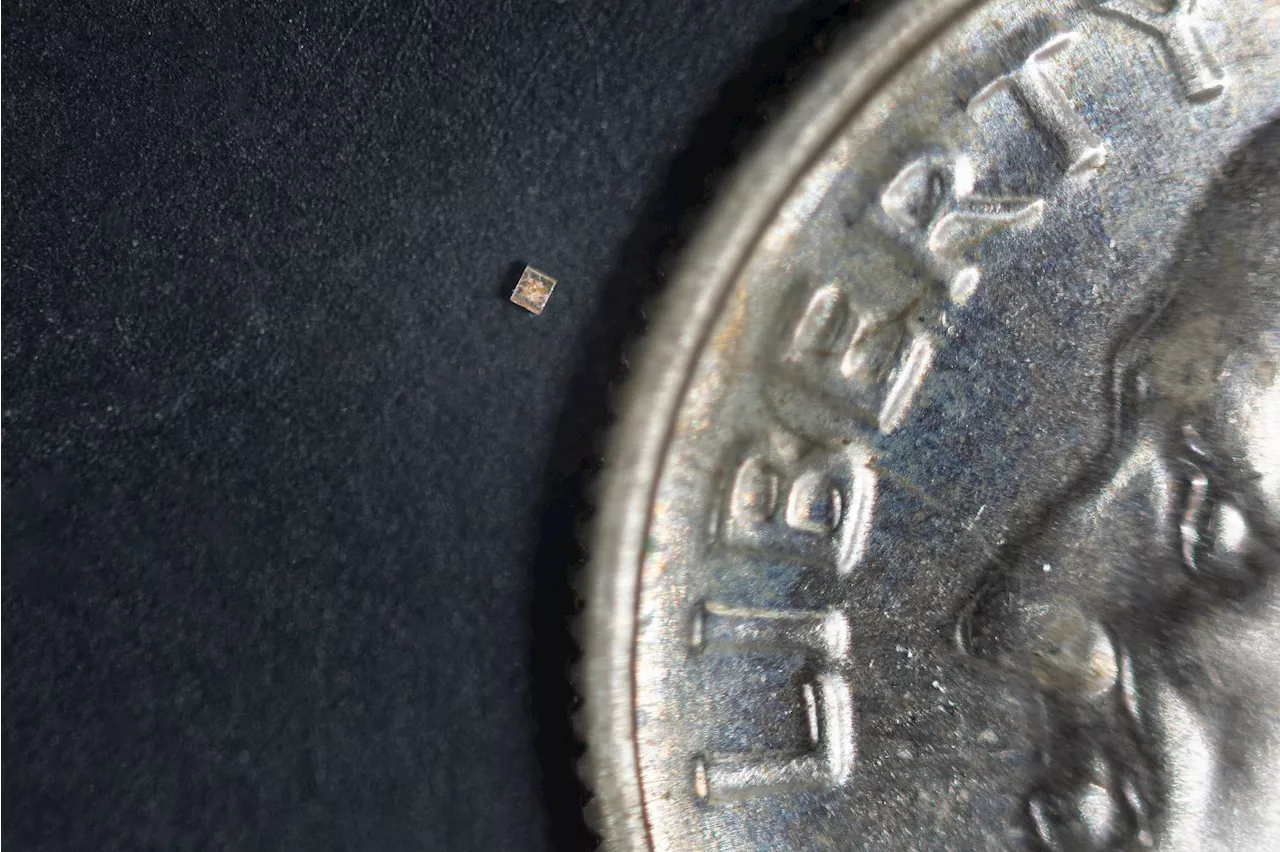
The sensor network is designed so the chips can be implanted into the body or integrated into wearable devices. Each submillimeter-sized silicon sensor mimics how neurons in the brain communicate through spikes of electrical activity.
Credit: Nick Dentamaro/Brown University This innovative method furthers the development of wireless sensor technology and opens the door to the potential use of vast numbers of unobtrusive sensors in implantable and wearable biomedical microdevices in the future. Writing in Nature Electronics, the research team describes a novel approach for a wireless communication network that can efficiently transmit, receive, and decode data from thousands of microelectronic chips that are each no larger than a grain of salt. The sensors detect specific events as spikes and then transmit that data wirelessly in real-time using radio waves, saving both energy and bandwidth.“Our brain works in a very sparse way,” said Jihun Lee, a postdoctoral researcher at Brown and study lead author. “Neurons do not fire all the time. They compress data and fire sparsely so that they are very efficient. We are mimicking that structure here in our wireless telecommunication approach. The sensors would not be sending out data all the time — they’d just be sending relevant data as needed as short bursts of electrical spikes, and they would be able to do so independently of the other sensors and without coordinating with a central receiver. By doing this, we would manage to save a lot of energy and avoid flooding our central receiver hub with less meaningful data.” This radiofrequency transmission scheme also makes the system scalable and tackles a common problem with current sensor communication networks: they all need to be perfectly synced to work well., the research team describes a novel approach for a wireless communication network that can efficiently transmit, receive, and decode data from thousands of microelectronic chips that are each no larger than a grain of salt. Credit: Nick Dentamaro/Brown University The researchers say the work marks a significant step forward in large-scale wireless sensor technology and may one day help shape how scientists collect and interpret information from these little silicon devices, especially since electronic sensors have become ubiquitous as a result of modern technology. “We live in a world of sensors,” said Arto Nurmikko, a professor in Brown’s School of Engineering and the study’s senior author. “They are all over the place. They’re certainly in our automobiles, they are in so many places of work and increasingly getting into our homes. The most demanding environment for these sensors will always be inside the human body.”That’s why the researchers believe the system can help lay the foundation for the next generation of implantable and wearable biomedical sensors. There is a growing need in medicine for microdevices that are efficient, unobtrusive, and unnoticeable but that also operate as part of a large ensembles to map physiological activity across an entire area of interest. “This is a milestone in terms of actually developing this type of spike-based wireless microsensor,” Lee said. “If we continue to use conventional methods, we cannot collect the high channel data these applications will require in these kinds of next-generation systems.” The events the sensors identify and transmit can be specific occurrences such as changes in the environment they are monitoring, including temperature fluctuations or the presence of certain substances. The sensors are able to use as little energy as they do because external transceivers supply wireless power to the sensors as they transmit their data — meaning they just need to be within range of the energy waves sent out by the transceiver to get a charge. This ability to operate without needing to be plugged into a power source or battery makes them convenient and versatile for use in many different situations. The team designed and simulated the complex electronics on a computer and has worked through several fabrication iterations to create the sensors. The work builds on previous research from Nurmikko’s lab at Brown that introduced a new kind of neural interface system called “neurograins.” “These chips are pretty sophisticated as miniature microelectronic devices, and it took us a while to get here,” said Nurmikko, who is also affiliated with Brown’s Carney Institute for Brain Science. “The amount of work and effort that is required in customizing the several different functions in manipulating the electronic nature of these sensors — that being basically squeezed to a fraction of a millimeter space of silicon — is not trivial.”The researchers demonstrated the efficiency of their system as well as just how much it could potentially be scaled up. They tested the system using 78 sensors in the lab and found they were able to collect and send data with few errors, even when the sensors were transmitting at different times. Through simulations, they were able to show how to decode data collected from the brains of primates using about 8,000 hypothetically implanted sensors. The researchers say the next steps include optimizing the system for reduced power consumption and exploring broader applications beyond neurotechnology.Reference: “An asynchronous wireless network for capturing event-driven data from large populations of autonomous sensors” by Jihun Lee, Ah-Hyoung Lee, Vincent Leung, Farah Laiwalla, Miguel Angel Lopez-Gordo, Lawrence Larson and Arto Nurmikko, 19 March 2024,SciTechDaily: Home of the best science and technology news since 1998. Keep up with the latest scitech news via email or social media.Astronomers have identified what could be two of the Milky Way’s earliest building blocks: Named “Shakti” and “Shiva,” these appear to be the remnants of…
United States Latest News, United States Headlines
Similar News:You can also read news stories similar to this one that we have collected from other news sources.
 Revolutionizing Computing: Inside Princeton’s Trailblazing AI Chip TechnologyScience, Space and Technology News 2024
Read more »
 Scientists revolutionize wireless communication with three-dimensional processorsScientists have pioneered a method for using semiconductor technology to manufacture processors that significantly enhance the efficiency of transmitting vast amounts of data across the globe.
Read more »
 Revolutionizing Time With Cutting-Edge Laser TechnologyScience, Space and Technology News 2024
Read more »
 Magnetic implants allow for wireless healthcare monitoringTiny magnetic implants revolutionize healthcare monitoring, offering wireless communication with wearable devices.
Read more »
 Artificial Intelligence Revolutionizing Problem Solving in Science, Medicine, and TechnologyArtificial intelligence, particularly through machine learning, is revolutionizing how we solve complex problems in various fields including science, medicine, and technology. Facilities like Argonne National Laboratory are leading these advancements, using AI to predict complex system behaviors, improve material selection, and assist in global challenges like disease and climate change.
Read more »
 Slam Dunk Technology: How AI Is Revolutionizing The Game Of BasketballNeil Sahota (萨冠军) is an IBM Master Inventor, United Nations (UN) Artificial Intelligence (AI) Advisor, Professor at UC Irvine, and author of the book: Own the A.I. Revolution. With 20 years of business experience, he works with clients and business partners to create next generation products/solutions powered by AI.
Read more »