Science, Space and Technology News 2024
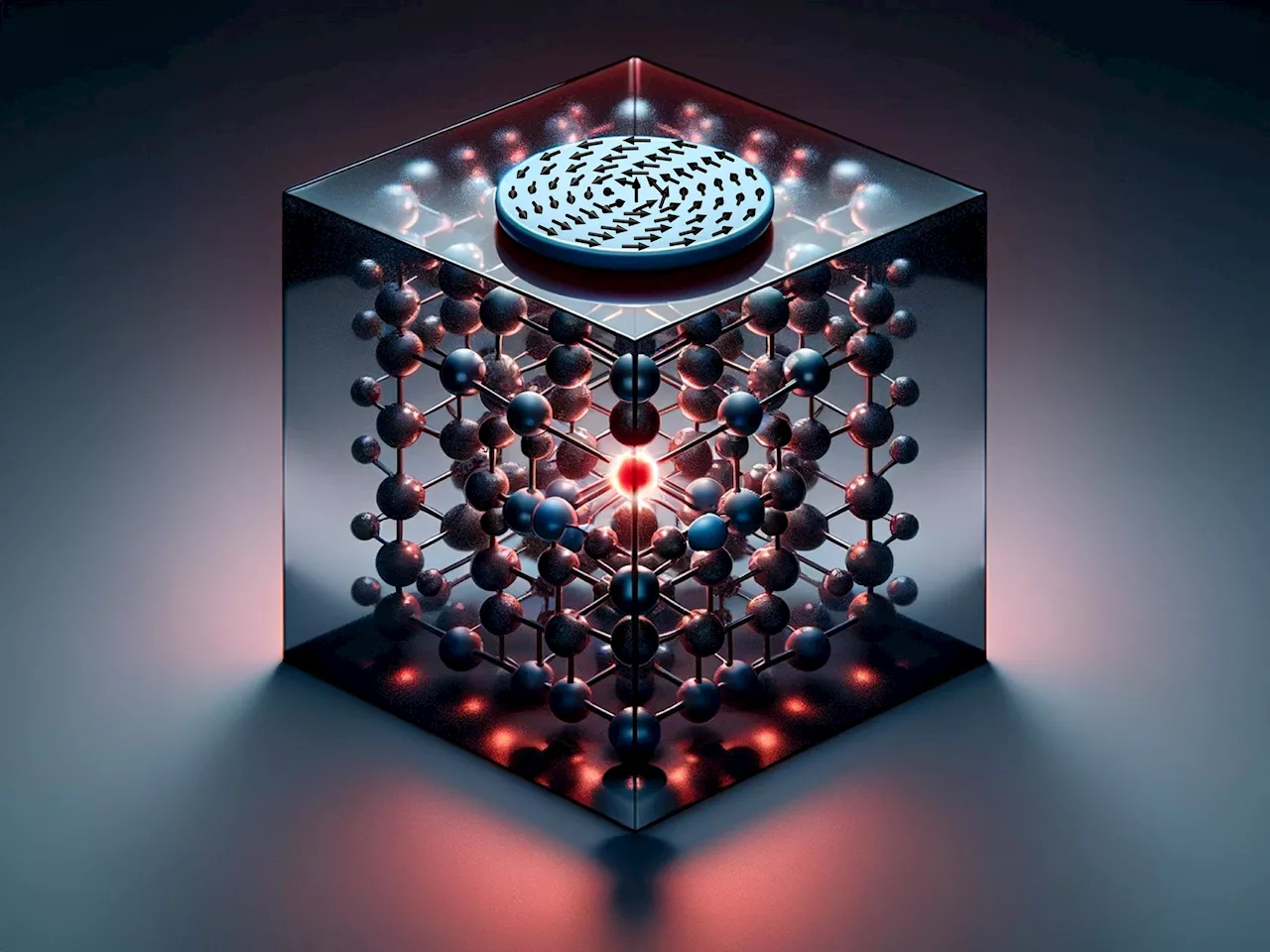
Researchers at HZDR managed to generate wave-like excitations in a magnetic disk – so-called magnons – to specifically manipulate atomic-sized qubits in silicon carbide. This could open new possibilities for the transduction of information within quantum networks.
Credit: HZDR / Mauricio Bejarano Researchers at HZDR have developed a new method to transduce quantum information using magnons, offering a promising approach to overcoming the challenges inQuantum computers promise to tackle some of the most challenging problems facing humanity today. While much attention has been directed towards the computation of quantum information, the transduction of information within quantum networks is equally crucial in materializing the potential of this new technology. is now introducing a new approach for transducing quantum information: the team has manipulated quantum bits, so-called qubits, by harnessing the magnetic field of magnons – wave-like excitations in a magnetic material – that occur within microscopic magnetic disks. The researchers presented their results in the journalThe construction of a programmable, universal quantum computer stands as one of the most challenging engineering and scientific endeavors of our time. The realization of such a computer holds great potential for diverse industry fields such as logistics, finance, and pharmaceutics. However, the construction of a practical quantum computer has been hindered by the intrinsic fragility of how the information is stored and processed in this technology. Quantum information is encoded in qubits, which are extremely susceptible to the noise in their environment. Tiny thermal fluctuations, a fraction of a degree, could entirely disrupt the computation. This has prompted researchers to distribute the functionalities of quantum computers among distinct separate building blocks, in an effort to reduce error rates, and harness complementary advantages from their constituents. “However, this poses the problem of transferring the quantum information between the modules in a way that the information doesn’t go missing,” says HZDR researcher Mauricio Bejarano, first author of the publication. “Our research lies precisely in this specific niche, transducing communication between distinct quantum modules.”The currently established method to transfer quantum information and addressing qubits is through microwave antennas. This is the approach used by Google and IBM in their superconducting chips, the technological platform standing at the forefront in this quantum race. “We, on the other hand, address the qubits with magnons,” says HZDR physicist Helmut Schultheiß, who supervised the work “These can be thought of as magnetic excitation waves that pass through a magnetic material. The advantage here is that the wavelength of magnons lies in the micrometer range and is significantly shorter than the centimeter waves of conventional microwave technology. Consequently, the microwave footprint of magnons costs less space in the chip.”The HZDR group investigated the interaction of magnons and qubits formed by vacancies of silicon atoms in the crystal structure of silicon carbide, a material commonly used in high-power electronics. Such types of qubits are typically called spin qubits, given the quantum information is encoded in the spin state of the vacancy. But how can magnons be utilized to control these types of qubits? “Typically, magnons are generated with microwave antennas. This poses the problem that it is very difficult to separate the microwave drive coming from the antenna from the one coming from the magnons,” explains Bejarano. To isolate the microwaves from the magnons, the HZDR team used an exotic magnetic phenomena observable in microscopic magnetic disks of a nickel-iron. “Due to a nonlinear process, some magnons inside the disk possess a much lower frequency than the driving frequency of the antenna. We manipulate qubits only with these lower frequency magnons.” The research team emphasizes they did not perform any quantum calculations yet. However, they showed that it is fundamentally feasible to address qubits exclusively with magnons.“To date, the quantum engineering community has not yet realized that magnons can be used to control qubits,” stresses Schultheiß. “But our experiments demonstrate that these magnetic waves could indeed be useful.” In order to further develop their approach, the team is already preparing for their future plans: they want to try to control several closely spaced individual qubits in such a way that magnons mediate their entanglement process – a prerequisite for performing quantum computations. Their vision is that, in the long term, magnons could be excited by direct electrical currents with such precision that they specifically and exclusively address a single qubit in an array of qubits. This would make it possible to use magnons as a programmable quantum bus to address qubits in an extremely effective manner. While there is plenty of work ahead, the group’s research highlights that combining magnonic systems with quantum technologies could provide useful insights for the development of a practical quantum computer in the future. Reference: “Parametric magnon transduction to spin qubits” by Mauricio Bejarano, Francisco J. T. Goncalves, Toni Hache, Michael Hollenbach, Christopher Heins, Tobias Hula, Lukas Körber, Jakob Heinze, Yonder Berencén, Manfred Helm, Jürgen Fassbender, Georgy V. Astakhov and Helmut Schultheiss, 20 March 2024,SciTechDaily: Home of the best science and technology news since 1998. Keep up with the latest scitech news via email or social media.Experts caution dog owners against allowing their pets to swim in the Colorado River. Scientists at UC Riverside have verified for the first time the…
United States Latest News, United States Headlines
Similar News:You can also read news stories similar to this one that we have collected from other news sources.
 Ethereum Well-Positioned to Defend Against Quantum Computing Threat, Says Vitalik ButerinVitalik Buterin, the co-founder of Ethereum, believes that Ethereum is well-prepared to defend against a potential quantum computing attack. He suggests a solution involving a hard fork of the blockchain and introducing new transaction types.
Read more »
 Quantum Computing Revolutionizes Biological ResearchScientists have discovered how quantum computing can revolutionize biological research, providing new insights into aging and disease. The study highlights the potential for advanced biological simulations and personalized treatments, emphasizing the critical role of quantum computing in analyzing vast amounts of biological data.
Read more »
 Solid-State Qubits: Artificial Atoms Unlock Quantum Computing BreakthroughScience, Space and Technology News 2024
Read more »
 Europium Unleashed: Rewriting the Rules of Quantum StorageScience, Space and Technology News 2024
Read more »
 Quantum Computing Breakthrough: Photons That Make Quantum Bits “Fly”Science, Space and Technology News 2024
Read more »
 Quantum leap: Scientists send messages with magnetism of magnons, a firstA Helmholtz-Zentrum Dresden-Rossendorf research team has controlled qubits using magnons, magnetic wave-like excitations in microscopic magnetic disks.
Read more »