
Since the United States and Israel launched their war against Iran on Feb. 28, the Trump administration claims to have all but “obliterated” the Islamic Republic’s military capabilities.
One wrong move: The sometimes-life-threatening reality inside Jacksonville’s road work zonesRead full article: Clay County Fair officials hold press conference on logisticsLegal expert questions whether Trump’s threats to Iran’s energy infrastructure cross a linePlumes of smoke rise from an oil facility in Fujairah, United Arab Emirates, Saturday, March 14, 2026.
A member of police special forces stands guard on top their car at the Enqelab-e-Eslami, or Islamic Revolution, square in downtown Tehran, Iran, Monday, March 30, 2026. Defense Secretary Pete Hegseth looks over as Chairman of the Joint Chiefs of Staff Gen. Dan Caine speaks to members of the media during a press briefing at the Pentagon in Washington, Tuesday, March 31, 2026. This March 15, 2026, satellite photo from Planet Labs PBC shows damage after an Iranian attack at Al Udeid Air Base, Qatar. Smoke rises from Kuwait international airport after a drone strike on fuel storage in Kuwait City, Kuwait, Friday, Wednesday, March 25, 2026. Plumes of smoke rise from an oil facility in Fujairah, United Arab Emirates, Saturday, March 14, 2026. – Since the United States and Israel launched their war against Iran on Feb. 28, the Trump administration claims to havedeclared last week that “never in recorded history has a nation’s military been so quickly and so effectively neutralized.” But after more than a month of punishing U.S.-Israeli airstrikes, a degraded Iranian military nonetheless remains a stubborn foe. Its steady stream of strikes against Israel and Gulf Arab neighbors are“Their strategy is to try to cause sustained pain and to drive up the costs of the war for the U.S.,” said Kelly Grieco, an expert in U.S. military strategy and operations who is a senior fellow at the Washington-based Stimson Center think tank., officials from both countries have repeatedly pointed to a steep drop-off in Iran’s firing of ballistic missiles as proof that their efforts to destroy launchers and weapons stockpiles were working. Chairman of the Joint Chiefs of Staff Gen. Dan Caine told reporters on March 4 that Iran’s “ballistic missile shots fired are down 86% from the first day of fighting and their one-way attack drone shots are down 73%." At a press briefing two weeks later, Hegseth said the volume of Iran’s ballistic missile attacks had dropped"90% since the start of the conflict.” On Tuesday, Hegseth told reporters at the Pentagon that in the past 24 hours Iran had fired its “lowest number” of missiles and drones, though neither he nor Caine gave any updated percentages. Trump said Tuesday on Truth Social that “Iran has been, essentially, decimated.” Claims of a slowdown in Iranian strikes are backed up by independent data from Armed Conflict Location & Event Data , a U.S.-based group that tracks conflicts around the world., the second day of the war, Iran fired off almost 100 strikes. The next day, its strike count dropped to 53 and it hovered at that rate for the next few days. In the three and a half weeks since March 6, ACLED data shows Iran hasn’t fired more than 50 strikes on any given day. A “strike,” in ACLED’s methodology, can include multiple individual strikes in the same location on the same day. Iran has maintained an average of 30 strikes each day for the last three weeks, and at various points it has picked up its tempo of attacks. “That makes me question whether it’s a capacity issue or a strategy issue,” Grieco said of the initial decline in Iran's strike rate. In other words, Iran may not be running out of firepower as much as deliberately rationing its missiles and drones.“We are vaporizing billions of dollars in long-range anti-missile defenses, which are scarce national resources,” said Tom Karako, the director of the Missile Defense Project at the Washington-based Center for Strategic and International Studies. The danger, Karako said, is that the U.S. and Israel could run out of interceptors before they are able to take out the rest of Iran's missile stockpiles and mobile launchers — an objective that has proven “maddeningly difficult.” Over a month into the war, Trump administration officials continue to refer to the first 72 hours as their point of comparison for claims about Iran’s crippled capacity. “A good percentage of Iranian missiles, at least half of the arsenal, is stored in very hardened facilities that are not easily reachable with air power,” said Farzin Nadimi, an expert on the Iranian missile program at The Washington Institute. “It looks like the Americans and the Israelis have been underestimating some level of complexity.”Contrary to Hegseth’s characterization of the Iranians as “flailing recklessly" by striking civilian and energy infrastructure across the Arabian Peninsula, analysts say Tehran appears to have fine-tuned its timing and “They have been able to strike targets more efficiently and therefore use fewer missiles to achieve the same result,” Nadimi said.across the Persian Gulf in a bid to impose a settlement on the U.S., hitting nearby states like the United Arab Emirates and Kuwait hardest. Last week, Iran fired ballistic missiles and drones at a Saudi air base, wounded more than two dozen U.S. troops and damaging aircraft. “In this asymmetrical war, the most important thing for Iran is attack the world economy in hopes of coercing the U.S. to stop,” said Assaf Orion, a retired Israeli brigadier general and senior researcher at the Institute for National Security Studies. That has become more important to Iran than attacking Israel, which views this war as existential and won’t be dissuaded, he added. How long Iran can sustain its current level of retaliation remains unclear, as U.S. and Israeli intelligence on Iran's missile and drone inventory is limited. Military experts from both countries offer varying estimates on the remaining arsenal, but agree that Iran most likely still has thousands of cheap, locally manufactured drones that it can deploy to menace U.S. allies even if much of its midrange ballistic missile capacity has been destroyed. “Iran built itself to be able to ride a war like this out,” said Karako. “It has been preparing for this."Copyright 2026 The Associated Press. All rights reserved. This material may not be published, broadcast, rewritten or redistributed without permission.The Jags are about to get a new 'home away from home' for 2027Lawmakers hope new law spurs affordable housing, but some say it weakens local government controlWoman found fatally shot in front yard of home on Jacksonville’s WestsideFlorida court shuts down online gift card business based in Ponte Vedra, imposes over $800K in finesDNA test connects Clay County Navy veteran to WWII POW missing for over 80 yearsSt. Augustine replacing downtown parking kiosks with cashless touchscreensHundreds participate in Jacksonville ‘No Kings’ rally against Trump administrationFlagler College students protest housing policy as seniors cite affordability, availability concernsGAME DAY ⚾🦐 The defending Triple-A National Champion Jacksonville Jumbo Shrimp returnShould an HOA or property management company be required to post parking rules for visitors?Fights erupt at Palatka Junior-Senior High after field trip focused on mental health
World News Pete Hegseth Washington News Tom Karako Dan Caine
United States Latest News, United States Headlines
Similar News:You can also read news stories similar to this one that we have collected from other news sources.
 US-Israeli war on Iran violates international law, German parliamentary study saysExperts say attacks breach the UN Charter as they lack self-defence grounds or Security Council approval.
Read more »
 Iran threatens to bomb US and Israeli universities in Middle EastThe threat came after the United States and Israel struck two Iranian universities this weekend.
Read more »
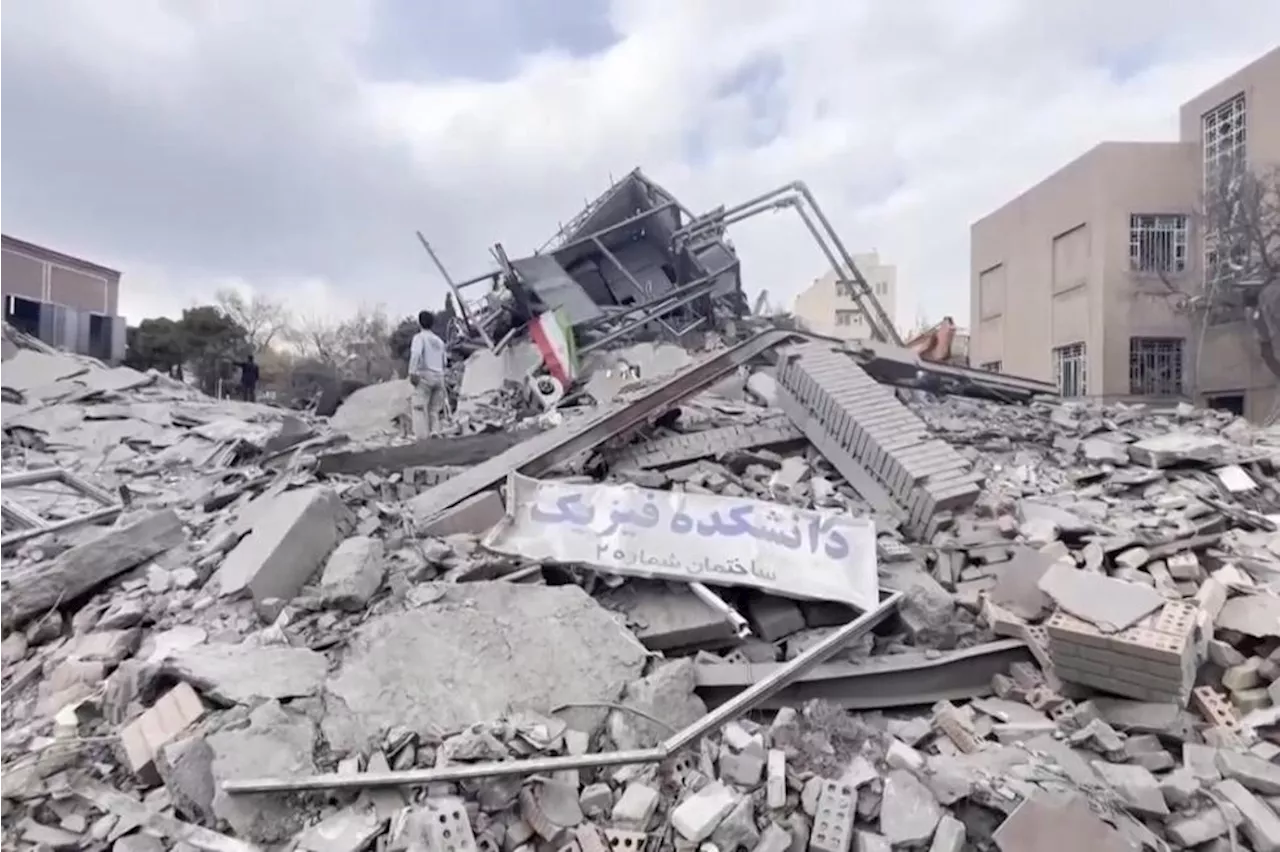 Iran University of Science and Technology building reduced to rubble by Israeli airstrikeThe country's Revolutionary Guard warned that Iran would consider Israeli universities and branches of U.S. universities in the region “legitimate targets” unless offered safety assurances for Iranian universities, state media reported.
Read more »
 What have US-Israeli forces claimed to have destroyed in Iran since start of war?Cumulatively, U.S. Central Command says 11,000 targets have been hit since the beginning of the conflict on Feb. 28.
Read more »
 Iran's internet blackout hiding strike damage and suppressing dissent, Israeli officials sayFox News Channel offers its audiences in-depth news reporting, along with opinion and analysis encompassing the principles of free people, free markets and diversity of thought, as an alternative to the left-of-center offerings of the news marketplace.
Read more »
 Iran threatens to target US and Israeli-affiliated universitiesBasic
Read more »