
New research reveals how quantum interference dictates molecular behavior upon collision with gold surfaces, offering insights into chemistry and materials science.
Scientists have revealed how quantum interference and symmetry dictate molecular behavior in collisions with gold surfaces, offering new insights into molecular interactions. The findings can have important implications for chemistry and materials science. When molecules collide with surfaces, a complex exchange of energy takes place between the molecule and the atoms composing the surface. But beneath this dizzying complexity, quantum mechanics plays a crucial role.
Quantum interference, in particular, is key. It occurs when different pathways that a molecule can take overlap, resulting in specific patterns of interaction: some pathways amplify each other, while others cancel out entirely. This 'dance of waves' affects how molecules exchange energy and momentum with surfaces, and ultimately how efficiently they react.Understanding these quantum effects in surface collisions, however, has been a challenge. Previously, observing quantum interference in such systems was nearly impossible because of the overwhelming number of pathways available for the system to take en route to the different collision outcomes. Many scientists have even wondered if all quantum effects would always 'wash out' for these processes, suggesting that the simpler laws of classical physics, which apply to everyday, 'macroscopic' objects, might be enough to describe them. Addressing this challenge, researchers in Rainer Beck's group at EPFL, with colleagues in Germany and the United States, developed a method to cut through the complexity. They tuned methane molecules to specific quantum states, scattered them off a gold (Au) surface, and measured their states after the collision. The team used a gold sample carefully grown to be perfectly crystalline and then cut along a special direction to reveal a surface named 'Au(111),' which is atomically smooth and chemically inert. To prevent contamination from gas particles present under normal ambient conditions, they kept the surface under ultra-high vacuum during experiments. The exceptional flatness and cleanliness of the Au(111) surface ensured that the observed scattering behavior arose from fundamental quantum wave aspects rather than random surface irregularities or impurities, allowing the team to focus purely on interference effects. The researchers then used a laser-based technique to precisely control the quantum states of methane molecules before they collided with the gold surface and measure the quantum states the molecules occupy after the collision. Methane molecules naturally exist in a mix of different energy states, meaning their internal vibrations and rotations vary. To make sure all the molecules started in the same well-defined quantum state, the researchers first fired a pump laser at a beam of methane molecules, exciting them into a well-defined quantum state. They then aimed the beam of methane molecules at a pristine Au(111) surface, where they collided and scattered. After the collision, the team hit the scattered molecules with a tagging laser tuned to specific energy levels. If a molecule was in a matching quantum state, it absorbed the laser's energy, creating a tiny change in temperature of the scattering molecules that the researchers could measure with a highly sensitive detector called a bolometer. The scientists used this method to figure out which quantum states the methane molecules occupied after colliding with the gold surface. When they compared their results to quantum theory, they found that symmetry dictated which transitions were allowed and which were forbidden. In simple terms, symmetry describes how something stays the same when flipped, rotated, or reflected. In the quantum world, every state of a molecule has a specific symmetry, and transitions between states must follow strict symmetry rules. If two states of a methane molecule had incompatible symmetry, then the different pathways taken between these two states canceled out one another. In this case the transition simply did not happen -- like trying to walk through a doorway that leads to a brick wall. But when the states had compatible symmetry, the pathways amplified one another and the transitions were strong and clearly visible -- like doors aligning between rooms, allowing smooth movement. This confirmed that quantum interference isn't just an abstract concept but actively controls molecular behavior at surfaces. In their paper, the authors draw an elegant analogy to the famous double-slit experiment, where particles like electrons produce interference patterns when passed through two slits, behaving like waves, just as methane molecules displayed interference here. Specifically, the study uncovers a new form of quantum interference in molecule scattering
Quantum Mechanics Molecular Interactions Surface Collisions Gold Quantum Interference Symmetry
United States Latest News, United States Headlines
Similar News:You can also read news stories similar to this one that we have collected from other news sources.
 Scientists Discover New Quantum State in 2D Semiconductors, Paving the Way for More Powerful Quantum ComputingResearchers at the Daegu Gyeongbuk Institute of Science and Technology have made a significant breakthrough in quantum computing by discovering a new quantum state within two-dimensional (2D) semiconductor chips. This discovery offers a promising path for controlling quantum information with enhanced reliability, potentially leading to more powerful and efficient quantum computers.
Read more »
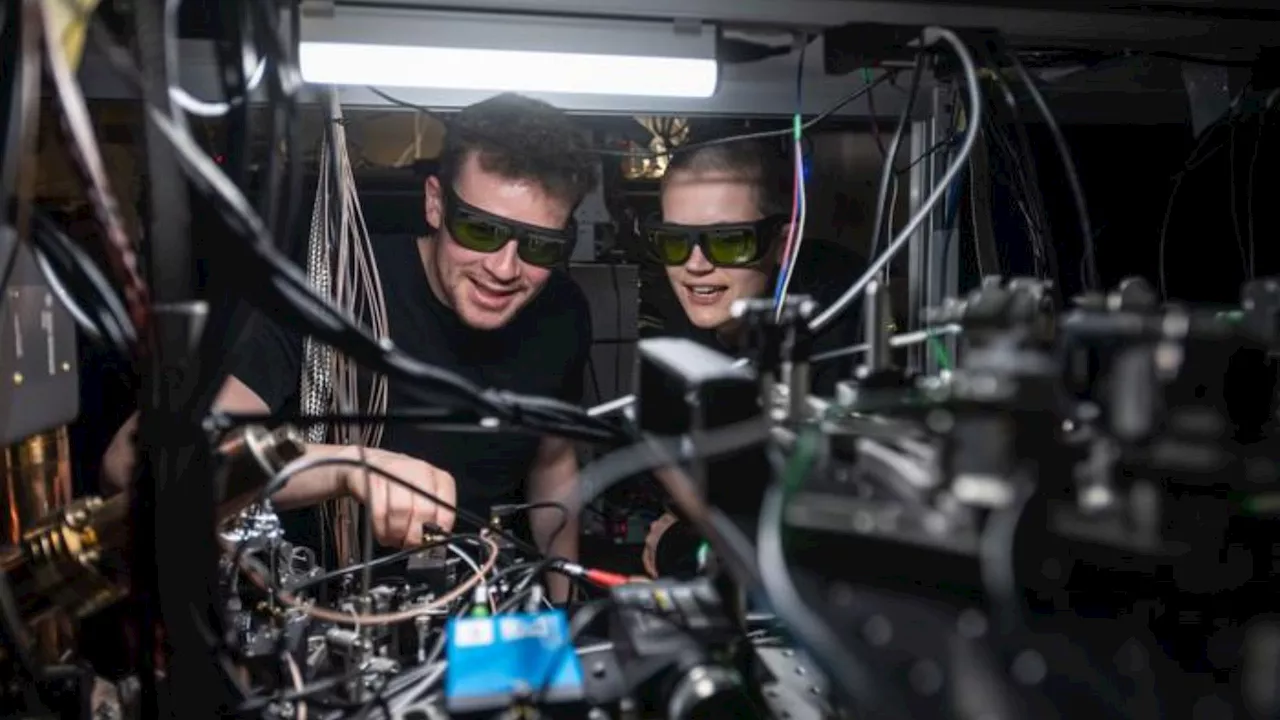 Oxford Researchers Achieve Quantum Teleportation of Logical Gates, Paving the Way for Scalable Quantum ComputingA team of researchers at Oxford University Physics has made a significant breakthrough in quantum computing by successfully demonstrating the first-ever quantum teleportation of logical gates. This achievement paves the way for building larger, more powerful quantum computers and overcomes the scalability challenges that have long hindered their progress.
Read more »
 Quantum Leap: Scientists Achieve Distributed Quantum ComputingScientists at Oxford University Physics have successfully connected two separate quantum processors using a photonic network interface, creating the first distributed quantum computer. This breakthrough paves the way for tackling complex computational challenges and addresses the scalability issue in quantum computing.
Read more »
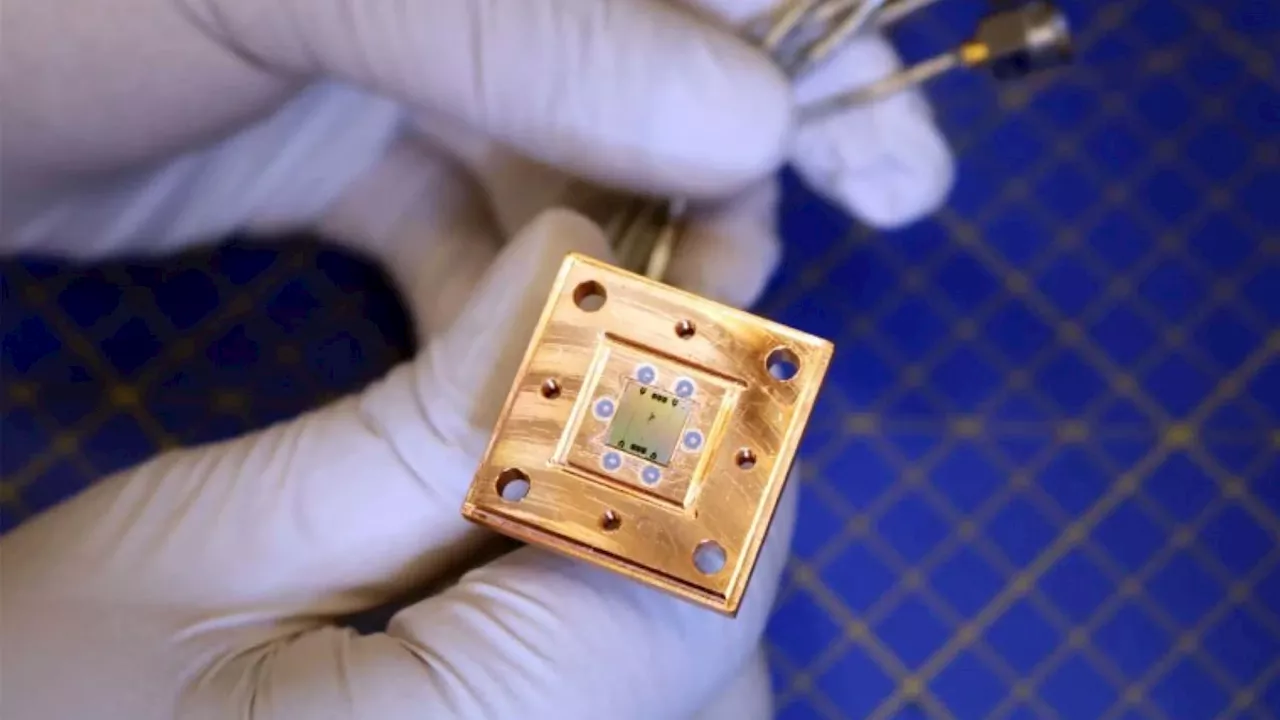 Autonomous Quantum Refrigerator Achieves Record-Low Temperature, Boosting Quantum Computer PerformanceScientists have developed a new type of autonomous quantum refrigerator that can cool qubits to a record-low temperature of 22 millikelvin. This breakthrough could significantly improve the performance and reliability of quantum computers by reducing errors caused by environmental disturbances.
Read more »
 Quantum Teleportation Achieves Milestone in Distributing Quantum ModulesResearchers at Oxford University successfully teleport quantum states between computers, proving the feasibility of distributing quantum modules without performance loss. This breakthrough paves the way for scaling quantum technology and building larger, more powerful quantum computers.
Read more »
 Exploring Quantum Computing: Texas' Potential in the Quantum EraThe Texas Tribune hosts a panel discussion with leading quantum computing experts to explore the potential of this transformative technology and its implications for Texas' future.
Read more »