
Scientists at NIST have developed a new type of thermometer using 'Rydberg' atoms, which are thousands of times larger than normal atoms. These giant atoms are highly sensitive to environmental changes, allowing for precise temperature measurements without the need for calibration.
Scientists have developed a new method for measuring temperature extremely accurately by using giant 'Rydberg' atoms. This atomic thermometer provides accurate measurements 'out of the box,' without needing initial factory adjustments, because it relies on the basic principles of quantum physics .
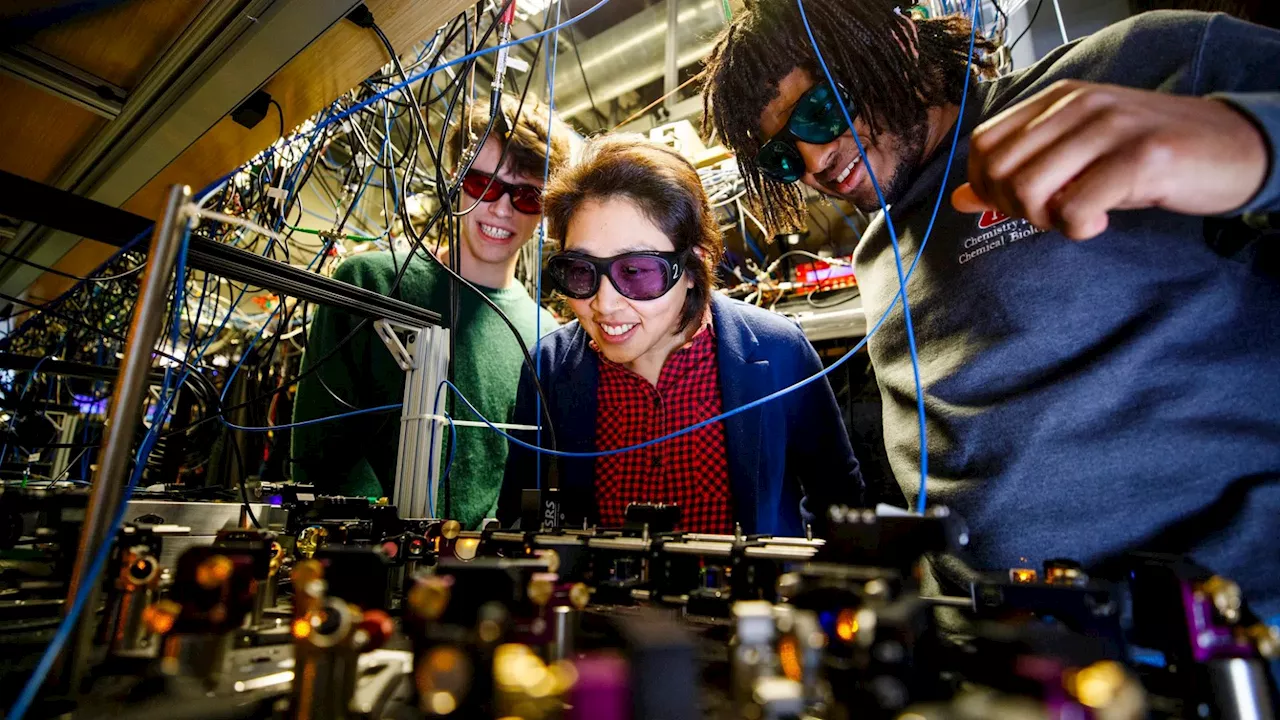
By using Rydberg atoms' sensitivity to environmental changes, this technique could simplify temperature sensing in extreme environments, from space to high-precision industries. Scientists at the National Institute of Standards and Technology have created a new thermometer using atoms boosted to such high energy levels that they are a thousand times larger than normal. By monitoring how these giant"Rydberg" atoms interact with heat in their environment, researchers can measure temperature with remarkable accuracy. The thermometer's sensitivity could improve temperature measurements in fields ranging from quantum research to industrial manufacturing. Unlike traditional thermometers, a Rydberg thermometer doesn't need to be first adjusted or calibrated at the factory because it relies inherently on the basic principles of quantum physics. These fundamental quantum principles yield precise measurements that are also directly traceable to international standards. "We're essentially creating a thermometer that can provide accurate temperature readings without the usual calibrations that current thermometers require," said NIST postdoctoral researcher Noah Schlossberger., is the first successful temperature measurement using Rydberg atoms. To create this thermometer, researchers filled a vacuum chamber with a gas of rubidium atoms and used lasers and magnetic fields to trap and cool them to nearly absolute zero, around 0.5 millikelvin . This means the atoms were essentially not moving. Using lasers, they then boosted the atoms' outermost electrons to very high orbits, making the atoms approximately 1,000 times larger than ordinary rubidium atoms. In Rydberg atoms, the outermost electron is far away from the core of the atom, making it more responsive to electric fields and other influences. This includes blackbody radiation, the heat emitted by surrounding objects. Blackbody radiation can cause electrons in Rydberg atoms to jump to even higher orbits. Rising temperatures increase the amount of ambient blackbody radiation and the rate of this process. Thus, researchers can measure temperature by tracking these energy jumps over time. This approach enabled the detection of even the most minor temperature changes. While there are other types of quantum thermometers, Rydberg thermometers can measure the temperature of their environment from about 0 to 100 degrees Celsius without needing to touch the object being measured. This breakthrough not only paves the way for a new class of thermometers but is particularly significant for atomic clocks, because blackbody radiation can reduce their accuracy. "Atomic clocks are exceptionally sensitive to temperature changes, which can cause small errors in their measurements," said NIST research scientist Chris Holloway."We're hopeful this new technology could help make our atomic clocks even more accurate." Beyond precision science, the new thermometer could have wide-ranging applications in challenging environments from spacecraft to advanced manufacturing plants, where sensitive temperature readings are essential."This method opens a door to a world where temperature measurements are as reliable as the fundamental constants of nature," Holloway added."It's an exciting step forward for quantum sensing technology."Noah Schlossberger, Andrew P. Rotunno, Stephen P. Eckel, Eric B. Norrgard, Dixith Manchaiah, Nikunjkumar Prajapati, Alexandra B. Artusio-Glimpse, Samuel Berweger, Matthew T. Simons, Dangka Shylla, William J. Watterson, Charles Patrick, Adil Meraki, Rajavardhan Talashila, Amanda Younes, David S. La Mantia, Christopher L. Holloway.Physicists developed a technique to arrange atoms in much closer proximity than previously possible, down to 50 nanometers. The group plans to use the method to manipulate atoms into configurations ... Scientists have succeeded in the stabilization and direct imaging of small clusters of noble gas atoms at room temperature. This achievement opens up exciting possibilities for fundamental research ... Physicists have learned to manipulate electrons in gigantic Rydberg atoms with such precision they can create 'synthetic dimensions' where the system acts as if it had extra spatial dimensions, which ... Researchers have generated Rydberg atoms - unusually large excited atoms - near nanometer-thin optical fibers. Their findings mark progress toward a new platform for quantum information processing, ...
Quantum Physics Atomic Thermometer Rydberg Atoms Temperature Measurement Precision Sensing
United States Latest News, United States Headlines
Similar News:You can also read news stories similar to this one that we have collected from other news sources.
 Atomic Diffraction Achieved: Atoms Wave Like Particles, Opening New Quantum FrontiersA groundbreaking experiment has demonstrated that atoms can exhibit wave-like behavior, challenging long-held scientific assumptions. The research, conducted by scientists at the German Aerospace Center, used a graphene sheet to successfully record a diffraction pattern from helium and hydrogen atoms, marking the first time atomic diffraction has been achieved.
Read more »
 Record cold quantum refrigerator paves way for reliable quantum computersQuantum computers require extreme cooling to perform reliable calculations. One of the challenges preventing quantum computers from entering society is the difficulty of freezing the qubits to temperatures close to absolute zero.
Read more »
 Harvard Scientists Trap Molecules for Quantum Operations, Ushering in a New Era of Quantum ComputingFor the first time, scientists have successfully trapped molecules and used them to perform quantum operations, marking a significant leap forward in the field of quantum computing. This breakthrough opens up new possibilities for building more powerful and versatile quantum computers.
Read more »
 Researchers Achieve Quantum Teleportation with Error CorrectionA team of researchers has successfully demonstrated quantum teleportation with error correction using a trapped-ion quantum computer. This breakthrough utilizes entanglement and quantum error correction techniques to transfer quantum information reliably, overcoming the limitations of traditional methods.
Read more »
 SEALSQ Unveils World's First Quantum-Resistant Secure HardwareSwiss semiconductor company SEALSQ introduces its latest platform, QS7001, designed to provide quantum-resistant security. This breakthrough technology utilizes post-quantum cryptography algorithms, KYBER and DILITHIUM, to protect against attacks from both current and future quantum computers. The platform meets FIPS and Common Criteria standards and offers advantages in energy efficiency and performance compared to traditional secure microcontrollers. This development positions SEALSQ as a leader in the quantum-resistant hardware market, addressing the growing need for secure solutions in the age of quantum computing.
Read more »
 Google's Willow Chip Achieves Quantum Supremacy MilestoneGoogle's latest quantum chip, Willow, has demonstrated a significant leap forward in quantum computing, achieving a milestone known as quantum supremacy. The chip outperformed even the most powerful classical supercomputers on a complex benchmark, solidifying Google's position as a leader in the field. This achievement highlights the rapid progress being made in quantum computing and its potential to revolutionize various industries.
Read more »