
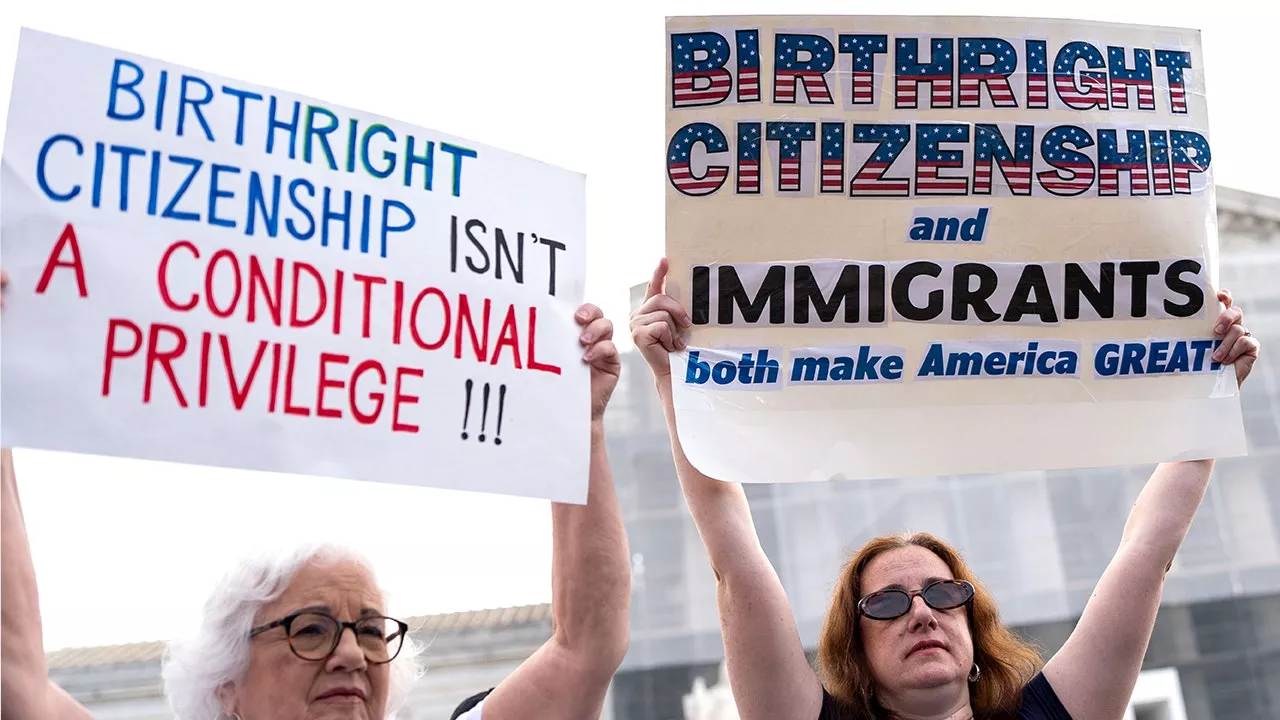
The Supreme Court is set to release opinions today, including the highly anticipated case of Trump v. Barbara, which challenges birthright citizenship. The case focuses on President Trump's executive order denying citizenship to children born to undocumented or temporary residents. Legal arguments will center on the 14th Amendment and its interpretation.
WASHINGTON, DC - MARCH 04: The U.S. Supreme Court is seen on March 04, 2026 in Washington, DC. The justices are expected to release opinions today in a series of cases before the court. The case, Trump v.
Barbara, centers around President Donald Trump’s Jan. 20, 2025, executive order that denies birthright citizenship to children born in the U.S. after Feb. 19, 2025, whose parents are either illegally present or temporary residents of the United States. The case will center around the 14th Amendment, a provision that conferred citizenship and voting rights to freed African Americans after the Civil War. The amendment would go on to become the bedrock for immigration law throughout the country. The 14th Amendment reads: “All persons born or naturalized in the United States, and subject to the jurisdiction thereof, are citizens of the United States and of the State wherein they reside. Legal analysts have said that the phrase “subject to the jurisdiction thereof” means more than being physically present in the United States. Ilan Wurman, a law professor at the University of Minnesota, said English common law – of which the United States’ founding documents were modeled – should be understood to only grant protections to immigrants with permission to be in the United States by a sovereign leader. Permission was relevant to protection and protection, as it turns out, was relevant to jurisdiction,” Wurman said. “The sovereign operated on children through the parents, which, of course, makes sense because parents have a natural authority over their children. Justices on the high court will also need to reckon with precedent by previous courts, like in U.S. v. Wong Kim Ark. In 1898, the Supreme Court said a child born to Chinese parents could be considered a U.S. citizen under the language of the 14th Amendment. The opinion from the justices created three categories of individuals who would be excluded from automatic U.S. citizenship, despite being born in the United States: children of diplomats, children born of invading armies and children born to American Indians. The question with Wong Kim Ark is whether that three item list is exhaustive and complete or whether there are other categories of people that might also be excluded,” said Eric Wessan, solicitor general for the Iowa office of the Attorney General. Lawyers arguing in favor of allowing birthright citizenship to all those born in the United States have appealed to the country’s long history and the decision in Wong Kim Ark. The lawyers have also pointed to fears of chaos if various states adopted different policies for who can be conferred citizenship. It would threaten to replace a long-established and eminently workable rule – around which a multitude of laws, systems, and policies have been shaped for generations – with an unclear, contingent, and chaotic experiment in exclusion from our national community,” lawyers wrote.It seems unlikely that the 14th Amendment was intended to serve as a magnet for birth tourism or to reward illegal re-entry,” Wessan said.The Ohio Department of Wildlife is working with other organizations to protect the state's environment, and together they are looking for help from the communitAs the weather warms and spring break approaches, there’s no better place for families to reconnect with nature, wildlife, and each other than the Columbus ZooA local expert is bringing comfort and care to patients' besides in a unique way.A jury declined to indict a father who allegedly fatally shot his daughter in the chest following an argument about President Donald Trump.'I love you. I feel kinda weird. I don’t know what to expect tomorrow. You’ve never done anything like this for me before.'
Supreme Court Trump V. Barbara Birthright Citizenship 14Th Amendment Immigration Law
United States Latest News, United States Headlines
Similar News:You can also read news stories similar to this one that we have collected from other news sources.
 Texas Supreme Court ends 2021 winter storm litigation against power generatorsWithout writing a single sentence to explain why, the Texas Supreme Court on Friday officially ended efforts by tens of thousands of Texas citizens and small...
Read more »
 Major Labels Take Over Landmark Copyright Termination Case to Force Supreme Court FightMajor labels are using an unusual legal maneuver to take over a landmark global music termination rights case in a bid to seek Supreme Court review.
Read more »
 Finland Supreme Court Convicts MP for 2004 Pamphlet Expressing Christian Opposition to HomosexualitySource of breaking news and analysis, insightful commentary and original reporting, curated and written specifically for the new generation of independent and conservative thinkers.
Read more »
 Finland's Supreme Court Convicts MP Päivi Räsänen of Hate Speech Over Comments on HomosexualityThe Finnish Supreme Court has convicted Christian Democrat MP Päivi Räsänen of hate speech, fining her and ordering the removal of content deemed derogatory towards homosexuals. The case, stemming from a 2004 publication, a 2018 radio appearance, and a 2019 social media post, has sparked debate over freedom of speech and religious expression.
Read more »
 Supreme Court prepares to review Trump executive order on birthright citizenshipFox News Channel offers its audiences in-depth news reporting, along with opinion and analysis encompassing the principles of free people, free markets and diversity of thought, as an alternative to the left-of-center offerings of the news marketplace.
Read more »
 Supreme Court to Issue Opinion in Trump v. Barbara Citizenship CaseThe Supreme Court is set to release its opinion on Trump v. Barbara, a case concerning President Trump's executive order denying birthright citizenship to children born in the U.S. to undocumented or temporary resident parents. The case centers on the interpretation of the 14th Amendment and its application to citizenship.
Read more »