
The breakthrough slip-prevention method allows robots to predict when an object might slip – and adapt their movements in real-time to prevent it.
Engineers from Britain implemented a novel approach to improve how robots grip and handle fragile, slippery or asymmetric objects. The breakthrough slip-prevention method shows impressive results and could pave the way for safer, more reliable automation across industries ranging from manufacturing to healthcare.
Demonstrated by researchers from the Surrey’s School of Computer Science and Electronic Engineering, the approach allows robots to predict when an object might slip – and adapt their movements in real-time to prevent it.The method is similar to the way humans naturally adjust their motions. The bio-inspired approach outperforms traditional grip-force strategies by allowing robots to move more intelligently and maintain a secure hold without simply squeezing harder. Robots to take a more human-like approach“If you imagine carrying a plate that starts to slip, most people don’t simply squeeze harder—they instinctively adjust their hand’s motion by slowing down, tilting or repositioning to stop it from falling. Traditionally, robots have been trained to rely solely on grip force, which can be ineffective or even damaging to delicate items,” said Dr. Amir Esfahani, associate professor in robotics.“We’ve taught our robots to take a more human-like approach, sensing when something might slip and automatically adjusting their movements to keep objects secure.”The research is the first to demonstrate and quantify the effectiveness of trajectory modulation for slip prevention in both humans and robots.Predictive control systemThe findings show that a predictive control system powered by a learned “tactile forward model” allows robots to anticipate when an object is likely to slip, continuously analysing its planned movements. Researchers also demonstrated that the system works on objects and movement paths it wasn’t trained on, highlighting its potential to generalise effectively to real-world settings, according to a press release. Esfahani believes that the method could be a game changer for future automation, from handling surgical tools in health care and assembling delicate parts in manufacturing to sorting awkward packages in logistics or assisting people in their homes.Potential in a variety of industrial and service robotic applications“We believe that our approach has notable potential in a variety of industrial and service robotic applications, and our work opens up new opportunities to bring robots into our daily life. We hope our findings will inspire future research in this area and further advance the field of robotics,” says Esfahani.Researchers revealed that ensuring a stable grasp during robotic manipulation is essential for dexterous and reliable performance. Traditionally, slip control has relied on grip force modulation.Published in the journal Nature Machine Intelligence, the study reveals that trajectory modulation provides an effective alternative for slip prevention in certain robotic manipulation tasks.Slip control policy based on trajectory modulation“We develop and compare a slip control policy based on trajectory modulation with a conventional grip-force-based approach. Our results demonstrate that trajectory modulation can significantly outperform grip force control in specific scenarios, highlighting its potential as a robust slip control strategy,” said researchers in the study.They also demonstrated that, similar to humans, incorporating a data-driven action-conditioned forward model within a model predictive control framework is key to optimizing trajectory modulation for slip prevention.“These findings introduce a predictive control framework leveraging trajectory adaptation, offering a new perspective on slip mitigation. This approach enhances grasp stability in dynamic and unstructured environments, improving the adaptability of robotic systems across various applications,” added researchers in the study.
United States Latest News, United States Headlines
Similar News:You can also read news stories similar to this one that we have collected from other news sources.
 Humanoid robots guided by AI set to compete in first 3-on-3 soccer gameThe RoBoLeague World Robot Soccer League will host its final match in the city’s Yizhuang Development Zone on Saturday.
Read more »
 M3GAN Spin-off Movie SOULM8TE Is ‘Fatal Attraction But With Robots’Director James Wan describes the concept of the M3GAN spinoff, SOULM8TE, as 'Fatal Attraction but with robots.'
Read more »
 Allison Williams and James Wan tease M3GAN spinoff SOULM8TE: 'Like Fatal Attraction but with robots' (exclusive)'SOULM8TE,' the upcoming erotic-thriller 'M3GAN' spinoff, will be 'a more adult story,' according to executive producers Allison Williams and James Wan, who describe it as 'Fatal Attraction' but with robots.
Read more »
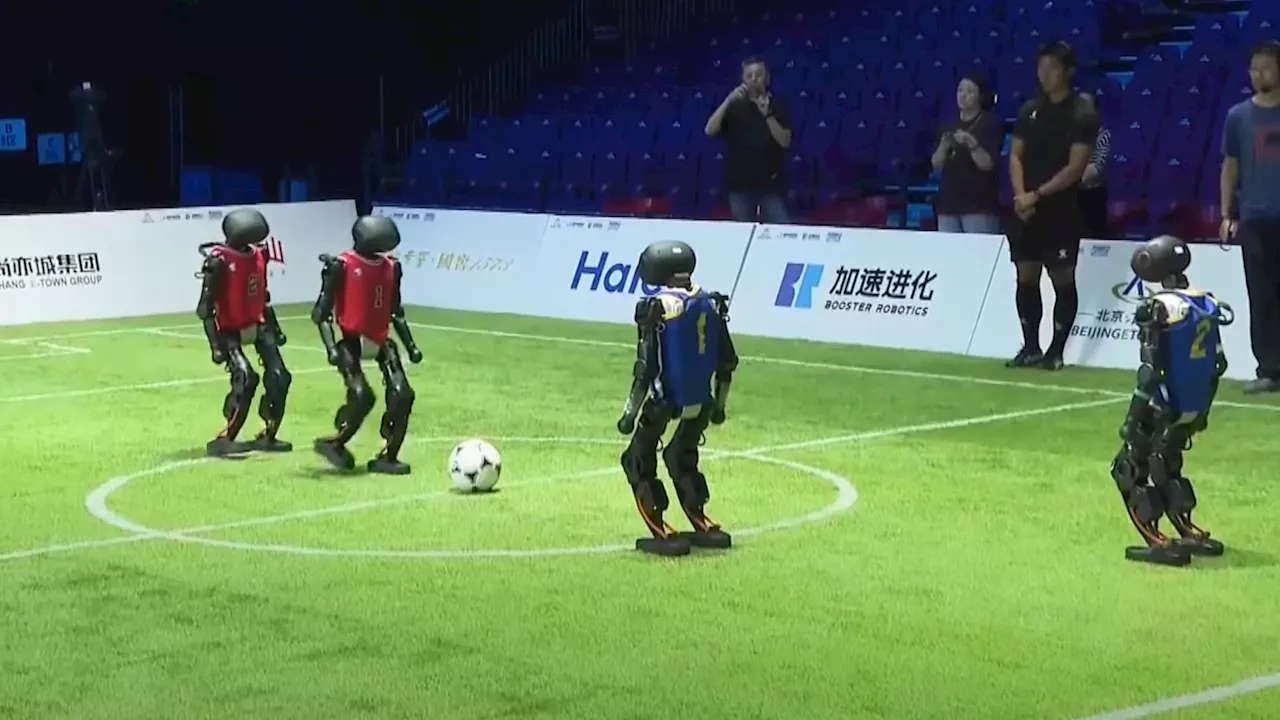 China’s brainy humanoid robots to play soccer game with 90% ball detection powerBeijing hosts the world’s first fully autonomous 3-on-3 robot soccer match, previewing the 2025 World Humanoid Robot Games.
Read more »
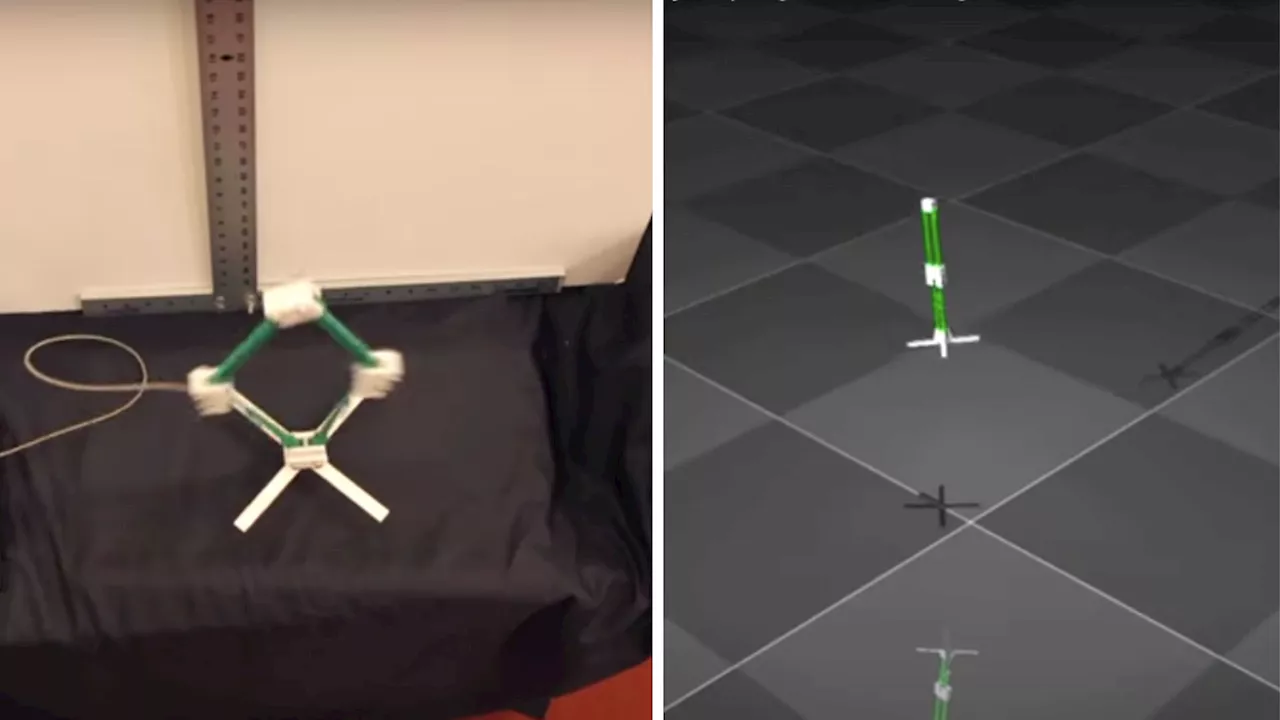 MIT’s new AI outwits scientists to design robots that jump 41% higher, land safelyIn robot development, AI-generated linkages are curved whereas the standard robot’s connecting parts are straight and rectangular.
Read more »
 Popular social media chiropractor 'Dr. Mike' sues Therabody for allegedly ripping off his designsRobots are taking over wellness in NYC
Read more »