
Physicists explore quantum mechanics and find no evidence that time flows in one direction
In their quest to uncover the origin of time's flow, University of Surrey physicists Thomas Guff, Chintalpati Umashankar Shastry, and Andrea Rocco embarked on a theoretical journey to explore the quantum realm, envisioning a scenario akin to a heated quantum bathtub submerged in the vast expanse of eternity. Their pursuit yielded no direct evidence of time's source, but it yielded a compelling confirmation: time flows backward with the same ease as it does forward.
This discovery, while not revealing the ultimate secret of time, holds profound implications for understanding why physics insists on the existence of history.Physics, at its core, exhibits a remarkable symmetry when it comes to time. While we rarely witness the uncrack of an egg or the transformation of an oak back into an acorn, the fundamental laws governing most processes remain largely unaffected by the direction of time. They offer little distinction between the past and the future ends of an equation.Cosmologists have long pondered the universe's expansion from a low-entropy to a high-entropy state in search of clues about time's asymmetry. Quantum physicists have also delved into the possibility that interactions with the environment might play a role. However, no definitive explanation has emerged to account for the cohesive nature of time's dimension. Guff, Shastry, and Rocco hypothesized that perhaps quantum equations of motion hold the key, containing a mechanism that renders a return to a past state impossible. They imagined this mechanism as a kind of ratchet, ensuring that a system's laws do not slip backward.To test this hypothesis, they developed a simplified model of heated particles interacting within an open container. Utilizing Markovian dynamics, where the system's memory extends only to the present, each new quantum state within the system would depend solely on its preceding state. This approach could potentially lead to either a one-way journey towards the future or an oscillation that equally facilitates travel back in time. However, their analysis revealed no signs that time-reversal symmetry conflicted with how quantum activity unfolded. The 'memory' of the Markovian system appeared to hold no preference for either past or future.Their findings suggest that while our everyday experience dictates a unidirectional flow of time, the quantum realm might permit a back-and-forth movement. This doesn't necessarily contradict our macroscopic experience of time's arrow. While time might jiggle back and forth at the quantum level, it remains firmly directed forward on the scale we observe in our daily lives. The cooling of a physical hot bath, for instance, is a clear illustration of irreversible processes. Some laws of physics are inherently irreversible. Yet, even if time were to reverse on a quantum scale, the cooling process would still occur. This suggests that on a quantum level, there is no inherent superiority of one direction over the other when it comes to physical processes
QUANTUM MECHANICS TIME PHYSICS UNIVERSITY OF SURREY RESEARCH
United States Latest News, United States Headlines
Similar News:You can also read news stories similar to this one that we have collected from other news sources.
 Scientists Discover New Quantum State in 2D Semiconductors, Paving the Way for More Powerful Quantum ComputingResearchers at the Daegu Gyeongbuk Institute of Science and Technology have made a significant breakthrough in quantum computing by discovering a new quantum state within two-dimensional (2D) semiconductor chips. This discovery offers a promising path for controlling quantum information with enhanced reliability, potentially leading to more powerful and efficient quantum computers.
Read more »
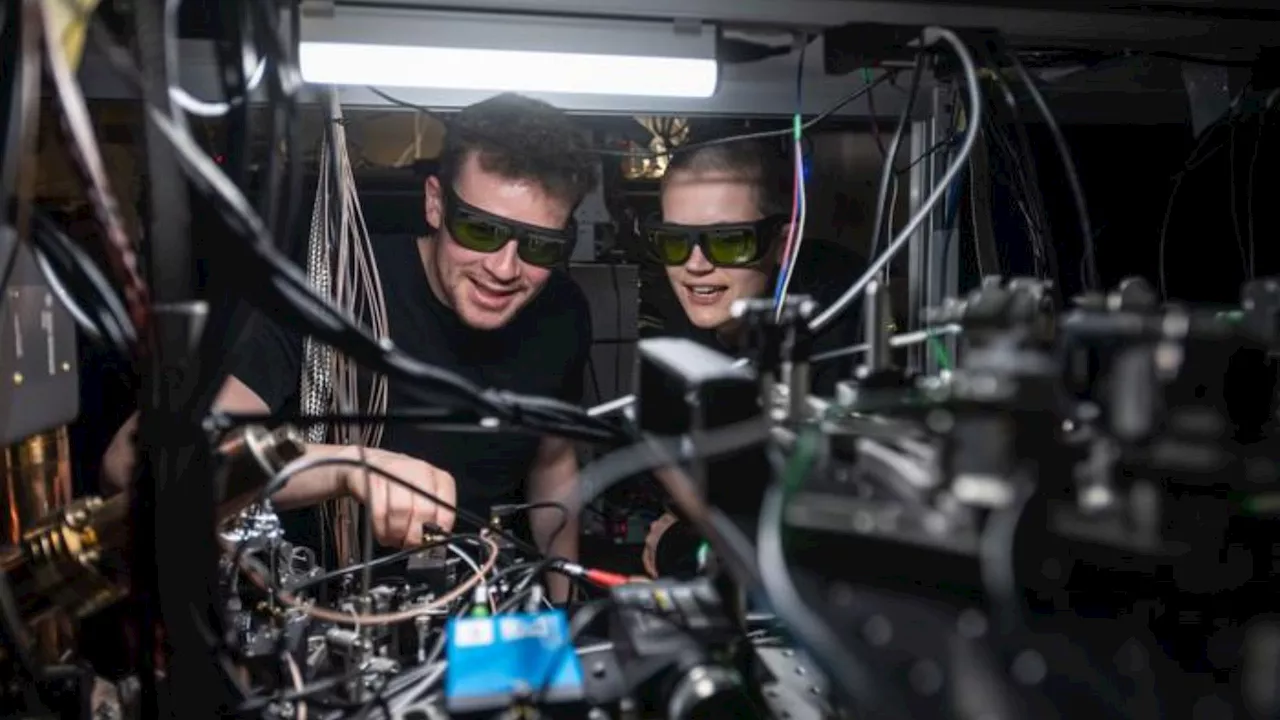 Oxford Researchers Achieve Quantum Teleportation of Logical Gates, Paving the Way for Scalable Quantum ComputingA team of researchers at Oxford University Physics has made a significant breakthrough in quantum computing by successfully demonstrating the first-ever quantum teleportation of logical gates. This achievement paves the way for building larger, more powerful quantum computers and overcomes the scalability challenges that have long hindered their progress.
Read more »
 Quantum Leap: Scientists Achieve Distributed Quantum ComputingScientists at Oxford University Physics have successfully connected two separate quantum processors using a photonic network interface, creating the first distributed quantum computer. This breakthrough paves the way for tackling complex computational challenges and addresses the scalability issue in quantum computing.
Read more »
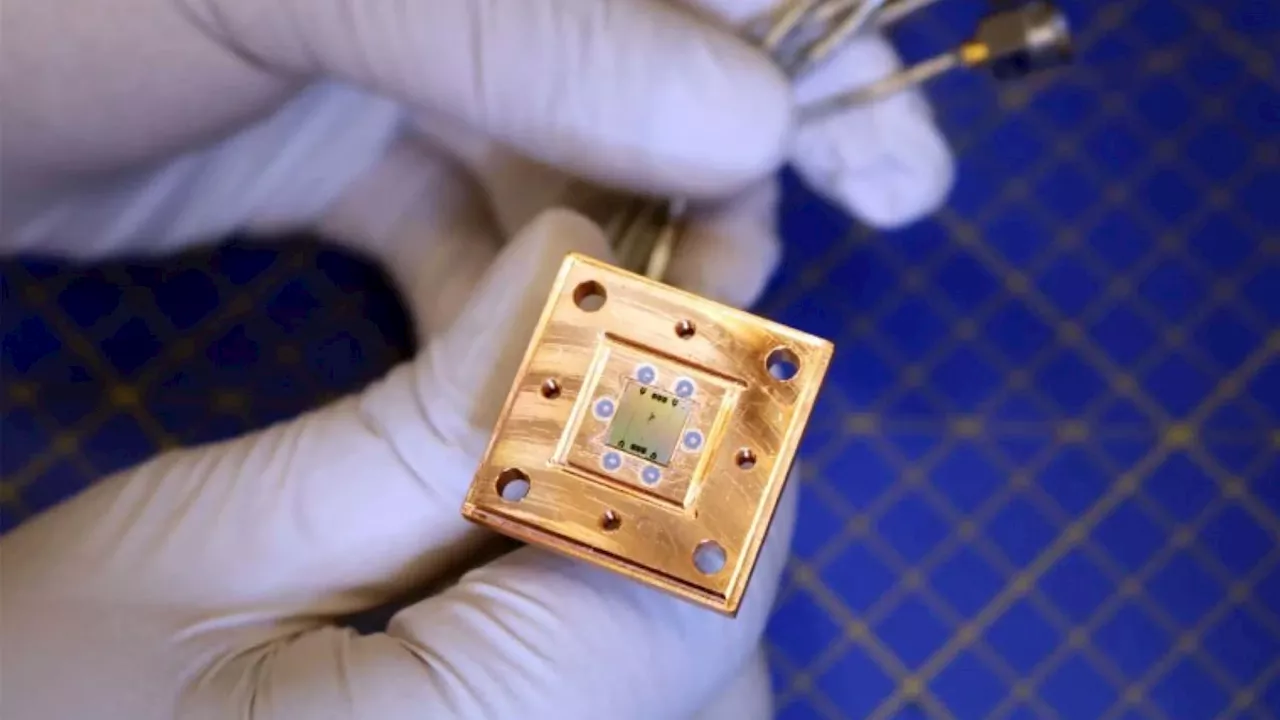 Autonomous Quantum Refrigerator Achieves Record-Low Temperature, Boosting Quantum Computer PerformanceScientists have developed a new type of autonomous quantum refrigerator that can cool qubits to a record-low temperature of 22 millikelvin. This breakthrough could significantly improve the performance and reliability of quantum computers by reducing errors caused by environmental disturbances.
Read more »
 Quantum Teleportation Achieves Milestone in Distributing Quantum ModulesResearchers at Oxford University successfully teleport quantum states between computers, proving the feasibility of distributing quantum modules without performance loss. This breakthrough paves the way for scaling quantum technology and building larger, more powerful quantum computers.
Read more »
 Exploring Quantum Computing: Texas' Potential in the Quantum EraThe Texas Tribune hosts a panel discussion with leading quantum computing experts to explore the potential of this transformative technology and its implications for Texas' future.
Read more »