
In quantum mechanics, skyrmions can appear as stable, wave-like structures that help protect quantum information.
A key challenge in developing stable quantum systems is protecting quantum information from environmental disturbances. It is also one of the biggest hurdles in achieving and maintaining unique quantum states such as entanglement.
Quantum entanglement is observed when two or more particles are able to communicate and influence each other regardless of the distance between them. Einstein referred to this concept as “spooky action at a distance.”However, despite being such a powerful quantum property, entanglement is also highly sensitive to environmental disturbances. Any unwanted noise resulting from stray particles, light rays, or other sources can break the entanglement — but now there’s a way to prevent it.A new study from researchers at the University of the Witwatersrand , Johannesburg, sheds light on a method that promises to keep quantum information even in a fragile state of entanglement.Harnessing the power of topologyThe Wits team proposes that encoding quantum information using topological structures, specifically quantum skyrmions, can enhance resilience against environmental noise. A skyrmion is a stable, swirling pattern that appears in fields like magnetism and quantum physics. It’s a stable topological structure, meaning its shape is preserved even if you try to deform it slightly, making it robust against noise and disturbances.Imagine a small whirlpool in a pond. No matter how the water moves around it, the whirlpool remains intact unless you completely disrupt it. A skyrmion behaves similarly in a magnetic or quantum field. It’s a twist in the system that resists being erased by small disturbances.In quantum mechanics, skyrmions can appear as stable, wave-like structures that help protect quantum information. In their study, the researchers theoretically demonstrated that engineering quantum states with specific topological properties allows them to protect quantum information even when particle entanglement begins to fail“We show that quantum skyrmions and their nonlocal topological observables remain resilient to noise even as typical entanglement witnesses and measures of the state decay,” the study authors note.“We complement our experiments with a full theoretical treatment that unlocks the quantum mechanisms behind the topological behavior, explaining why the topology leads to robustness,” they added.Stability is essential for operating big quantum networksThis isn’t the first time scientists have discovered an approach to secure quantum information in fragile quantum states. For instance, we previously reported on a technique called correction code switching that uses special protocols to preserve the stability of quantum systems.However, most previous methods are either tricky to implement or focus on keeping the quantum state intact. They don’t provide a method to keep information secure even when chaos has spread across the system. This is where topological features such as skyrmions can make a big difference. “What we’ve found is that topology is a powerful resource for information encoding in the presence of noise,” Andrew Forbes, one of the researchers and a professor at Wits School of Physics, said. The study authors believe that their approach could play an important role in the development of highly robust global quantum networks and quantum computers capable of overcoming noise in any environment. “It can be especially valuable in creating advanced medical imaging technologies and more powerful artificial intelligence systems harnessing entanglement,” Forbes added.The study is published in the journal Nature Communications.
Quantum Entanglement Quantum Mechanics
United States Latest News, United States Headlines
Similar News:You can also read news stories similar to this one that we have collected from other news sources.
 Microsoft and Purdue Researchers Achieve Breakthrough in Topological Quantum Computing MeasurementA team of Microsoft and Purdue University researchers has made significant progress in measuring the state of quantum devices, a key step towards realizing topological quantum computers. The research, published in Nature, focuses on a device crucial for this type of quantum computing, which promises greater robustness and power compared to existing technologies.
Read more »
 Breakthrough in high-sensitivity quantum sensors with diamond heteroepitaxyHeteroepitaxial growth technology has made it possible to create larger diamond substrates, opening new opportunities for industrial-scale production of diamond quantum sensors.
Read more »
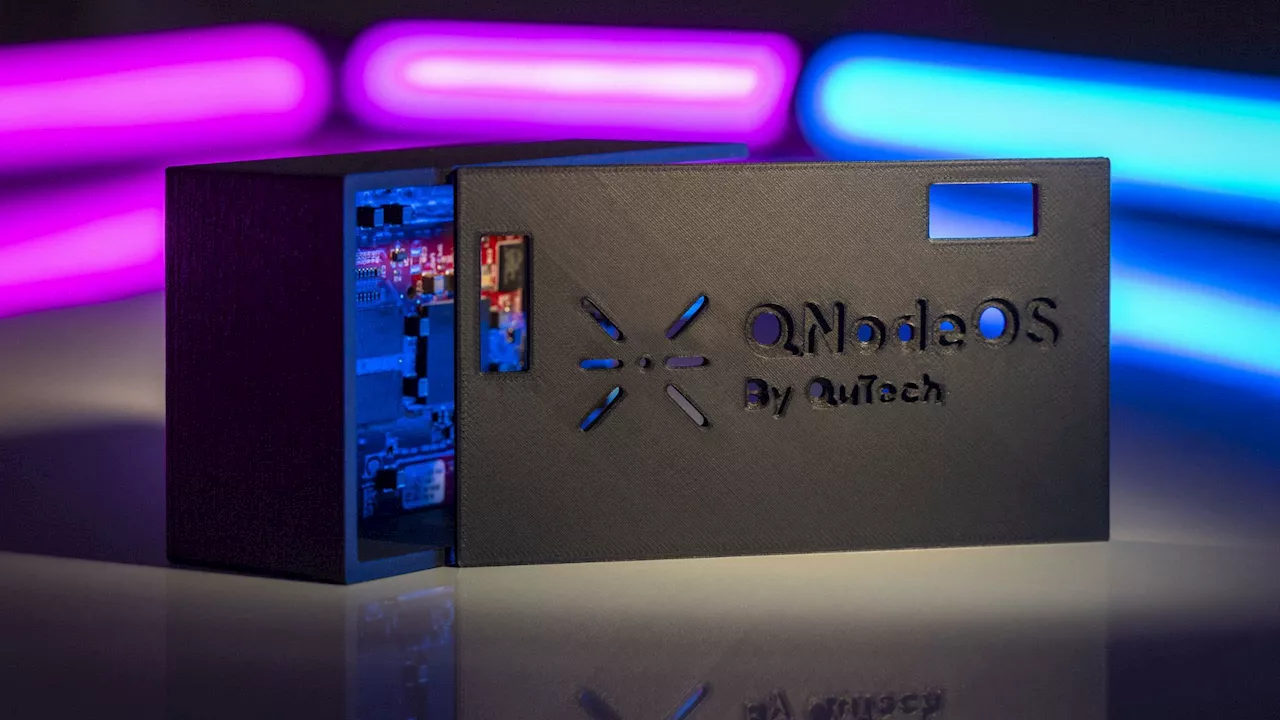 World’s first operating system for quantum network unveiled in internet breakthroughResearchers develop QNodeOS, the first operating system for quantum networks, bridging hardware and software gaps.
Read more »
 Are D-Wave’s Claims of ‘Quantum Advantage’ Just ‘Quantum Hype’?D-Wave’s fresh claim that it has achieved “quantum advantage” has sparked criticism of the company—and of the scientific process itself
Read more »
 US engineers create quantum ‘super highway’ for instant processor communicationUS researchers have built a breakthrough quantum interconnect allowing direct, high-speed communication between quantum processors.
Read more »
 Quantum Computing Is Dead. Long Live Quantum Computing!Schrödinger’s cat is alive and dead at the same time. Ironically enough, so is quantum computing.
Read more »