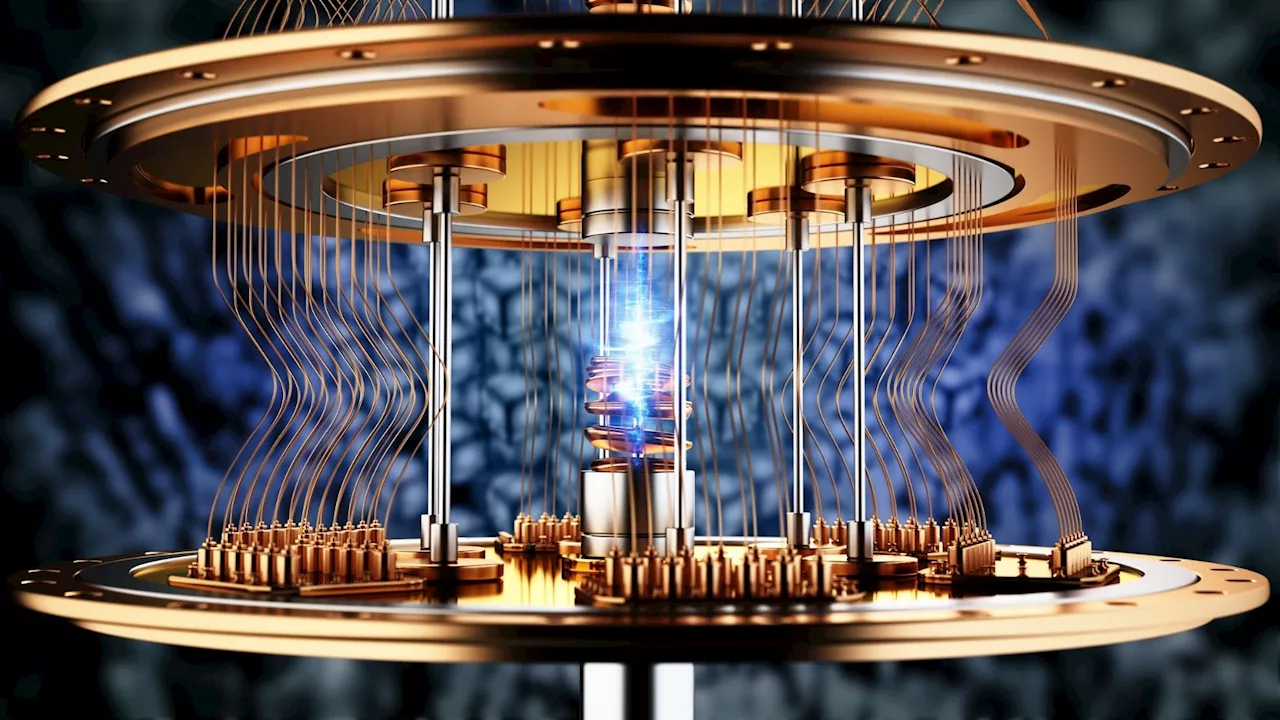
US researchers have built a breakthrough quantum interconnect allowing direct, high-speed communication between quantum processors.
Quantum computers are expected to solve problems far beyond the reach of today’s most advanced supercomputers. For these machines to work on a large scale, their individual processors need to communicate with each other quickly and accurately.
Right now, most methods of connecting quantum processors rely on “point-to-point” links, where information passes step by step from one processor to the next. However, this approach can lead to errors as the data moves along the network.To solve this problem, researchers at MIT have now developed an innovative interconnect device that allows for “all-to-all” communication between quantum processors. This system makes it possible for every processor in a quantum network to talk directly to one another, greatly improving scalability and efficiency. A new way of processor communicationThe MIT team created a device that connects two quantum processors using a superconducting waveguide — a special type of wire that carries photons, which are tiny particles of light used to transmit quantum information. Each processor contains four qubits, which are the fundamental units of quantum computing.Some of these qubits are designed to send and receive photons along the waveguide, while others store data. By using microwave pulses, the researchers energize a qubit so it releases a photon. Through careful control of these pulses, they can direct the photon along the waveguide in a chosen direction, where it can be caught and absorbed by a second processor.This setup successfully demonstrated remote entanglement — a unique quantum phenomenon where two processors become linked, even though they are not physically connected. Entanglement is key to allowing processors to work together as if they were side by side, no matter the physical distance between them.Overcoming challenges in photon transferFor this system to work effectively, the photon needs to be absorbed successfully when it reaches the receiving processor. However, imperfections in the waveguide, such as wire joints and connections, can distort the photon during its travel. This makes it difficult for the photon to be absorbed at the other end.“The challenge in this work was shaping the photon appropriately so we could maximize the absorption efficiency,” explains Aziza Almanakly, an electrical engineering and computer science graduate student and lead author of the paper.To tackle this, the team used reinforcement learning, a type of artificial intelligence, to optimize the shape of the photon before it was sent. This adjustment significantly improved the photon’s absorption rate, reaching over 60% efficiency.Potential for larger quantum networksWith this advancement, researchers are closer to building larger, more reliable quantum computing systems. “Pitching and catching photons enables us to create a ‘quantum interconnect’ between nonlocal quantum processors, and with quantum interconnects comes remote entanglement,” says William D. Oliver, senior author of the study.Looking forward, the team hopes to enhance their design by arranging components in three dimensions or making the travel path shorter to reduce potential errors. “In principle, our remote entanglement generation protocol can also be expanded to other kinds of quantum computers and bigger quantum internet systems,” Almanakly adds.The study was published in the journal Nature Physics.
MIT Research Quantum Breakthrough Quantum Communication Quantum Computing Quantum Network Remote Entanglement
United States Latest News, United States Headlines
Similar News:You can also read news stories similar to this one that we have collected from other news sources.
 Dragon Ball Super’s New Chapter Just Fixed Super Hero in the Best Possible WayGoten and Trunks in their Saiyaman costumes in front of the original, Gohan.
Read more »
 Why Didn't Goku Ever Use Super Saiyan 4 in Dragon Ball Super?Dragon Ball Super's latest episode revealed Goku's long-hidden Super Saiyan 4 form, sparking debate among fans about its place in the timeline and why Goku never used it before. This article explores several instances throughout Dragon Ball Super where Super Saiyan 4 could have been a game-changer, highlighting both the missed opportunities and the strategic reasons behind Goku's decision to hold back.
Read more »
 Dragon Ball Super: Super Hero - A Return to FormDragon Ball Super: Super Hero, released during the franchise's 40th anniversary, sees Goku and his friends venturing into the Demon World. Thrust into childhood, they face challenges and ultimately defeat the villainous King Gomah. The anime concludes with Majin Kuu ascending as the new Demon King, promising a change in the Demon World's landscape.
Read more »
 The Unseen Hand: How Takashi Kojima Elevated Dragon Ball Super: Super Hero's Post-Credits SceneDive into the art of animation and discover how Takashi Kojima's brilliance brought the post-credits scene of Dragon Ball Super: Super Hero to life.
Read more »
 Takashi Kojima's Masterful Animation Elevates Dragon Ball Super: Super Hero's Post-Credits SceneThe post-credits scene of Dragon Ball Super: Super Hero, lauded for its humor and stunning animation, is the work of renowned animator Takashi Kojima. His distinct style, known for its expressive character acting and attention to detail, elevates the scene to a memorable masterpiece.
Read more »
 New Dragon Ball Super Art Settles Debate Over Broly’s Newest Super Saiyan FormDragon Ball Super has dropped some new art confirming Broly's look in his new controlled SSJ state
Read more »