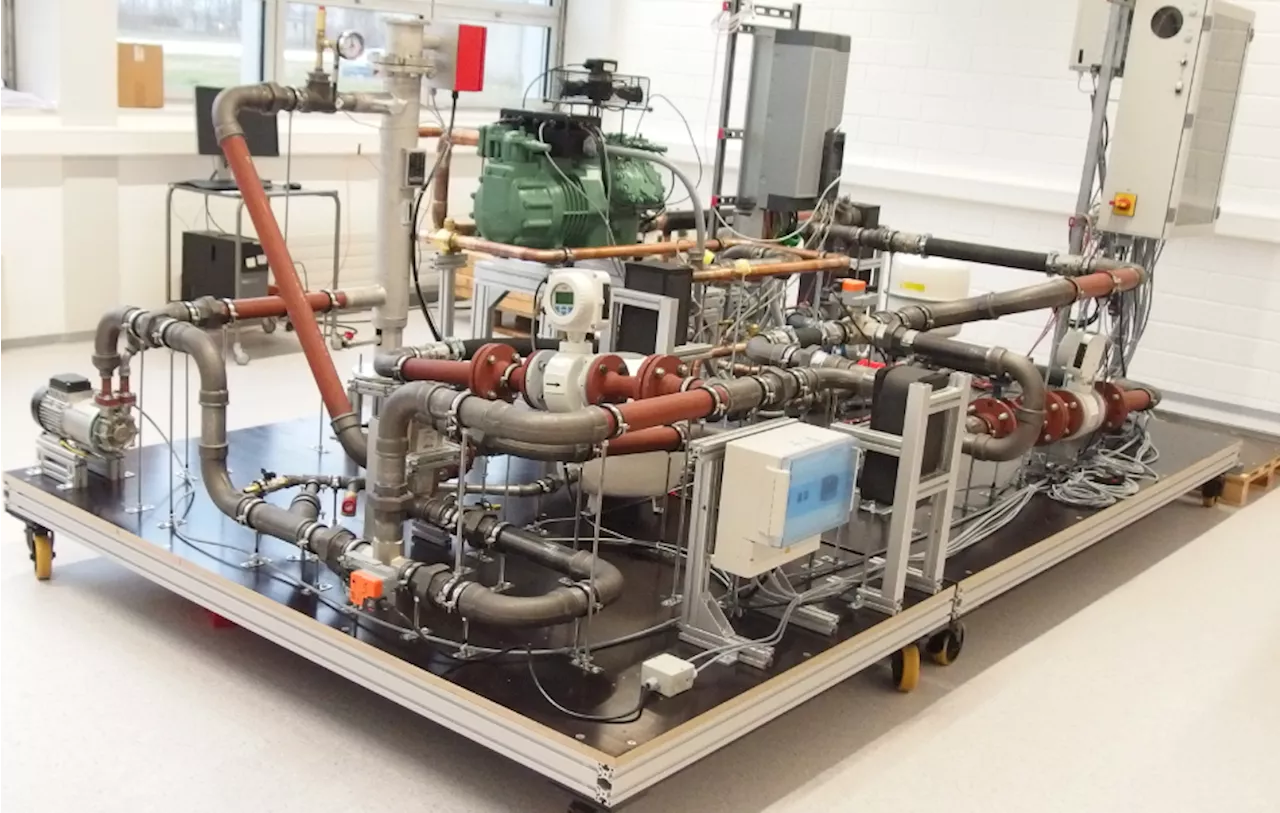
A new industrial heat pump design from ETH Zurich promises to be more flexible and more energy efficient as well.
Process heat is essential to the manufacturing of many products. Some heat is needed to cook food and pasteurize milk. Higher temperatures are needed to dry the paint on automobiles or make conventional lithium batteries.
Today, about 95% ofcomes from burning fossil fuels and accounts for 8% of global carbon emissions. A heat pump is capable of supplying heat for manufacturing up to 200º C , so why not use heat pumps to supply process heat for industrial and commercial applications?, one of the world’s preeminent research institutions, in a conventional heat pump, the achievable temperature and temperature profiles are largely determined by the choice of refrigerant. All the heat pump components — from the evaporator and compressor to the condenser and expansion valve — are tailored to the characteristics of the refrigerant used. If a factory requires heat at different temperatures for multiple applications, this can only be achieved by using multiple heat pumps, each with a different refrigerant. This is both costly and inconvenient, which is why using a heat pump has made little headway in the industrial sector. André Bardow, Professor of Energy and Process Systems Engineering at ETH Zurich, believes his team has come up with a better solution: “Instead of a single refrigerant, we use a blend. This allows a heat pump to use different heat sources and generate different temperature profiles.” The composition of the refrigerant blend can be varied to cater to different applications. This is a key benefit for companies. Instead of having to redesign the entire heat pump whenever they need a different temperature, they can simply modify the mixture, which is much simpler and cheaper. The mixture itself consists of a traditional refrigerant and one further component. The temperature profile of the heat pump is dictated by the ratio of these two ingredients. “In principle, you can have any number of different profiles for industrial processes, as long as the temperatures don’t exceed 200 degrees. That’s the major advantage our technology offers,” Bardow says.To identify suitable components for the refrigerant blend, the researchers developed a computer model that simulates the heat pump circuit with different variants of refrigerant mixture. “We extended the existing thermodynamic models for heat pumps by integrating the heat pump components as well as the composition of the mixture into the optimization process,” says Dennis Roskosch, senior scientist in the research group headed by André Bardow. The researchers’ model analyzed over 200 million known synthetic molecules to simulate a blend of two molecules that offers the most efficient heat pump performance. Once the researchers found the optimum refrigerant blend, they confirmed its properties in the heat pump laboratory at the Eastern Switzerland University of Applied Sciences. “The tests showed that our mixture increases the efficiency of a commercially available industrial heat pump by up to 25 percent, just as we predicted,” says Professor Stefan Bertsch, who heads up the heat pump laboratory. The researchers were also able to demonstrate how different compositions of the refrigerant mixture affect the temperature profile. The team now hopes to provide even more concrete examples of how their technology could benefit specific industrial applications. The new heat pump is likely to be of particular interest in the food, pharmaceutical and chemical industries, where numerous processes require temperatures of less than 200 degrees. At the same time, the researchers are working closely with heat pump manufacturers such as MAN Energy Solutions, Scheco AG, and with Swiss industry partners such as Lindt. The next step is to plan and build a pilot plant to carry out further tests. Switzerland has a goal of reducing its greenhouse gas emissions to net zero by 2050, which will require a fossil fuel-free energy supply based on renewable and sustainable energy sources. With its Energy Science Center, ETH Zurich is supporting the energy transition in Switzerland with specific solutions in the areas of research, teaching and knowledge transfer.The watchword for climate sustainability going forward is efficiency. Traditional means of creating heat through combustion waste somewhere between half andcontained in fossil fuels. “Today’s fossil energy system is incredibly inefficient,” says RMI. “Almost two thirds of all primary energy is wasted in energy production and transportation use before fossil fuel has done any work or produced any benefit. That means over $4.6 trillion per year — almost 5% of global GDP and 40% of what we spend on energy — goes up in smoke due to fossil inefficiency.” Today’s energy system is incredibly inefficient, RMI points out. We waste almost 400 exajoules of all the energy going into our energy system. A joule is a unit of energy equal to the work done when a force of one newton acts through a distance of one meter. It is also a unit of electrical energy equal to the work done when a current of one ampere is passed through a resistance of one ohm for one second. Pretty small stuff, in other words. An exajoule, on the other hand is big stuff. It represents 10 joules to the 18th power. Another way to put it is that one exajoule is equal to 277,778 gigawatt-hours of electricity. In 2019, humans extracted energy equivalent to 606 exajoules , but only about 200 EJ was put to productive use. The rest — around 400 EJ — was wasted, mostly as heat. Waste heat is no small thing. Researchers at the University of New South Wales in Australia postulate that humans have released heat equivalent toa day worth of wasted heat. One would think that any sentient being would understand that continuing to do that is simply unsustainable.A heat pump — not to put too fine a point on it — also uses energy, but is about 50% more efficient. Translation — the same amount of heating or cooling for half as much energy used. Who wouldn’t take that deal? The new technology from ETH Zurich is 25% more efficient than a conventional industrial heat pump. The news about finding ways to use the energy we have as efficiently as possible just gets better and better.Steve writes about the interface between technology and sustainability from his home in Florida or anywhere else The Force may lead him. He is proud to be"woke" and doesn't really give a damn why the glass broke. He believes passionately in what Socrates said 3000 years ago:"The secret to change is to focus all of your energy not on fighting the old but on building the new." You can follow him on Substack and LinkedIn but not on Fakebook or any social media platforms controlled by narcissistic yahoos.
United States Latest News, United States Headlines
Similar News:You can also read news stories similar to this one that we have collected from other news sources.
 Assistant Professor (Tenure Track) of Biomolecular Engineering for Health - Zurich, Switzerland job with ETH ZurichThe Department of Biosystems Science and Engineering (D-BSSE) (www.bsse.ethz.ch) at ETH Zurich invites applications for the above-mentioned position.
Read more »
 The Hunt for the Most Efficient Heat Pump in the WorldA new generation of engineers has realized they can push heat pumps to the limit, but just how much heat you can extract depends on your setup.
Read more »
 100-year-old house displays record-breaking heat pump, one of UK’s bestRob Ritchie, a retired chemist, proudly claims his heat pump ranks second on HeatPumpMonitor.org, emphasizing its great efficiency in the UK.
Read more »
 Philadelphia heat: Tips to avoid heat-related illness as dangerous heat lingersThe dangerous heat in the Delaware Valley is being blamed for at least one death and as the heat wears on, it really takes a toll on everyone's bodies.
Read more »
 Deep Red State Catches Electric Heat Pump Fever, BiglyIn another sign that the electrification trend is widening and deepening, the new Scout EV factory will deploy new heat pump technology.
Read more »
 Dogecoin Sees Epic 90% Pump in Volume as DOGE ETF Talks Heat UpDogecoin's trading volume skyrockets 90% overnight amid DOGE ETF rumors
Read more »