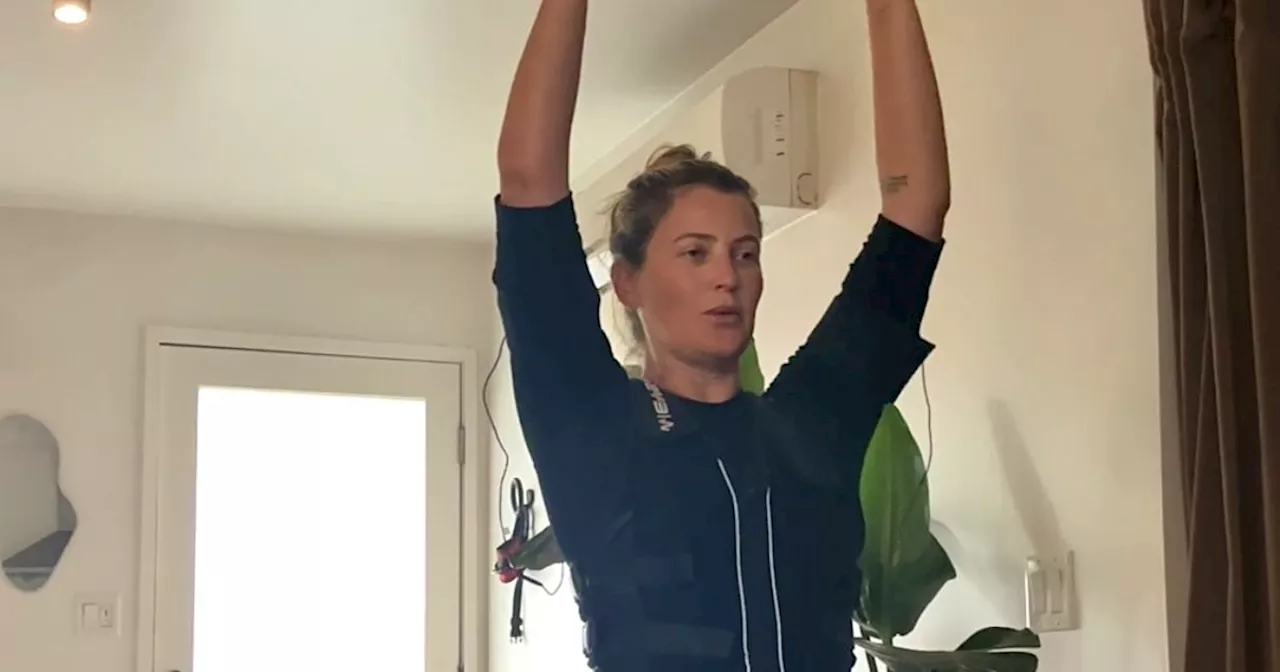
One PS editor tried electrical muscle stimulation, or EMS, training for a month and documented her experience. Here's her honest take on the experience.
But looking back, I can honestly say I've never been totally blown away by an experience. I've enjoyed plenty of workouts, of course, and I've had varying degrees ofdepending on the style and the intensity, but they've all been relatively predictable and I've always been pretty sure of what the actual class was going to be like.
. Not so with EMS, or electrical muscle stimulation, is exactly what it sounds like: extra stimulation of your muscles to make your workouts more effective. The technology was originally used in physical therapy to help build back muscle strength after an injury or atrophy. Now, the EMS suits— literally a full-body suit full of electrodes that you wear while exercising — are being used to enhance workout.is equivalent to two hours in the gym."There is no other workout where you can focus on your arms, but simultaneously also have every other large muscle group working and completely activated," saysin Los Angeles."EMS contracts up to 90 percent of muscle fibers and can help your body do up to 85 contractions per second."and try the EMS workout for myself. Over the course of a month, I did eight 20-minute sessions . Keep reading to learn about my EMS experience and my results.EMS delivers electrical impulses to targeted muscle groups, stimulating the deep muscle fibers which are often hard to engage during regular exercise. According to Herrin, pairing these muscle contractions with movement makes for a very efficient workout, usually in just 20 minutes. EMS is meant to target almost all of the major muscle groups in your body: inner thighs, hamstrings, abs, low back, mid-back, shoulders, chest, glutes, and arms. You can also turn off specific areas of the suit to just focus on the muscle groups you want to target."With EMS, you're working your whole body for the entirety of the 20-minute session," says Herrin. Because the EMS suit is bypassing your brain and contracting your muscles for you, you have no other option but to keep your muscles fully engaged for the entire workout, she adds.While most of the existing research behind EMS is generally positive, many of the studies were done on small groups — there isn't much high-quality, large-scale research out there. Meaning, more evidence is needed before we can say for sure how effective it is or what the long-term risks are.found that people who did a six-week squat program using EMS had greater strength improvements over those who didn't use EMS; anothershowed that the set of women who did low-intensity resistance exercises three times a week for six weeks using the EMS suit had a significantly more improved body circumference and cardiovascular function than those who didn't use EMS. Other recent studies have shown that EMS has positive effects onLet me preface this by saying that I mostly do yoga, with the occasional barre or Pilates class thrown in. I don't do a ton of cardio or weight lifting, and I had knee surgery in my 20s so I don't do any HIIT training. I'm pretty fit, but not all that used to weight training — and EMS definitely humbled me. With The Studio EMS, a trainer came to my house for each session. Most EMS trainers do in-home visits, but you may be able to find a gym that also offers the program. In order for the electrodes on the suit to activate, you have to wear activewear made from either cotton or tencel — other fabrics can disrupt the electronic stimulation. I got myBefore actually getting into the suit, it has to be pretty thoroughly drenched in water, which acts as a conductor from the electrodes to the muscles for a consistent electrical flow. So yes, you're going to be wet during the workout, but it's honestly not all that noticeable since you immediately begin sweating .Once your suit is wet, your trainer will strap you in. Be prepared for the suit to be tight — I'm talking corset-level tight. The tighter the better, actually, so that the electrodes don't go sliding around and stay on top of their designated muscle groups. It does tend to loosen up during the workout, usually about halfway through, which Herrin says is because of a lymphatic flush due to increased blood flow.while my trainer slowly started to crank up the electricity on each muscle group; the stimulation contracted the muscles for five seconds, then released for five seconds. The suits used by The Studio EMS are wirelessly hooked up to an iPad that the trainer uses to control the impulses on each area. I would tell them when it was starting to feel spicy and then we'd move on to the next muscle group, increasing the intensity on each specific muscle group throughout the workout. The muscle contractions themselves aren't painful, just kind of strange and tingly. It feels like you're flexing your muscles as much as you can and holding them in that flex for five-second intervals. I'm one of those people who like to go as hard as possible while working out to get the best results possible, so I asked my trainer to keep punching up the intensity as much as I could tolerate throughout the 20 minutes. As far as the actual workouts, they were mostly low-intensity Pilates-style exercises: a lot of lunges with leg holds and twists,and leg-lift ab exercises, and low-weight arm reps. On the face of it, they were pretty simple but the EMS suit made everythingmore difficult. It felt like I was moving through molasses. Bicep curls with a three-pound weight suddenly felt like I was lifting a 20-pounder, and crunches — which I normally crush — left me totally winded. My trainer was very focused on linking breath with the movements and the stimulation intervals, as well as being really technical about my form.Honestly, about 15 minutes in I was about ready to call it, which was wild for me since I'm used to doing 60 to 90 minute classes with ease. Twenty minutes truly is all you want to do with the EMS suit on, and I was drenched in sweat and tired AF after each session. Two things to be aware of: One, you definitely have to get the hang of the feeling in your arms to make sure you're not locking out your elbows. If I fully extended my elbows while the electricity was contracting my muscles, my arms would essentially get stuck in the outstretched position. Not the most comfortable! Once I got it in my head that I always needed to keep a slight bend in my elbows when extending, I was totally fine. Second, if your suit isn't tight enough and the electrodes move onto your skin away from muscle, it kind of zaps you. If that starts to happen, you just need to tell your trainer to readjust the suit. For example, some of the electrodes are over your pecs; these kept scooting down onto the top of my boobs and not over my chest muscles. Since pecs weren't really an area I wanted to work out, we just decided to keep those electrodes inactive. Overall, it's a super challenging workout, but I felt really elated after each one. Herrin says this feeling is normal — and part of the reason why she loves the workout."During your session, you will experience a whole new sense of mind to muscle connection," she says. As far as recovery went, the days after my first EMS session were the most intense. My hamstrings and inner thighs, which are always tight, were on fire and my arms felt like wet noodles. I took the two days after my EMS workout off just to stretch and go to a slow-flow hot yoga class, which helped loosen me up."Since the suit is stimulating 90 percent of your muscle fibers, your body will be working overtime to repair the muscles throughout the next two days," says Herrin. Thankfully, I never had such a difficult recovery time after that first session — it kind of felt like my body was saying,"WTF did you just put me through?!" and then was more prepared each time. I typically did my workouts every three or so days, with mostly yoga on the days in between. Each session felt more and more natural, and I could feel myself getting stronger during each session. Herrin recommends drinking a lot of water and taking it easy the following day by doing light cardio, gentle yoga, a brisk walk, sauna, or stretching."You'll be sore, so don't push it!" she says."We always tell people to feel it out after your first couple sessions. Some people feel the most sore they have ever been, and others get used to it more quickly. Herrin notes that, like most workouts, your diet and lifestyle play a big part in seeing results, so EMS workouts alone won't transform your fitness level.After a month of training, what is most apparent is how strong I feel. I'm able to do things in my regular yoga classes that were once more of a challenge with ease. I feel this in my ability to do advanced arm balances in particular, which use arm, shoulder, and core strength. I also feel like my stamina has improved — I'm able to hold poses for longer, do higher-intensity classes, and go all out for longer before my muscles burn out. In terms of how I look, my arms are definitely more defined and my stomach muscles feel as hard as a rock. I don't believe I've lost any weight, however that wasn't really my goal. I wanted to feel stronger, challenge myself, and build more lean muscle, all of which I feel like I accomplished.If you're pregnant, have a pacemaker or defibrillator, or have any metal in your body , you shouldn't do EMS. Otherwise, pretty much anyone can train using the suit."Pretty much if you're cleared to workout, you're cleared for EMS," says Herrin."We have suits for every sized body.". However, this is super rare and can be caused by any other intense strength training regimen or going too hard on your regular workout.about shocks, burns, and blisters with these devices. To make sure this doesn't happen, make sure you're going to a reputable trainer with an EMS certification, and steer clear of buying one of the suits to use on your own. The FDA has also only clearedEMS workouts are admittedly on the expensive side, mostly because the suits and tech itself is expensive. A single in-home session with The Studio EMS, for example, is $165. That being said, EMS should really be thought of as a complement to your normal workout; one to two-sessions per week is all you really need. If you're OK with spending that much, I'd say EMS is absolutely worth it if you want to feel the strongest you've ever felt. I personally will be adding EMS sessions into my normal workout routine.is the director of branded content for Vox Media and oversees lifestyle content across the portfolio of brands. She manages a team of editors who write articles in the wellness, fitness, beauty, fashion, health, entertaining, pets, and finance categories. She is also a beauty and fitness enthusiast and contributes many articles to the POPSUGAR editorial site.
Aviel Kanter Fitness Workouts Full-Body Workouts 30-Minute Workouts Personal Essay Editor Experiments
United States Latest News, United States Headlines
Similar News:You can also read news stories similar to this one that we have collected from other news sources.
Houston Rockets to Hold Training Camp in New Training FacilityFor the first time in a long time, the Houston Rockets will hold their training camp in Houston, Texas. This year it will be at their new training facility.
Read more »
 Houston Rockets New Training Center Ready for October Training CampThe Rockets recently unveiled a new training center that will serve as the team's home during their upcoming training camp dates.
Read more »
 Hawley: Lead Advance Agent at Trump PA Rally ‘Failed One or More Training Exams’Source of breaking news and analysis, insightful commentary and original reporting, curated and written specifically for the new generation of independent and conservative thinkers.
Read more »
 'Transformers One' review: An origin story no one wantsMovie origin stories finally reach their nadir this week with “Transformers One,” the super-violent, toy-selling vehicle that tells the tale of how Optimus Prime and Megatron went from besties to foes, Associated Press critic Mark Kennedy says.
Read more »
Navigating Training to Failure Safely in Strength TrainingSafe strategies for training to failure in strength training
Read more »
 Of All the Marathon-Training Mistakes You Could Make, Avoid This OneIn this episode of The Amazing Runner’s World Show, Jeff and Aly discuss a recent article on the 7 marathon training mistakes that coaches see athletes make. Our favorite: Running your easy days too fast. We explain why.
Read more »