
Chinese researchers have developed the BHMbot-B, a 15 mm long microrobot capable of quick forward and backward movements. The robot switches between motions using vibration mode transition control and is equipped with a battery, control circuit, and electromagnetic actuators, allowing it to perform tasks in confined spaces with accuracy and agility.
Chinese researchers have created the BHMbot-B, a 15 mm long microrobot with quick forward and backward movements, which is ideal for navigating small places. The robot effectively switches between forward and backward movement by aligning the vibratory motions of its magnet, cantilever, and linkages using vibration mode transition control.
The Beihnag University team claims that the device combines a battery, a control circuit for wireless operation, and two electromagnetic actuators for a high load capacity. According to researchers, with forward and backward speeds of 18.0 body lengths per second and 16.9 BL/s , respectively, the BHMbot-B demonstrates its ability to maneuver through challenging settings with accuracy and agility.Large machines struggle to navigate confined spaces for tasks like inspections or unclogging without risking structural damage. Microrobots have emerged as a solution, offering fast speeds and precise turning. However, in tight tunnels where turning is impossible, they face challenges if they encounter dead ends. Unlike insects that instinctively retreat when blocked, most microrobots lack the ability to move backward effectively, a critical skill for navigating unknown, narrow environments. Previous designs, like the HAMR robot, demonstrated forward and backward movement using multiple actuators, but such systems are complex and difficult to miniaturize for untethered operations. Images show BHMbot’s structure, actuation mechanism, and bouncing motion during its running cycle with high-speed visuals. According to researchers, backward motion can be enabled by manually adjusting microrobot structures, such as tilting legs or flipping bodies. However, remote control is not practicable. One of the biggest challenges is still finding compact, effective solutions for real-time direction changes.Insects instinctively retreat when facing obstacles in tight spaces, a behavior mimicked by the BHMbot-B, which is designed to move forward and backward without turning.operates using an electromagnetic actuator, cantilever, and four-bar linkage system. The cantilever moves when alternating current is applied to a coil, which causes the magnet to oscillate. The robot may move forward or backward by swinging its forelegs in different directions while the motion switches between first-order and second-order vibration modes.travel in the same direction, a forward friction force is created as the forelegs hit the ground, causing forward movement. Conversely, in the second-order mode, the magnet and cantilever move oppositely, causing the forelegs to surpass their equilibrium position briefly and generate backward friction.analysis confirms the distinct gaits for both movements, demonstrating precise kinematics. The design enables efficient recovery from dead ends in confined environments.With speed tuned close to cantilever resonant frequencies, the BHMbot-B microrobot reaches remarkable running speeds of 38.7 BL/s forward at 163 Hz and 44 BL/s backward at 680 Hz. Because of the efficient foreleg-ground contact during travel, backward speeds are higher than forward ones. The team highlights that the robot’s hind legs were designed with tiny rollers to minimize friction and increase load-bearing capability for untethered operation. It can transport loads up to 32 times its mass, including a 5.18-g metal column, while maintaining 3.2 BL/s speed and supporting more than five times its body weight. Because of its design, BHMbot-B is positioned as a top microrobot for agility and payload efficiency in tight locations. The BHMbot-B microrobot demonstrates adaptability across surfaces like glass, sand, and curved tubes. It moves forward and backward untethered, carrying loads such as a battery, gyroscope, or micro camera. These enable real-time data transmission and imaging in confined spaces. According to the team, future research will focus on adding environmental sensing and autonomous navigation, enhancing its utility in challenging environments.Jijo is an automotive and business journalist based in India. Armed with a BA in History from St. Stephen's College, Delhi University, and a PG diploma in Journalism from the Indian Institute of Mass Communication, Delhi, he has worked for news agencies, national newspapers, and automotive magazines. In his spare time, he likes to go off-roading, engage in political discourse, travel, and teach languages.
Microrobot Bhmbot-B Chinese Researchers Navigation Confined Spaces
United States Latest News, United States Headlines
Similar News:You can also read news stories similar to this one that we have collected from other news sources.
 Researchers develop artificial plants that purify indoor air, generate electricityScientists are repurposing their research about bacteria-powered biobatteries into a new idea for artificial plants that can feed off carbon dioxide, give off oxygen and even generate a little power.
Read more »
 Researchers develop low-cost system to detect wildfires within seconds of ignitionThe researchers have developed FireLoc, an affordable, crowdsourced mobile phone network that detects wildfires within seconds.
Read more »
 Researchers develop robotic sensory cilia that monitor internal biomarkers to detect and assess airway diseasesMechanical engineers have developed a system of artificial cilia capable of monitoring mucus conditions in human airways to better detect infection, airway obstruction, or the severity of diseases like Cystic Fibrosis (CF), Chronic Obstructive Pulmonary Diseases (COPD) and lung cancer.
Read more »
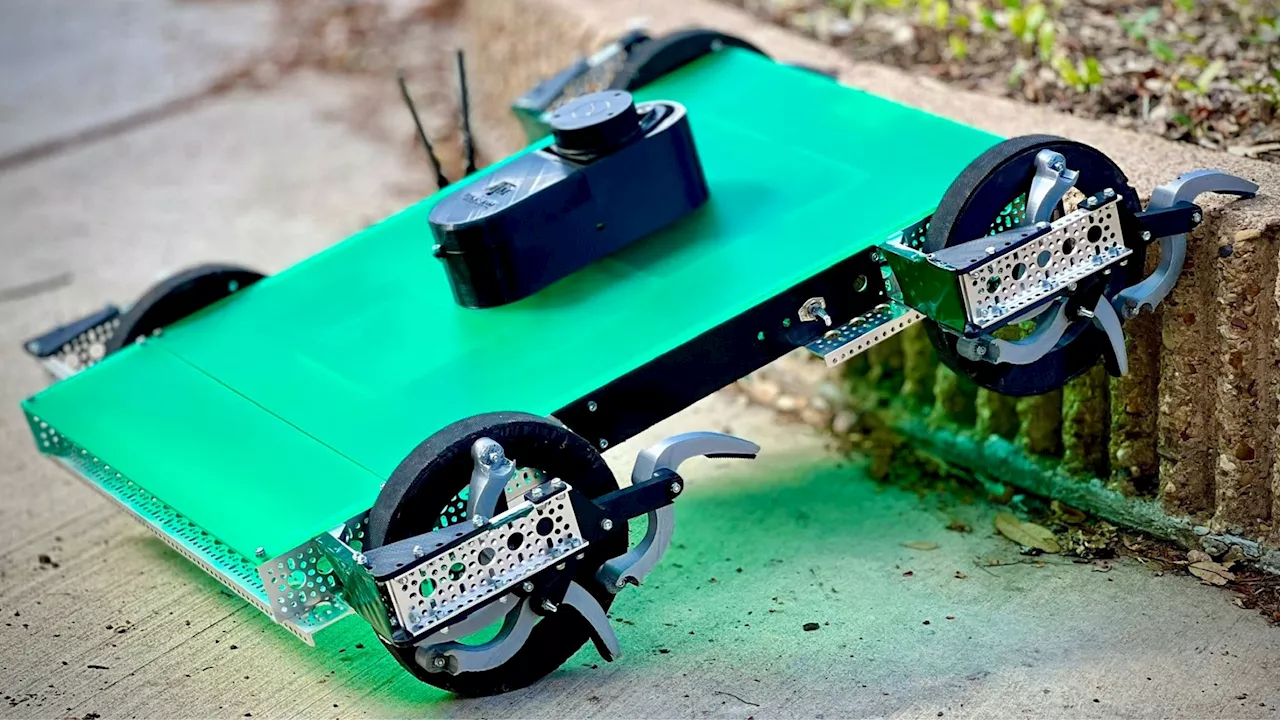 US researchers develop all-terrain robot with cycloidal wheels for any weatherResearchers at Texas A&M University have unveiled CLAW, a cycloidal-wheel robot designed to navigate diverse terrains and weather conditions.
Read more »
 Researchers develop nanofiber patch for treatment of psoriasisResearchers have developed a patch for easier and more effective treatment of psoriasis. The method may also be used in treatment of other inflammatory skin diseases.
Read more »
 Researchers develop minimally invasive neural interface in revolutionary studyA team of researchers has developed a technique for diagnosing, managing and treating neurological disorders with minimal surgical risks.
Read more »