
Invasive plant species can be an expensive problem for farmers, stealing vital nutrients away from crops.
Invasive plants can be found just about anywhere in the world. They can endanger the environment by directly competing with native plants for vital moisture, sunlight and space.New research from the University of California, Davis, shows that some invasive species could be lying dormant, going unnoticed until they suddenly spread.
Mohsen Mesgaran, an assistant professor in the Department of Plant Sciences at UC Davis, has developed formulas that help predict the potential emergence of these invasive species 'time bombs.''We should be very concerned about this,' Mesgaran said.Invasive plant species can be an expensive problem for farmers, stealing vital nutrients away from important crops.'The best-known impact in agriculture is reducing the production and ultimately affecting the food security, so the price of food,' Mesgaran said.With the help of computer modeling, scientists like Mesgaran can predict the potential emergence of one of these 'time bombs.''Like what you do with a weather forecast, you say, 'Tomorrow it's going to be raining.' I can tell you, tomorrow you’re going to have 10 weeds coming out of your field,' Mesgaran said.Plant scientists make these forecasts by analyzing variables like soil condition, air temperature and moisture and lining them up with the timing of a specific plant species emergence.In a recent publication, Mesgaran and his co-authors analyzed more than 5,700 species of invasive plants around the world. They found that some were dormant for decades to centuries.'It’s a problem because you ignore them. You think they’re going to always stay dormant but it’s just a matter of time,' Mesgaran said. 'The sooner you get on a problem and eradicate them or control them, it’s better. It’s way cheaper than when are exploding and they’re everywhere.'Other research shows that human-caused climate change is expected to have an impact on where and when certain invasive weeds could take off. Increasing amounts of carbon in the atmosphere are leading to rising temperatures in some regions. Those temperature changes could be enough to tip off an invasive species 'time bomb.'Mesgaran says model predictions can help the agriculture industry get ahead of invasive plants. Currently, preventative planning is not a common practice for invasive species in the United States.
UC Davis Invasive Plants Time Bombs Mmnd
United States Latest News, United States Headlines
Similar News:You can also read news stories similar to this one that we have collected from other news sources.
 New minimally-invasive bunionectomy challenges traditional methods for painless reliefBunions are small bony bumps on toes that cause tremendous pain. Surgery is the solution, but a traditional method is being challenged by a newer procedure.
Read more »
 Continuous non-invasive glucose sensing on the horizon with the development of a new optical sensorFor decades, people with diabetes have relied on finger pricks to withdraw blood or adhesive microneedles to measure and manage their glucose levels. In addition to being painful, these methods can cause itching, inflammation and infection.
Read more »
 New technique for predicting protein dynamics may prove big breakthrough for drug discoveryUnderstanding the structure of proteins is critical for demystifying their functions and developing drugs that target them. To that end, a team of researchers at Brown University has developed a way of using machine learning to rapidly predict multiple protein configurations to advance understanding of protein dynamics and functions.
Read more »
 New technique for predicting protein dynamics may prove big breakthrough for drug discoveryUnderstanding the structure of proteins is critical for demystifying their functions and developing drugs that target them. To that end, a team of researchers has developed a way of using machine learning to rapidly predict multiple protein configurations to advance understanding of protein dynamics and functions.
Read more »
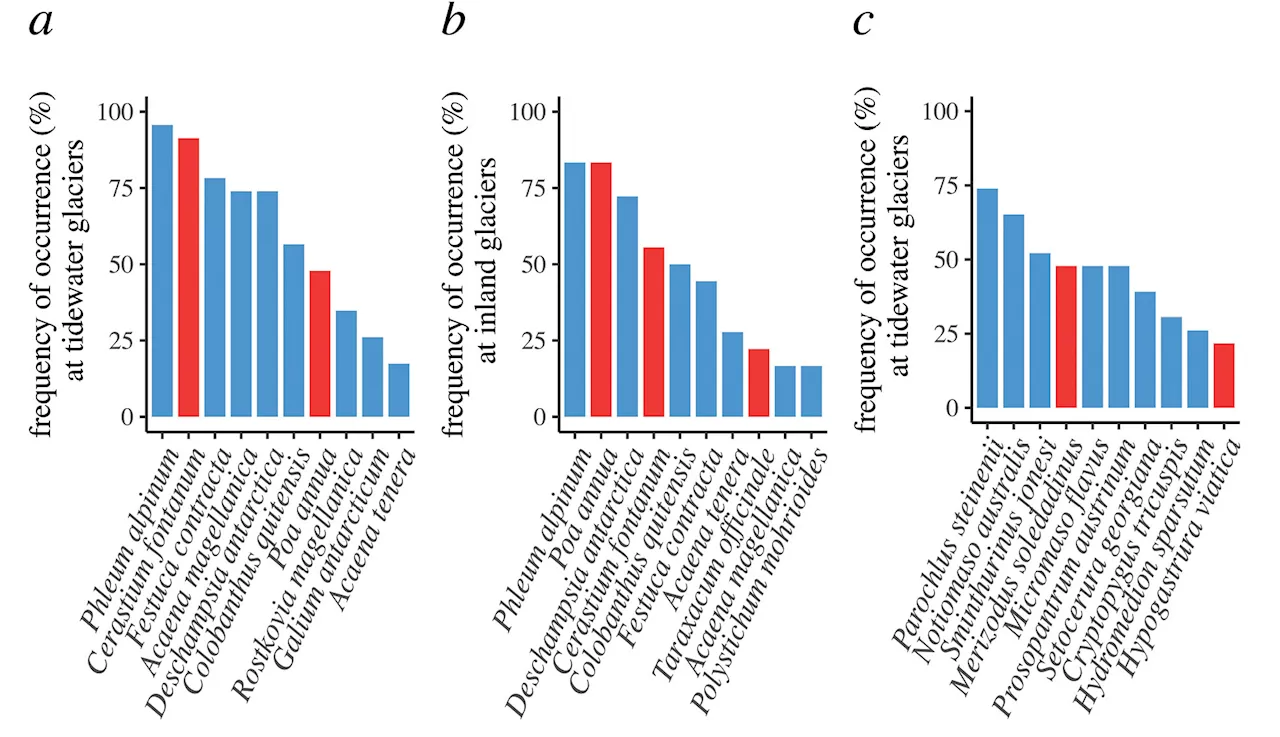 Melting glaciers in a warmer climate provide new ground for invasive speciesInvasive species have rapidly colonized new ground exposed by melting glaciers in the sub-Antarctic island of South Georgia, according to new research.
Read more »
 Invasive Species Rapidly Colonize New Ground in South Georgia, Study FindsBiologists report that invasive species have rapidly colonized new ground exposed by melting glaciers in South Georgia, leaving few pristine areas for native species. Further research is needed to understand the impacts of invasive species on fragile ecosystems after glacier melting.
Read more »