
A research team at Syracuse University has introduced a new concept for designing ultra-thin absorbers with a record-high bandwidth-to-thickness ratio, potentially several times greater than that of conventional absorbers.
A research team at Syracuse University has made a groundbreaking discovery in the field of electromagnetic absorption, introducing a novel concept for designing ultra-thin absorbers. These absorbers have the potential to achieve a record-high bandwidth-to-thickness ratio, exceeding the capabilities of conventional approaches by several times.
The advancement in absorber design holds immense promise for various industries, including defense, energy harvesting, and advanced communication systems.Absorbers play a crucial role in numerous technologies, from energy harvesting and stealth systems to communication networks. They efficiently capture electromagnetic waves across broad frequency ranges, enabling the development of sustainable, self-powered devices like remote sensors and the Internet of Things (IoT) systems. In addition, they are vital for stealth technology, minimizing radar visibility and enhancing the performance of aircraft and naval systems. They also contribute to improving communication networks by reducing stray signals and mitigating electromagnetic interference, making them essential in our increasingly interconnected world.Traditionally, the bandwidth-to-thickness ratio of metal-backed, passive, linear, and time-invariant absorbing layers has been limited by a theoretical upper bound. Prior absorbers, regardless of their operational frequency range or material thickness, have fallen short of this theoretical limit, unable to fully exploit the potential of passive, linear, and time-invariant systems. However, Professor Younes Ra'di and his research team have overcome this limitation with their innovative approach, published in Nature Communications. By utilizing this concept, they designed and experimentally verified an absorber that achieves an exceptionally high bandwidth-to-thickness ratio, bringing us closer to the ultimate theoretical bound
ULTRA-THIN ABSORBERS ELECTROMAGNETIC ABSORPTION BANDWIDTH-TO-THICKNESS RATIO ENERGY HARVESTING STEALTH TECHNOLOGY COMMUNICATION NETWORKS
United States Latest News, United States Headlines
Similar News:You can also read news stories similar to this one that we have collected from other news sources.
 Engineering researchers develop deep-UV microLED display chips for maskless photolithographyIn a breakthrough set to revolutionize the semiconductor industry, engineers have developed the world's first-of-its-kind deep-ultraviolet (UVC) microLED display array for lithography machines.
Read more »
 South Korean Researchers Develop Self-Extinguishing, Explosion-Proof Solid-State BatteryDGIST researchers have created a groundbreaking solid polymer electrolyte battery with enhanced safety features and longer lifespan.
Read more »
 Aalto University Researchers Develop a More Efficient and Environmentally Friendly Infrared PhotodiodeA team of researchers at Aalto University in Finland has developed a new type of infrared photodiode that is 35 percent more sensitive than other currently used germanium-based applications. This breakthrough offers a more sustainable and efficient alternative to the commonly used InGaAs material, which is toxic and not CMOS compatible.
Read more »
 Chinese Researchers Develop Perovskite Solar Cells with Enhanced Efficiency and StabilityChinese scientists have made a breakthrough in perovskite solar cell technology by developing a new type of cell that boasts higher efficiency and improved stability. The key innovation lies in the use of a hole-selective interlayer that effectively inhibits ion diffusion, a major cause of instability in traditional perovskite solar cells.
Read more »
 Japanese Researchers Develop Non-Flammable Quasi-Solid-State Lithium-Ion BatteryA Japanese research team has created a quasi-solid-state lithium-ion battery that is non-flammable, overcoming the drawbacks of traditional batteries. The innovation combines liquid and solid electrolytes to enhance safety and durability.
Read more »
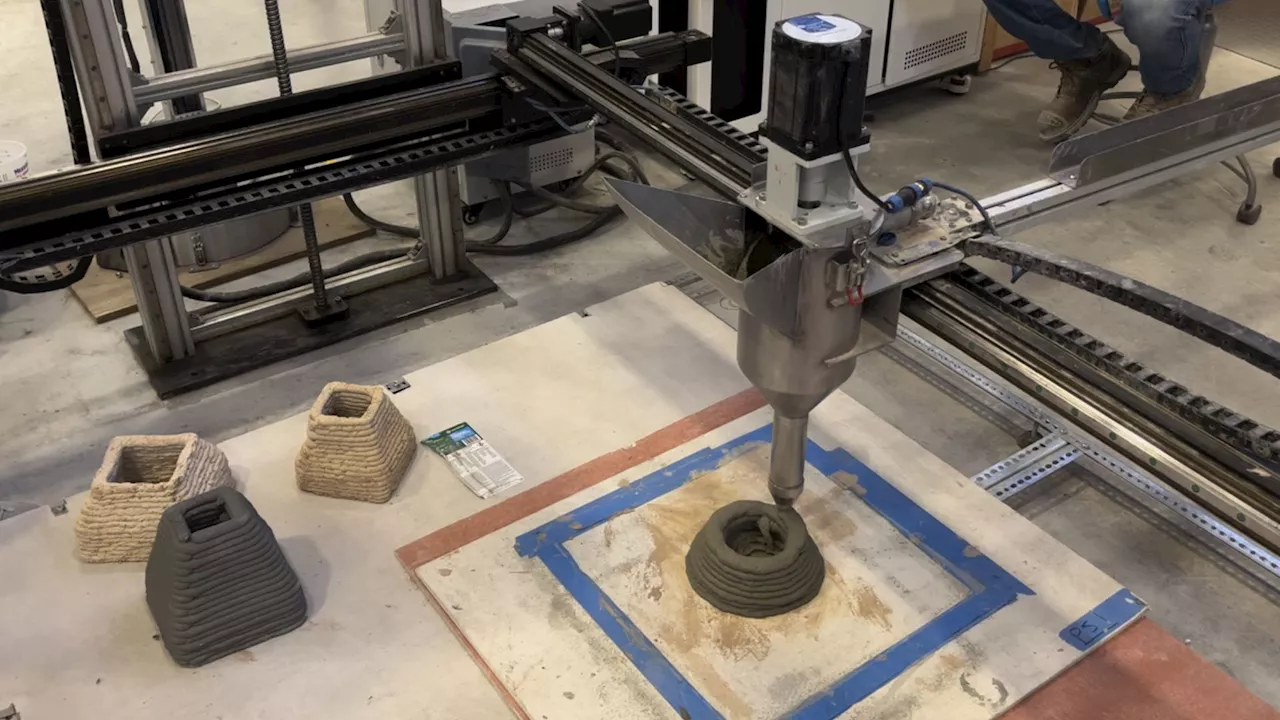 UNM Researchers Develop Bendable Concrete for 3D PrintingThe University of New Mexico researchers have invented a bendable concrete material designed for 3D printing, potentially revolutionizing construction and infrastructure maintenance. This self-reinforced ultra-ductile cementitious material offers enhanced flexibility and strength, addressing the brittleness of traditional concrete. The patented technology could lead to safer, more resilient buildings and bridges, requiring less frequent repairs.
Read more »