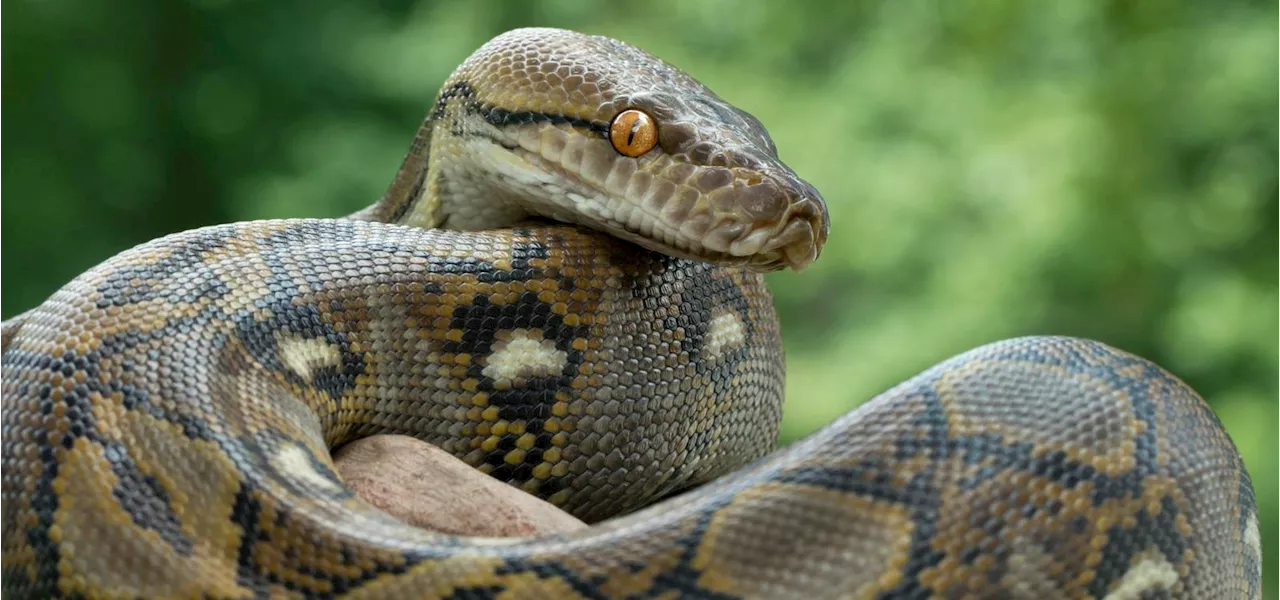
I am an American evolutionary biologist, based at Rutgers University, where I specialize in biodiversity, evolution, and genomics. Drop me a note, here. Thanks for your readership and support.
There are hundreds of deadly snakes in the world, but only a few that actually want to eat you—andBased on a series of interviews with the Agta Negritos–a hunter-gatherer group of the Philippines who are among the island chain’s oldest inhabitants –the researchers report that reticulated python s had attacked 26% of the 58 male tribesmen they spoke with, as well as one woman.
The gender discrepancy is likely based on the fact that men of the Agta Negritos are responsible for going into the jungle to hunt for game and edible plants. “Usually those people attacked had sustained bites that left scars on the lower limbs, hands, and torso, and they had escaped by dispatching snakes with a bolo knife or homemade shotgun,” report the authors. However, six fatalities were reported. In one case, a man named Dinsiweg was killed in Dinapgigi, a jungle region on the east coast of Luzon. The man’s son, Sinayatan, found the snake the next day and cut it open to recover and bury the body. Another fatal incident involved a reticulated python sneaking into a thatched dwelling at sunset and killing two children.Robert Plant Alison Krauss Offer Up Magical Evening On Stage Outside ChicagoWhile deaths are rare, reticulated pythons in the Phillippines have no reservations about hunting and killing humans, as well as other primates. The researchers describe the relationship between the Agta people and the reticulated python as “reciprocally prey, predators and potential competitors.” “We show that 20th century hunter-gatherers had intense, complex interactions with giant serpents,” state the authors. “The threat of being killed by a python must have significantly influenced the lives of precontact Agta, and because they learned during butchering that those snakes also eat deer, pigs, and macaques, they would have accurately regarded pythons as ecological competitors.” Reticulated pythons aren’t the only snake species capable of hunting and killing primates, even humans. Here are two other giant snakes known to have hunted people.) is a formidable constrictor snake native to sub-Saharan Africa. Among the largest snake species in the world, African pythons can grow to lengths exceeding 20 feet. They possess a distinctive pattern of brown blotches outlined by lighter scales, providing effective camouflage in their natural habitat. Preferring diverse environments including grasslands, savannas, forests, and even semi-desert regions, African pythons are highly adaptable predators, preying on a variety of animals including mammals, birds, and reptiles.on the Ivory Coast of West Africa. In the book, he described an incident in the town of Butre in which an African python was killed and the whole body of a human was found inside the massive snake.), which inhabits the dense jungles and swamps of South America. With the ability to reach lengths exceeding 20 feet and weights of over 200 pounds, the green anaconda holds the title of the world's heaviest snake. Known for their olive-green coloration with distinctive black spots, anacondas are expert ambush predators, utilizing their incredible strength and formidable constriction to overpower prey that ranges from small mammals to large caimans. Secondhand accounts of giant anacondas consuming full-grown humans can be found in Ralph Blomberg’s 1956 book “Giant Snake Hunt.” He writes, “We also hear gross exaggerations about how dangerous the anaconda is. Despite intensive research, I have only been able to find two definite cases of anacondas causing the death of human beings. One man was killed on the Napo River in Ecuador, when he went for a swim and was entwined by one of these snakes. He struggled in vain to get away but was drawn underwater and carried off.” John Murphy, author of a 2020 chapter on Giant Snake-Human Relationships, sums up the relationship between serpent-eating men and man-eating serpents succinctly: “During much, if not all, of human history, we were sympatric with several of the most massive snakes, and these animals undoubtedly were selection factors in our evolution. They preyed upon us, we killed and ate them, and they were one of our competitors for much of the same protein.”Our community is about connecting people through open and thoughtful conversations. We want our readers to share their views and exchange ideas and facts in a safe space.Insults, profanity, incoherent, obscene or inflammatory language or threats of any kindContinuous attempts to re-post comments that have been previously moderated/rejectedAttempts or tactics that put the site security at riskProtect your community.
Deadly Predators Human Prey Primate Predators Constrictor Snakes Wildlife Encounters Anaconda Attacks Reticulated Python Primate Hunting Snakes Dangerous Reptiles
United States Latest News, United States Headlines
Similar News:You can also read news stories similar to this one that we have collected from other news sources.
 Half Naked Florida Man Drives Camry Into Jail, Attacks Cops With Rubber Snakes And Motor OilThe 40-year-old homeless man is now facing four charges of aggravated assault on a law enforcement officer
Read more »
 Meet 4 Deadly-Venomous ‘Krait’ Snakes—One Is Brand New To ScienceI am an American evolutionary biologist, based at Rutgers University, where I specialize in biodiversity, evolution, and genomics. Drop me a note, here. Thanks for your readership and support.
Read more »
 Oh, My Hopes For The Ballad Of Songbirds & Snakes 2 Just Took A Major HitLucy Gray Baird playing a song in Ballad of Songbirds and Snakes
Read more »
 Stepping on snakes for science, and crows that count out loudOn this week’s show: A roundup of online news stories featuring animals, and researchers get crows to “count” to four
Read more »
 Can the Bears shake off a stunning Game 6 loss and put away Cleveland’s comeback kids tonight?Hershey and Cleveland meet in Game 7 of the Eastern Conference Finals at Giant Center.
Read more »
 To Meet Or Not To Meet: That Is The QuestionI’m a Boston Consulting Group managing director and partner, founder of BCG’s Behavioral Science Lab, and leader of our network of behavioral scientists. I serve as a member of the BCG Change Management leadership team.
Read more »