
Powered by solar cells and optical signals, new autonomous smartlets fold into cubes, sense stimuli, and coordinate in aquatic environments.
In a step toward intelligent robotic collectives, scientists at Chemnitz University of Technology have built a new generation of autonomous microrobots. These “smartlets,” each just a millimeter wide, can communicate, respond to light, and coordinate with one another in water.
Researchers at the university’s Research Center for Materials, Architectures and Integration of Nanomembranes developed the devices using flexible, origami-inspired materials. The smartlets fold themselves into tiny hollow cubes, giving each unit interior and exterior functions. That surface area supports solar cells, onboard processors, and optical signaling systems.Unlike earlier microrobots that required bulky external controls, these smartlets carry integrated photovoltaic cells and silicon microchips. Each unit also includes micro-LEDs and photodiodes for optical communication.“For the first time, we demonstrate a self-contained microrobotic platform that not only senses and moves in water but also interacts with other microrobots in a fully programmable and autonomous manner,” said Prof. Oliver G. Schmidt, Scientific Director of MAIN and co-author of the study.The cubes propel themselves with bubble-generating engines that create buoyancy forces. In water, they rise and sink as needed. They can also send out pulses of light to broadcast instructions to nearby smartlets, enabling synchronized movements and group responses.Powered and linked by lightOne breakthrough lies in using light for both power and communication. “The idea of using light as both energy and information opens up a compact and scalable way to create distributed robotic systems,” said Dr. Vineeth Bandari, research group leader at MAIN and co-corresponding author.The robots rely on a “wireless communication loop” that removes the need for external magnets, antennas, or cameras.Each smartlet interprets signals with logic programmed on its microchip. Engineers attached these microscopic silicon chiplets, called lablets, using soft bonding to the origami layers.This system allows decentralized control and lays the foundation for robotic colonies that adapt and collaborate. Prof. John McCaskill, another co-author, stressed the significance of distributed intelligence.“We’re still far from creating artificial life,” he said, “but we are starting to see how distributed intelligence and modular hardware can build systems that begin to mirror the adaptive, communicative behaviors of living collectives.”Future applicationsBecause the devices are untethered and biocompatible, the team sees potential uses in medicine and environmental monitoring. They could one day assist in water quality checks, minimally invasive diagnostics, or probing confined biological systems.The researchers also envision applications in soft robotics and distributed sensing networks. “We’re exploring ways to further increase autonomy by adding chemical and acoustic sensing modules,” said Dr. Yeji Lee, whose Ph.D. work advanced the project. “These smartlets could evolve into multifunctional platforms that sense, act, and adapt in complex fluidic environments.”The team imagines future colonies resembling digital organisms, where specialized units handle sensing, moving, or communication. Much like zooids in colonial marine animals, the coordinated smartlets could achieve behaviors impossible for single units.By integrating power, logic, and communication into such small systems, the Chemnitz researchers have created a foundation for robotic collectives that may one day self-organize inside droplets, tissues, or miniature ecosystems.The study is published in the journal Science Robotics.
Bubble Engines Chemnitz University Of Technology Microrobots Nanomembranes Optical Communication Origami Robotics Smartlets Solar-Powered Robots
United States Latest News, United States Headlines
Similar News:You can also read news stories similar to this one that we have collected from other news sources.
 Solar-powered ambush drones can wait for targets like land minesRussian ambush drones have been seen in Ukraine fitted with cheap solar panels, which enable them to lurk indefinitely, waiting for a target to come near
Read more »
 Missionaries Are Targeting Isolated Tribes in Brazil With Solar-Powered Audio Devices, Investigation FindsThe device is called 'Messenger' and recites biblical readings in multiple languages.
Read more »
 Solar Powered Moon Brick Factory Could Build Future Lunar CitiesImagine building an entire city on the Moon using nothing but sunlight and lunar soil! Chinese scientists have made this science fiction dream a reality by creating a revolutionary machine that acts like a solar powered 3D printer, melting lunar soil at temperatures exceeding 1,300°C to create strong construction bricks.
Read more »
 World’s first sound-powered microscope sees 5x deeper into brain without altering cellsA new microscope combines ultrafast light pulses with sound detection to map single-cell molecular activity far deeper than existing methods.
Read more »
 Solar-Powered Device Turns Moon Dirt Into Bricks, a Potential Breakthrough in Lunar ConstructionA new invention could make a sustained presence on the Moon more feasible.
Read more »
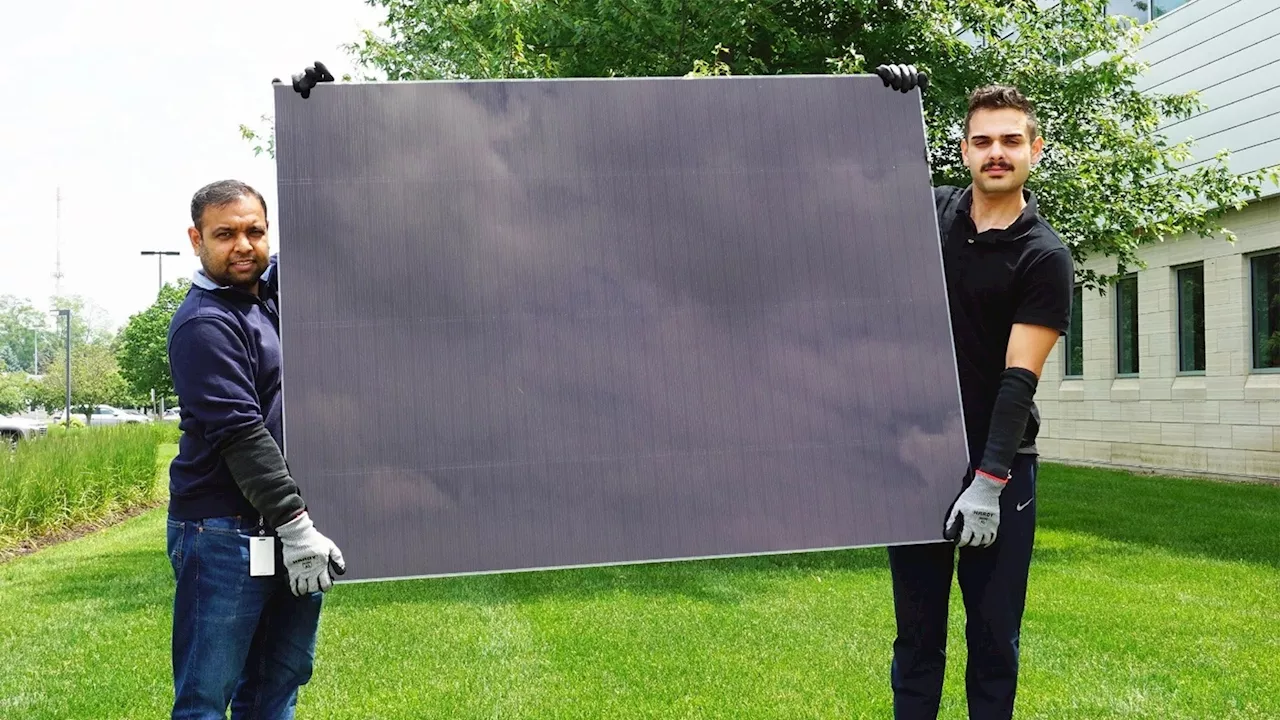 US tech firm unveils 20.7 sq ft solar hydrogen module powered by sunlight, waterUS green energy startup has showcased a 20.7 square foot reactor that produces hydrogen using only sunlight and water.
Read more »