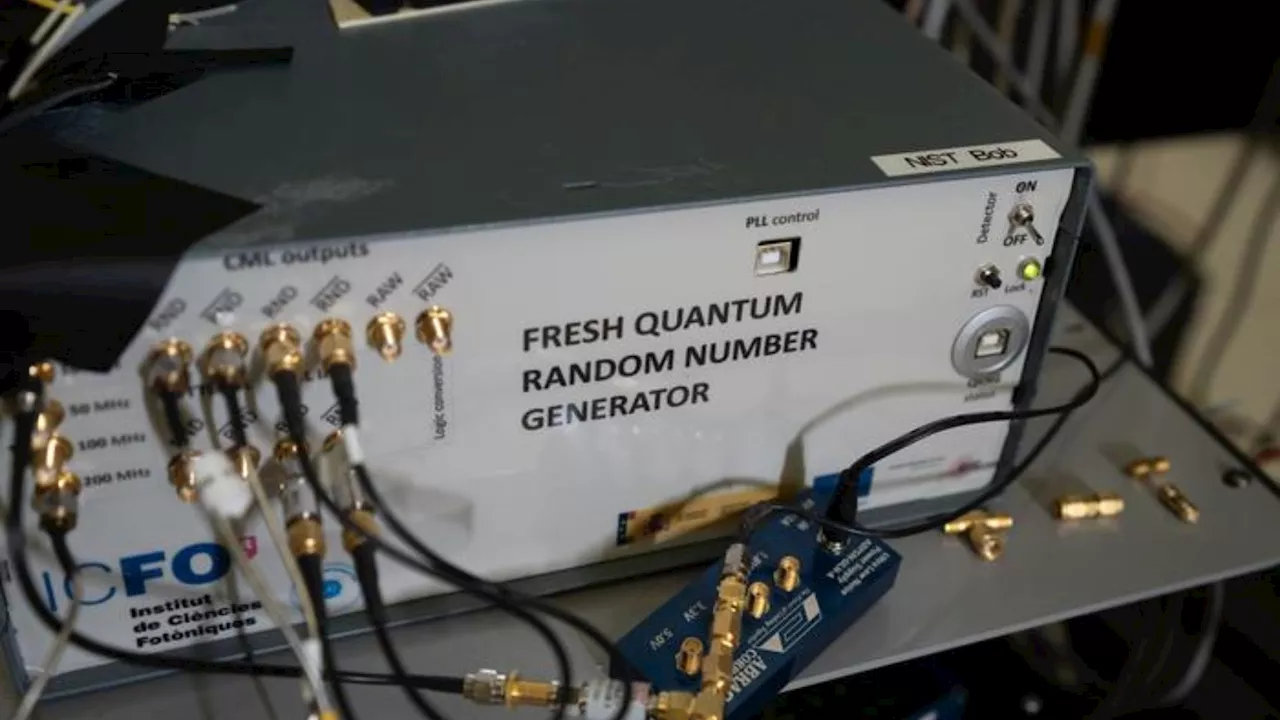
US researchers have developed a quantum-based random number generator whose output can be verified and certified.
Researchers at the National Institute of Standards and Technology and the University of Colorado Boulder have developed the world’s truest random number generator based on quantum mechanics.Dubbed Colorado University Randomness Beacon , the system automatically generates random numbers and broadcasts them through a website as a public service.
Picking a random item to fill a shopping cart or throwing a ball at a random person might seem like a crazy idea, but randomness is extremely necessary and useful. A random draw is used to pick a lottery winner or select a jury member for a trial. When used in a security password, random numbers increase its strength and make it more difficult to crack than when using a string of characters or numbers with a certain meaning or significance. These days, computer software programs generate random numbers or security passwords. But these aren’t truly generated at random. An algorithm determines the output, and a person with sufficient knowledge can predict the next output, too. Similarly, even the outcome of a random event, like a coin toss, can be influenced by someone with enough expertise. So, how does one generate truly random outcomes? The answer lies in quantum mechanics. Quantum-based random numbersEinstein was certain that nothing in the universe is random when he said, “God does not play dice with the universe.” Years of research in quantum physics have shown that the brilliant mind was wrong, and events in quantum mechanics are indeed random. NIST researchers generated entangled photons using a non-linear crystal in a quantum experiment called the Bell test. Using optical fibers, the photons were made to travel to separate labs. Although separated by physical distances, these photons have correlated properties, and their polarizations were measured, which are truly random. Since the particles are correlated, these measurements can be verified. NIST first performed these experiments 2015, requiring months of work to produce a small set of random numbers. Over the years, the researchers have made the system more robust and can now generate numbers on demand. In 40 days of operation, it has produced 7,454 random numbers, with a 99.7 percent success rate, a press release said. The process is repeated 250,000 times per second. Then, the outcomes are sent to a computer program at the University of Colorado Boulder to convert quantum measurements into binary bits. Traceable and certifiableThis is the first random number generator that uses quantum nonlocality to source its numbers. However, its significance is greater since the service also allows the results to be traceable and certified. To do so, NIST researchers developed a quantum-compatible blockchain system to verify the randomness of the Bell test. The Twine protocol creates a hash or a digital fingerprint for each data set that is generated and scrutinized. The protocol helps users verify the randomness of each number and incorporate other beacons to create a network of randomness verifiable with the hash. “CURBy is one of the first publicly available services that operates with a provable quantum advantage. That’s a big milestone for us,” said Krister Shalm, a physicist at the NIST, in the press release. “The quality and origin of these random bits can be directly certified in a way that conventional random number generators are unable to.”The research findings were published in the journal Nature.
Dice Einstein Inventions And Machines NIST Random Number Generator Random Numbers UCB Universe
United States Latest News, United States Headlines
Similar News:You can also read news stories similar to this one that we have collected from other news sources.
Dallas homebuilding firm sold for $1.2 billionDallas-based Landsea Homes was acquired by California-based New Home Co. for $1.2 billion.
Read more »
Cryptocurrencies Price Prediction: Bitcoin, Ripple & QuantBitcoin (BTC) price is edging below $102,000 at the time of writing on Thursday after repeated rejections at the $105,000 resistance over the past five days.
Read more »
Maker, Quant extend gains as Robinhood submits RWA proposal to the SECMaker (MKR) and Quant (QNT) are holding onto their 24-hour gains on Tuesday, riding the wave of renewed investor interest in real-world asset (RWA) tokens.
Read more »
BlockTrust IRA Brings Quant Trading Tools to Crypto Retirement AccountsBy leveraging trading signals from Animus Technologies, BlockTrust IRA promises to beat benchmark BTC and ETH positions.
Read more »
Cryptocurrencies Price Prediction: Dogecoin, PEPE & QuantDogecoin (DOGE) and Shiba Inu (SHIB) are down roughly 1% at press time on Tuesday.
Read more »
Inside the Paris-based $18 billion quant CFM's balancing actBusiness Insider tells the global tech, finance, stock market, media, economy, lifestyle, real estate, AI and innovative stories you want to know.
Read more »