
A new book examines Springsteen’s most impactful record, ‘Born in the U.S.A.,’ an oft-misunderstood masterpiece that foreshadowed the changing politics of America.
A new book examines Springsteen’s most impactful record, ‘Born in the U.S.A.,’ an oft-misunderstood masterpiece that foreshadowed the changing politics of America.tour progressed, its cultural significance shifted in the nation’s newspapers.
What started out as fodder for local music critics in 1984 eventually became an obsession for political columnists in ’85. The most infamous example of this change would affect how Bruce Springsteen and his most popular album were perceived for decades afterward.on September 13, 1984, and then syndicated to newspapers throughout the country, a column written by the paper’s most popular right-wing columnist made the case forrepresenting old-fashioned American values. Entitled “Bruce Springsteen’s U.S.A.,” the column recounts Pulitzer Prize–winner George F. Will’s experience at a Springsteen concert. Even while presenting himself as an unapologetic Poindexter—“I may be the only forty-three-year-old American so out of the swim that I do not even know what marijuana smoke smells like,” he admits—Will raves about the show, albeit for questionable reasons. “There is not a smidgen of androgyny in Springsteen,” Will writes, “who, rocketing around the stage in a T-shirt and headband, resembles Robert De Niro in the combat scenes of. This is rock for the United Steelworkers, accompanied by the opening barrage the battle of the Somme.” Later, he praises Springsteen as the embodiment of professional competency: “In an age of lackadaisical effort and slipshod products, anyone who does anything—anything legal—conspicuously well and with zest is a national asset. Springsteen’s tour is hard, honest work and evidence of the astonishing vitality of America’s regions and generations. They produce distinctive tones of voice that other regions and generations embrace.” Here’s the most notable part of Will’s column: “I have not got a clue about Springsteen’s politics, if any, but flags get waved at his concerts while he sings songs about hard times. He is no whiner, and the recitation of closed factories and other problems always seems punctuated by a grand, cheerful affirmation: ‘Born in the U.S.A.!’” This was the paragraph that caught the attention of Ronald Reagan’s reelection campaign. Six days after the column published, the president praised Bruce Springsteen during a speech in Hammonton, New Jersey. “America’s future,” Reagan declared, “rests in a thousand dreams inside your hearts. It rests in the message of hope in the songs of a man so many young Americans admire—New Jersey’s own, Bruce Springsteen.” It’s impossible to talk about the song “Born in the U.S.A.” without dwelling on how people like Reagan and Will misinterpreted it as a simpleminded, patriotic rallying cry. It’s such a part of the song’s lore that it now seems like Bruce was unintentionally trolling the sorts of people who sent the protagonist of “Born in the U.S.A.” off to war in the first place. I hope it goes without saying that I find the “patriotic” take on “Born in the U.S.A.” to be moronic. But I also believe that George F. Will’s shortcomings as a music critic are ultimately beside the point. What’s more meaningful in my view is that his interpretation of the song wasMonths before Will’s column, local music critics similarly positioned Springsteen as the “honest blue-collar” alternative to allegedly shallow pop-culture phenomena like The Jacksons’—the local paper of Motown, The Jacksons’ one-time artistic home—praised Springsteen for playing nearly three hours of “flat-out rock ’n’ roll without the hoopla and razzle-dazzle showmanship of the Jacksons’ outing.” The racial implications of comparing the white Springsteen’s work ethic with the purportedly empty “hoopla and razzle-dazzle” of the black Jackson brothers are obvious and discomforting, reminiscent of the old sportscaster cliché about praising a white athlete for their “smarts” and “scrappiness” and a black athlete for their “natural” ability. But as the American stadium tour in 1985 commenced, the thinkpieces ramped up this kind of rhetoric. “Springsteen has struck a common nerve with America,” wrote the’s music critic Zach Dunkin ahead of a sold-out concert at the Hoosier Dome in September. Dunkin continues on a George F. Will—like tangent about this “blue-collar hero” and “old-fashioned populist” who “speaks for the inarticulate and the deprived”: Tired of the bisexual looks of Boy George and Prince, both male and female admirers feel safe with Springsteen. He’s a man’s man. And a woman’s man. He’s clean, honest, drug-free, and unpretentious.Reflecting on the aftermath of a show at Soldier Field on August 9, 1985, Galloway begins his article with a meta-commentary on the “middle-aged exercise” of explaining the significance of Bruce Springsteen in a manner that recalls the air quotes-loving Chris Farley character Bennett Brauer fromHe has become something more than a rock-and-roll superstar. He has become a “cultural icon,” “an American archetype,” “an international symbol of America.” These are some of the terms that those of us who write for newspapers and magazines and who expound on television have used in recent weeks to describe Springsteen. Unlike a lot of journalists “expounding” on Springsteen at the time, Galloway notes a rather obvious fact: the overwhelming whiteness of the tour’s audience, as well as the economic gap between the downtrodden characters in Springsteen’s songs and “the legions of yuppies and college students here and at all his concerts, people of privilege who may not be able or inclined to identify with the problems of their blue-collar contemporaries.” Nevertheless, he reaches a Will-like conclusion about Bruce’s appeal: “In a world where products seem to be increasingly shoddy, where corners seem to be cut as a matter of course and service given only grudgingly, Springsteen represents quality. He gives people their money’s worth. He prides himself in working long and hard hours, and his concerts have become the standard against which all others are measured.”’s editorial board reached a similar conclusion in an opinion piece with a truly dumbfounding headline: “The Rambo of Rock and Roll.” The paper drew a direct line to the year’s biggest movie star, Sylvester Stallone, who appeared in the third-and fourth-highest-grossing films of 1985,. Commentators frequently noted the resemblance between Bruce and Sly and concluded that they represented something positive about America’s strength. It did not matter that Bruce wrote about veterans who came home to America from Vietnam as broken men, while Sly played a veteran who went backWhich is to say, these two half-Italian Stallions weren’t all that much alike at all. But that was easy to elide. What mattered was that they both stood tall as mesmerizing mountains of American muscle. The editorial is similarly filled with lines that are meant to be complimentary but that come off as patronizing or insulting. But the central thesis does encapsulate how Bruce Springsteen was viewed in the media: “Liberals praise the way Mr. Springsteen voices working-class frustrations. Conservatives praise the way he makes Americans feel good about themselves.” I am not interested in making the well-worn argument that Bruce Springsteen—who over time would be recognized as the most outwardly leftist stadium-rock star ever—can’t possibly garner praise from conservatives without those people somehow “missing the point” of his songs. This, again, seems beside the point. What’s critical here isn’t necessarily the “truth” of Springsteen’s lyrics. What I am interested in ismisinterpretation denies Springsteen’s agency. The truth is that Bruce created a rhetorical void that commentators were inclined to fill, and that appears to be wholly intentional.interview in which Bruce is asked whether he “sees his albums as being connected by an evolving sociopolitical point of view.” While praising Springsteen for his thoughtful answer, Galloway also muses, “Can you imagine Elvis Presley being asked a question like that?” The point is that you can’t. But Galloway doesn’t make note of a different passage from the interview that, I think, is far more important. Bruce is pressed by his interlocuter Kurt Loder several times for an opinion about that year’s presidential election between Reagan and his Democratic challenger, Walter Mondale. Loder asks whether Bruce is registered to vote, and Bruce says he is but not for any particular party. “I find it very difficult to relate to the whole electoral system as it stands,” he says. Here is the exchange that follows:I don’t know. I think there are significant differences, but I don’t know how significant. And it’s very difficult to tell by preelection rhetoric. It seems to always change when they all of a sudden get in. That’s why I don’t feel a real connection to electoral politics right now— it can’t be the best way to find the best man to do the hardest job. I want to try and just work more directly with people; try to find some way that my band can tie into the communities that we come into. I guess that’s a political action, a way to just bypass that whole electoral thing. Human politics. I think that people on their own can do a lot. I guess that’s what I’m tryin’ to figure out now: where do the aesthetic issues that you write about intersect with some sort of concrete action, some direct involvement, in the communities that your audience comes from? It seems to be an inevitable progression of what our band has been doin’, of the idea that we got into this for. We wanted to play because we wanted to meet girls, we wanted to make a ton of dough, and we wanted to change the world a little bit, you know?him. But I think he presents a very mythic, very seductive image, and it’s an image that people want to believe in. I think there’s always been a nostalgia for a mythical America, for some period in the past when everything was just right. And I think the president is the embodiment of that for a lot of people. He has a very mythical presidency. I don’t know if he’s a bad man. But I think there’s a large group of people in this country whose dreams don’t mean that much to him, that just get indiscriminately swept aside. I guess my view of America is of a real bighearted country, real compassionate. What can we ascertain from this? Bruce views Reagan as a leader who doesn’t care about all Americans. But he also doesn’t think that automatically makes Reagan “a bad man,” whatever that means. More important, he’s not sold on the premise that Walter Mondale would offer a better alternative Instead, Bruce subscribes to what he calls “human politics,” which was manifested on themost famous populist— declined to offer public support in an election year to the opponent of a president viewed by many as being openly hostile to underprivileged and marginalized people. And this culminated with the most lopsided victory in US history, with 525 electoral votes in Reagan’s column and only 13 in Walter Mondale’s. It doesn’t seem like Bruce Springsteen was in any way blamed for this. Which shows how different pop stars are treated in the twenty-first century compared with in the eighties. In 2016, Taylor Swift—who was at least as popular in the 2010s as Bruce was in the Reagan era—was criticized when she declined to offer public support to Hillary Clinton. When Clinton eventually lost to Donald Trump, and the media entered a four-year #resistance meltdown, Swift faced a brief but intense backlash over her failure to proactively police the beliefs of her fans. After the election, a rash of media stories appeared about Swift’s alleged “Aryan” appeal among racist lowlifes, as if racist lowlifes don’t lurk in the fanbases ofpopular cultural institution. Nevertheless, in a 2018 concert review of Swift’sin 2017. Noting her silence amid an entertainment world that was “united in its disdain” for Donald Trump, the paper cited “the parallels between the singer and the president: their adept use of social media to foster a diehard support base; their solipsism; their laser focus on the bottom line; their support among the ‘alt-right.’” Never mind that every modern pop star can be credibly accused of “adept use of social media” and “solipsism” and “laser focus on the bottom line.” WhatIt’s unclear how calculated Springsteen’s decision to not publicly endorse Walter Mondale was. With Taylor Swift in 2016, her critics presumed that not publicly backing Clinton was an attempt to placate the conservatives in her base. Though by the next presidential election in 2020, the cultural winds had changed so dramatically that she was now finally compelled to use her celebrity to support left-leaning causes. As for Springsteen, he has long since abandoned a nonpartisan public-facing stance. But in the mid-eighties, he successfully stayed above the fray. As a person who is wary of too much value being put on the political opinions of pop stars, I have mixed feelings about all of this. If an artist feels like leveraging their fame to forward their activism, by all means that person should. But blaming an artist for a political outcome is a sign of a deeply unserious culture. It also strikes me as potentially dangerous. Maybe I listened toby Pink Floyd too many times as a teenager, but a progression from stadium rock to political fascism is not inconceivable. A pop star on the magnitude of Taylor Swift already wields tremendous power without also adding a political dimension. Her army of Swifties could potentially overwhelm many of the world’s military battalions. If she decided to take a Roger Waters-style turn, our national anthem might very well be changed to “All Too Well.” Bruce Springsteen and the East Street Band performing at the Brendan Byrne Arena in East Rutherford, New Jersey on August 11, 1984.I’m being facetious here. But there is something appealingly utopian about Bruce Springsteen’s commitment to “human politics,” even if it does seem more metaphorical than utilitarian. For instance, covering Edwin Starr’s “War” at the conclusion of theof war. But the power of the tour—or Live Aid or any other massive gathering of people—stemmed from the idea that people from all corners of the country can come together over a common interest. Even if that interest is “only” rock music, the symbolism of a stadium full of individuals enjoying something together has resonance that goes back to at least Woodstock and other idealistic “gatherings of the tribes” from the sixties. In the mid-eighties, a pop star could still position himself “above” politics and exist as a common touchstone that people with opposing ideologies could enjoy. Although Bruce did not bridge the racial divide with thetour, he did appeal to both liberals and conservatives. Not equally, perhaps, though that’s impossible to quantify. What matters is that BruceHis music stood for American concepts that nobody could disagree with at face value: each person has dignity, your bonds to family and community are vital, and our country can and must do better. The core ideal—which was unspoken but felt by many observers—was that if you just put people in the same room and get them to agree on Bruce, then maybe they could also agree on matters more fundamental to the nation’s well-being. And then it wouldn’t matter who you voted for—we could all invest in “human politics.” It was a new spin on an old American political dream about “meeting in the middle.” In the mid-eighties, the middle was Bruce Springsteen.
United States Latest News, United States Headlines
Similar News:You can also read news stories similar to this one that we have collected from other news sources.
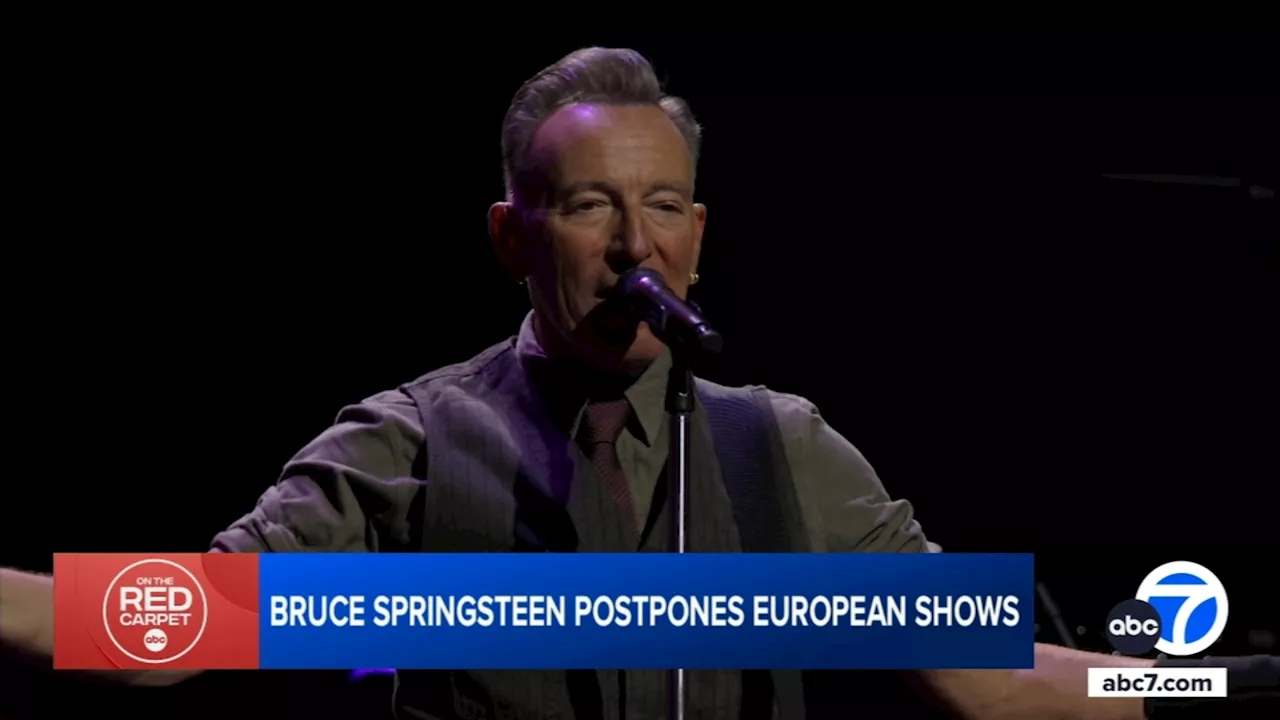 Bruce Springsteen postpones concerts in Marseille, Prague and Milan due to 'vocal issues'Bruce Springsteen has postponed concerts in three European cities over the next two weeks due to vocal issues.
Read more »
 Bruce Springsteen postpones 3 European concerts due to 'vocal issues'Bruce Springsteen postpones three European concerts due to 'vocal issues,' citing doctor's orders.
Read more »
 Bruce Springsteen Forced to Postpone Several European Concerts Due to 'Vocal Issues'Bruce Springsteen took to Instagram to reveal that he and the E Street Band won't be able to perform at a few upcoming concert dates.
Read more »
 Bruce Springsteen breaks silence after health concerns postponed concertsHe shared an update on Instagram
Read more »
 Bruce Springsteen promises fans 'we will be back' after postponing shows due to 'vocal issues'The rocker said 'we plan to rock you into the ground' when tour resumes June 12.
Read more »
 Bruce Springsteen shares first personal update since postponing European tourSpringsteen announced that doctors had ordered him to stop performing upon “further examination and consulting” after “vocal issues” postponed his Marseille concert on Saturday night.
Read more »