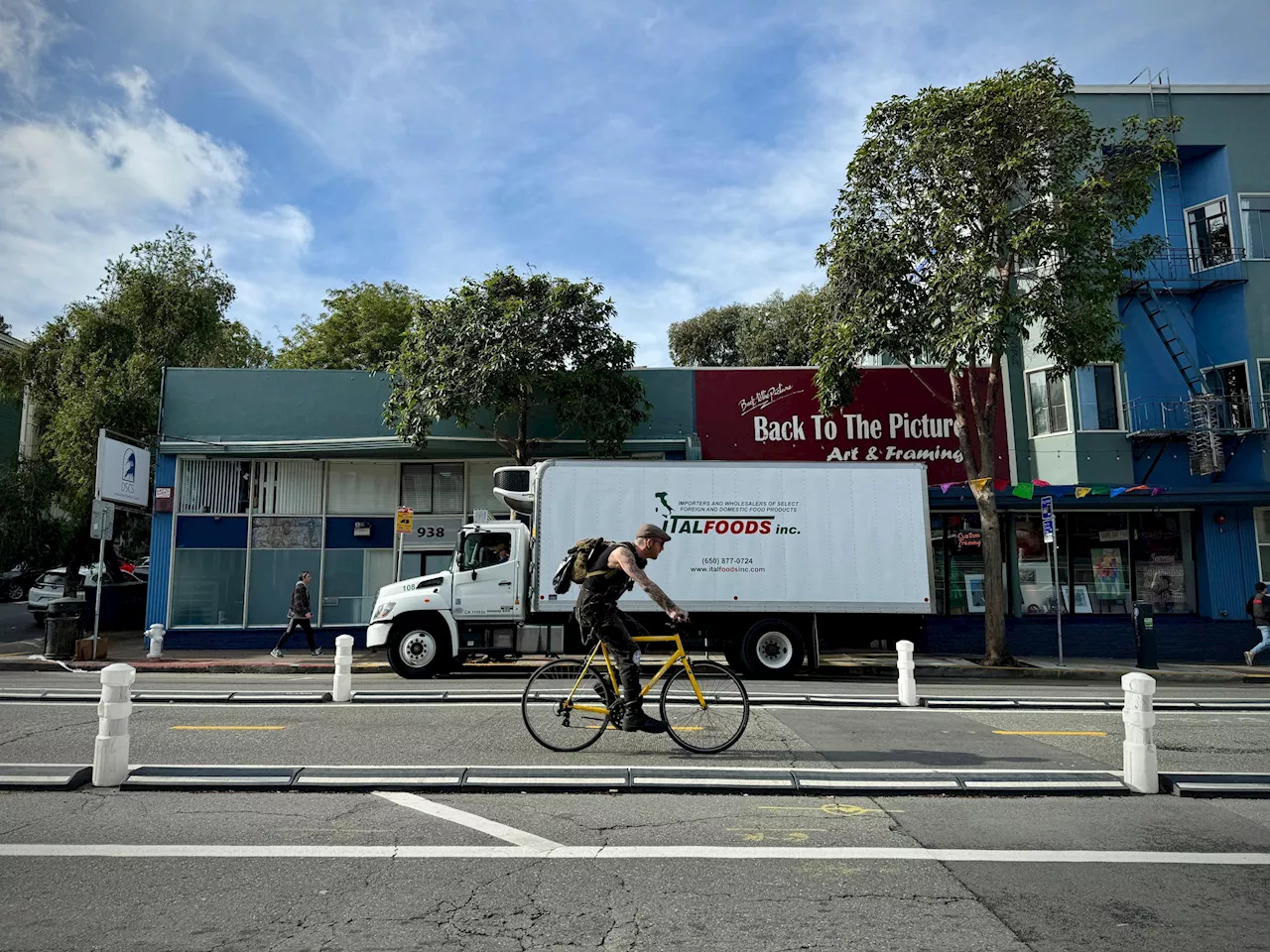
Valencia St. near the center bike lane appears to be doing more business than anywhere else in the Mission District, according to new data.
Despite continuing unhappiness about the center bike lane from businesses along the Valencia Street corridor, that eight-block stretch appears to be doing more business than anywhere else in the Mission District, according to data from the San Francisco Controller’s Office.
New data shows that sales-tax revenue in July, August and September of 2023 was up 3.2 percent, compared to the same months in 2022. During the period in which the bike lane was installed — construction began in April, but it opened in August — businesses along Valencia sold more goods than they had during the same period the year before. The data covers sales tax reports from businesses on 15th Street, where the center bike lane begins, to 23rd Street, where it ends. While Valencia saw a slight uptick, sales tax revenue on the identical stretch of Mission Street fell by 0.9 percent. For the entire 94110 zip code, sales tax revenue dropped by 1.9 percent. When asked about the discrepancy between merchants’ experience and the sales tax data, Sean Quigley, the owner of Paxton Gate, said the shop did not see a measurable change in sales before or after the introduction of the bike lane, but sales for the entire year dropped by 13 to 15 percent, month over month. “To me, means something else is going on alongside the bike lane,” said Quigley. The decline in sales across the zip code would suggest the same. Mission Localthe economic impact of the bike lane, showing how sales-tax data from April through June of last year, during the bike lane’s construction, was down 6 percent, not the 30 to 40 percent claimed by some businesses. The new data, including July through August, is presented below. Data shows a year-over-year increase of 3.2% for merchants along the bike lane, while sales tax revenue declined 1.9% for the 94110 region as a whole. Sales tax figures comparing Valencia St with Mission St. The final reporting quarter of last year shows slight gains on Valencia compared with a slight loss on Mission.Craig has been a Mission/Bernal resident since 2011 when he and his wife followed their kids to the Bay Area from SoCal. After a 40-year career in tech he is proud to support Mission Local behind the scenes and as an occasional reporter. When not working on ML Craig spends his time taking his granddaughter around the City, biking, rooting for the Warriors, and fixing pinball machines.There’s quite a lot left out of my interview with Mr. Mautner, which I did by email for this reason. Here’s my full answer to his question about sales along Valencia: “At Paxton Gate we did not experience a measurable dip in sales before or after the introduction of the center-running bike lane. But, our sales were down for the entire year by 13 to 15% month over month which, to me, means something else is going on alongside the bike lane. Personally, I’d point to the “doom loop” scenario the national press fell victim to, describing San Francisco like some post-apocalyptic wasteland. Where really, those of us who work and live here, know that things aren’t nearly as bad as they were saying. This meant fewer tourists in restaurants and shops and less money being spent. For us, things changed in December with the first two weeks being scarily slow. Sales were about 20% below last December, but then the final two weeks leading up to Christmas ramped up with December almost matching 2023. In the end, for the year we were about 9% down, which almost felt like a win. I think some places have it worse than others. Destination stores might not have felt the hit from the bike lane as much as services or restaurants since those types of businesses might be available closer to home or in neighborhoods where parking and driving isn’t such a challenge. So, maybe Paxton Gate got hit with a notable drop mostly due to a reduction in visitors to SF in general, whereas other businesses got hit by that as well as locals not bothering to come to their space for a drink, meal, or a cup of coffee. I’ve heard from business colleagues that their sales were down 20, 30, even 40%. Anecdotally, it seems to be impacting restaurants, bars and cafes more, but I’m really just guessing. ” When asked about the sales tax data not aligning with what merchants were saying, I replied, “The only thing I can think of is that some sales are not being taken into account in those figures. Businesses who provide services don’t charge sales tax so will not show up in that data. I believe there are some to-go food or beverage options that also don’t include sales tax. Also, sales tax is paid in a variety of ways, so I’m not certain the timing of receiving it will align exactly with the dates of construction and the pilot. My understanding is that some business pay more frequently then others. Whether sales tax is an accurate measurement of how the bike lane is impacting business is certainly something worth looking into.”I appreciate your effort to be as objective as possible. Too many people are being very strident in their opinions around what is happening on Valencia, and that is not helpful in understanding what is working or not. Thank you!The Mission District lost a lot of high income techies who used to spend freely at our restaurants and bars. Also, the neighborhood is perceived as dangerous and therefore doesn’t attract as many locals from the East Bay or tourists. jThe sales tax data isn’t that great. My shop’s in-store sales took a giant shit so we’re working extra hard to make up for it with online orders, which still pay out the same sales tax but are way more work and expensive for us to fill. Some of my neighboring businesses have multiple locations who all report taxes from their main Valencia St location though their Valencia sales are way down while other locations are doing better. I am 100% in support of protected bike lanes on Valencia, but I want the discussion around it based on reality and not misleading dataYou commented on another post about sales tax revenue about your “online orders.” Most businesses on Valencia do not have those. Restaurants do not , though they pay sales tax. I have trouble, as I picture businesses up and down Valencia, picturing many who have online sales. Maybe Self Edge. Not Cherin’s. Not Black and Gold, I don’t think. Not Veo. And so on. So maybe the “online sales” tack is not a relevant one to measure against. Existing merchants and commercial property owners: collectively fund cleanup crews and frequently power-wash the sidewalks. Blast SF311 with requests for poop cleanup and sidewalk repairs. Most of the photos on ML show storefronts with graffiti. Call out the landlords who are not interested in revitalizing the nabe, because they keep rent renewals or initial leases at ridiculously high levels . Don’t chastise or threaten the landlords, simply print their names with available public info. Kindly encourage them to be buenos ciudadanos vecinos. Or ask them to sell their properties to people dedicated to improving the neighborhood for all. Small business owners & entrepreneurs: attend business classes at City College to learn how to sufficiently capitalize a business, financially survive, provide top customer service and manage your employees well.It is strange that we have been schooled in “supply and demand” for . . . centuries? . . . and all of a sudden, in the 21st Century, San Francisco real estate comes along and says “JUST KIDDING!” I suspect that Prop. 13 has something to do with this. If your property taxes are perpetually at 1980 rates, you don’t have a fire under you to make sure you’re tenanted.Prop 13 and other tax-dodging benefits, the highly-illiquid nature and interest rate-dependence of real estate, the competition of organic buyers and renters with volatile inorganic demand , make real estate “sticky”, which is an anodyne way of saying that supply & demand theory doesn’t do a very good or timely job of modeling real estate markets.economics is a hoax that has been used to justify the massive redistribution of wealth over the last forty years from the millions of workers who create it up to to a small number of powerful billionaire oligarchs who benefit from a miseducated populace.Valencia is not a cheap place to shop nor be in business. As one friend mentioned, they charge Rodeo Drive prices in a number of stores. Yet Valencia, much as we absolutely love it, is not Rodeo Drive.The sidewalk experience along Valencia is worse than I’ve remembered in decades. So much graffiti and trash. It’s unpleasant.A common theme among the commercial vacancies on Valencia, and on Mission, as well as the bourgeoning residential vacancies throughout the Mission: Rent Too High.The Mission District lost a lot of high income techies who used to spend freely at our restaurants and bars. Also, the neighborhood is perceived as dangerous and therefore doesn’t attract as many locals from the East Bay or tourists. jLook at the situation around each of the BART station entrances/exits along Mission St. It’s madness. I can protect myself reasonably well and don’t often feel unsafe, but the scenes at 16th/Mission and 24th/Mission are pretty scary. If people don’t feel safe using BART, then the neighborhood is going to lose a ton of business from people wanting to visit the area.The narrative on the bike lane was set before it even opened, and unfortunately it’s difficult to change a narrative once its set. I’m a regular user of it and love it – much much x1000 safer than the previous ‘bike lanes’. Looks like its good for business too.One way to increase sales is simply increase prices. Sales tax revenue doesn’t reflect the number of transactions. Only their total value. e.g. Awhile back after reading rave reviews, I visited Hila on Valencia. I saw single scoop was $12 and decided the usual “gourmet” supermarket ice creams would satisfy my desires.“Valencia Street corridor, that eight-block stretch appears to be doing more business than anywhere else in the Mission District” This is not saying much. The entire Mission District is economically depressed due to anti-growth culture and policy. “sales tax revenue in July, August and September of 2023 was up 3.2 percent compared to the same months in 2022.”As Mr. Quigley said, sales tax is not be an accurate reading of the health of a businesses, although it is important to the city. A 3.2 % increase may not cover the cost of living increase during that time. Soaring rents and other expenses demand higher profits just to break even. Companies can lay off employees or cut back on hours to boost profits, but that doesn’t mean the business is healthy.If you have to use revenue to cover cost of living increases, it’s not profit. Profit is what’s left after your various expenses. I wonder why rents would “soar” along a commercial corridor when the claims of decreased business would make owners reluctant to sign a new lease and potential owners wouldn’t want to move into a place where there’s a huge drop in business for along the corridor. Maybe the “info” provided is wrong. Plus, if rents are soaring, the business owners should blame that rather than the loss of a few parking spots.excessively high since the wave of tech-fueled gentrification started in the late ’90s. Lots of neighborhood-serving businesses on Valencia closed as a result of the high rent because they couldn’t pass the rent increases on to their customers. As they closed, there arrived a wave of businesses catering to high-earning techie transients who didn’t think twice about waving their phones over the Square pad for their $12 boba smoothie. That cohort is now dribbling away to other cities in search of jobs, more affordable rent and cost of living, or a just respite on the parents’ basement couch while waiting hopefully for the next tech bubble to emerge. As a result, the Mission businesses that were able to pay the inflated rent are now feeling the pinch that the remaining neighborhood-serving businesses have been feeling all along.Has inflation been considered in the calculation?Has the number of empty stores been considered?Has the number of transactions been considered?Has the number of parking tickets been considered?Has the average amount per transaction been considered?Has the number of non local patrons been considered?I do not care if a bike rider ‘feels’ safer.No parking, no sale for me. Please keep your comments short and civil. Do not leave multiple comments under multiple names on one article. We will zap comments that fail to adhere to these short and very easy-to-follow rules.
United States Latest News, United States Headlines
Similar News:You can also read news stories similar to this one that we have collected from other news sources.
Former School Trustee Blocked from District's Facebook PageFormer South San Antonio Independent School District trustee Stacey Alderete has been blocked from the district's Facebook page, which she believes is retaliation for her efforts to hold the district accountable.
Read more »

New CEO of Cleveland Metropolitan School District introduces budget cutsDr. Warren G. Morgan is introduced as the new CEO of the Cleveland Metropolitan School District. He plans to involve the community in decision-making but has already proposed budget cuts.
Read more »
Two pedestrians hit by suspected drunken driver in Fort Worth Entertainment DistrictTwo pedestrians were hit by a suspected drunken driver who was running from police in the Fort Worth Entertainment District. The driver, 29-year-old Andrew Michael Guerra, is facing charges for hitting another vehicle and the pedestrians while trying to escape. The police are awaiting the results of a blood alcohol test. The incident occurred after the police spotted a gray pickup truck driving the wrong way down a one-way street.
Read more »
Oceano Community Services District General Manager Announces Early RetirementThe General Manager of Oceano Community Services District, Will Clemens, announced his early retirement after 24 years in public service. He blamed the new board majority for his departure and expressed his intention to leave by the end of the year. Clemens had received a favorable performance review and a $25,000 annual increase to his salary before his retirement.
Read more »


