
Science, Space and Technology News 2023
We and our partners use cookies to Store and/or access information on a device. We and our partners use data for Personalised ads and content, ad and content measurement, audience insights and product development.
An example of data being processed may be a unique identifier stored in a cookie. Some of our partners may process your data as a part of their legitimate business interest without asking for consent. To view the purposes they believe they have legitimate interest for, or to object to this data processing use the vendor list link below. The consent submitted will only be used for data processing originating from this website. If you would like to change your settings or withdraw consent at any time, the link to do so is in our privacy policy accessible from our home page..Rice University physicists, in a study led by Qimiao Si, have bridged two quantum physics subfields by demonstrating that specific unchangeable topological states, crucial for quantum computing, can intertwine with alterable quantum states in certain materials. This discovery enables potential operations at significantly higher temperatures, offering immense functional promise.“The surprising thing we found is that in a particular kind of crystal lattice, where electrons become stuck, the strongly coupled behavior of electrons in d atomic orbitals actually act like the f orbital systems of some heavy fermions,” said Qimiao Si, co-author of a study about the research inThe unexpected find provides a bridge between subfields of condensed matter physics that have focused on dissimilar emergent properties of quantum materials. In topological materials, for example, patterns of quantum entanglement produce “protected,” immutable states that could be used for quantum computing and spintronics. In strongly correlated materials, the entanglement of billions upon billions of electrons gives rise to behaviors like unconventional superconductivity and the continual magnetic fluctuations in quantum spin liquids. In the study, Si and co-author Haoyu Hu, a former graduate student in his research group, built and tested a quantum model to explore electron coupling in a “frustrated” lattice arrangement like those found in metals and semimetals that feature “flat bands,” states where electrons become stuck and strongly correlated effects are amplified. Qimiao Si is the Harry C. and Olga K. Wiess Professor of Physics and Astronomy at Rice University and director of the Rice Center for Quantum Materials. Credit: Jeff Fitlow/Rice University The research is part of an ongoing effort by Si, who won a prestigious Vannevar Bush Faculty Fellowship from the Defense Department in July to pursue the validation of a theoretical framework for controlling topological states of matter.In the study, Si and Hu showed that electrons from d atomic orbitals could become part of larger, molecular orbitals that are shared by several atoms in the lattice. The research also showed that electrons in molecular orbitals could become entangled with other frustrated electrons, producing strongly correlated effects that were very familiar to Si, who has spent years studying heavy fermion materials. “These are completely d-electron systems,” Si said. “In the d-electron world, it’s like you have a highway with multiple lanes. In the f-electron world, you can think of electrons moving in two tiers. One is like the d-electron highway, and the other is like a dirt road, where movement is very slow.” Si said f-electron systems host very clean examples of strongly correlated physics, but they aren’t practical for everyday use. “This dirt road lies so far from the highway,” he said. “The influence from the highway is very small, which translates to a minute energy scale and very low-temperature physics. This means you need to go to temperatures around 10 Kelvin or so to even see the effects of coupling. “That is not the case in the d-electron world. Things couple to one another quite efficiently on the multilane highway there.” And that coupling efficiency persists, even when there is a flat band. Si likened it to one of the highway’s lanes becoming as inefficient and slow as the f-electron dirt road. “Even when it has faded into a dirt road, it still shares status with the other lanes, because they all came from the d orbital,” Si said. “It is effectively a dirt road, but it is much more strongly coupled, and that translates to physics at much higher temperatures. “That means I can have all of the exquisite, f-electron-based physics, for which I have well-defined models and a lot of intuition from years of study, but instead of having to go to 10 Kelvin, I can potentially work at, say, 200 Kelvin, or possibly even 300 Kelvin, or room temperature. So, from a functionality perspective, it is extremely promising.” Reference: “Coupled topological flat and wide bands: Quasiparticle formation and destruction” by Haoyu Hu and Qimiao Si, 19 July 2023,Si is the Harry C. and Olga K. Wiess Professor of Physics and Astronomy at Rice, a member of the Rice Quantum Initiative and director of the Rice Center for Quantum Materials . The study was funded by the Department of Energy, the Air Force Office of Scientific Research, the Welch Foundation and received support through computational and visiting facilities by the National Science Foundation.SciTechDaily: Home of the best science and technology news since 1998. Keep up with the latest scitech news via email or social media.Dr. Michael Demkowicz predicted self-healing in metal; this summer it was finally observed, shocking scientists around the world. A microscopic crack grew in a very…
United States Latest News, United States Headlines
Similar News:You can also read news stories similar to this one that we have collected from other news sources.
 Unraveling The Infostealer ThreatMike Wilson is the Founder & CTO of Enzoic, a cybersecurity company that helps prevent account takeover of employee and customer accounts. Read Mike Wilson's full executive profile here.
Read more »
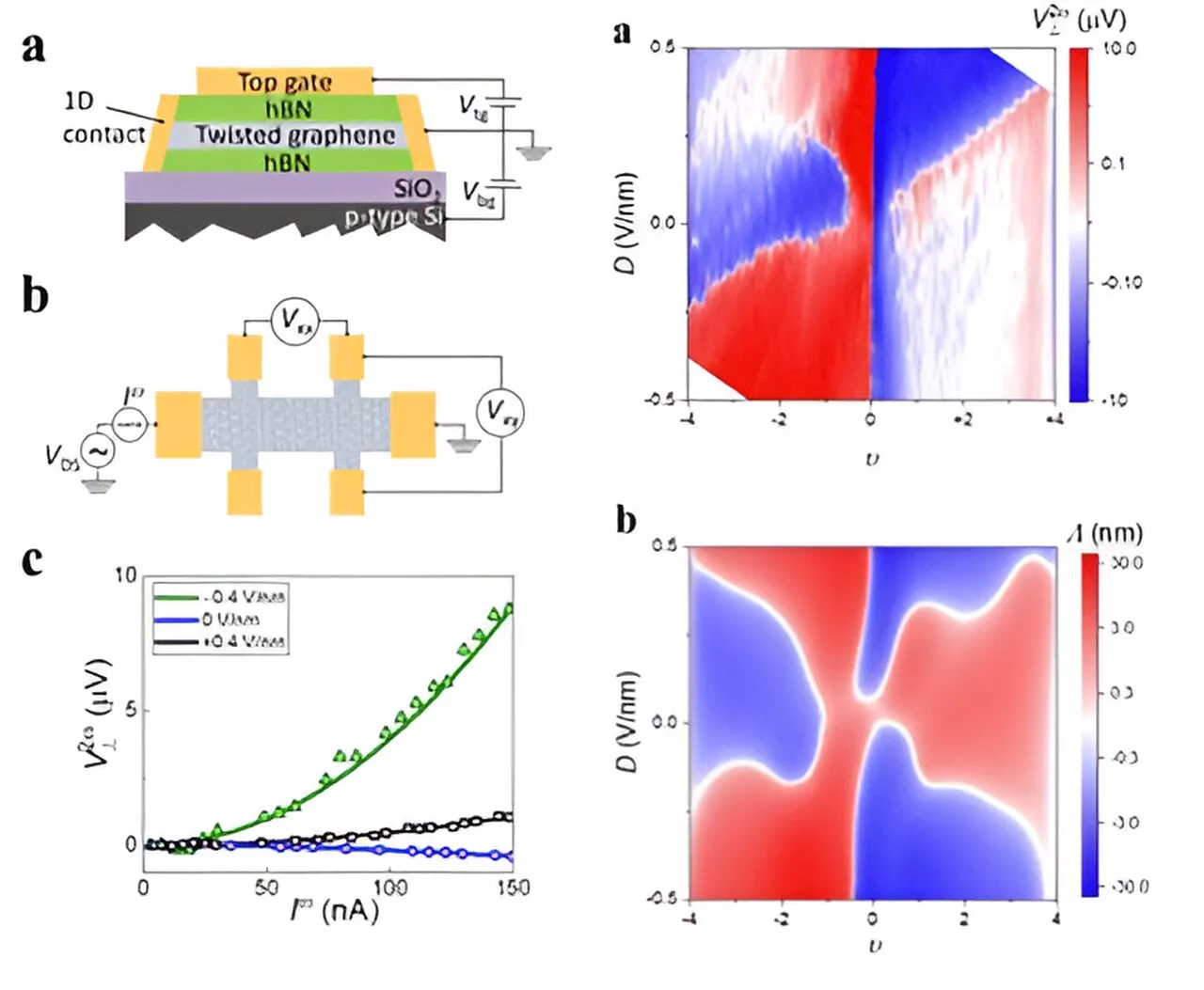 Physicists unlock controllable nonlinear Hall effect in twisted bilayer grapheneA team of international researchers led by The University of Hong Kong (HKU) and The University of Science and Technology (HKUST) has made a significant discovery in the field of quantum materials, uncovering the controllable nonlinear Hall effect in twisted bilayer graphene.
Read more »
 The quantum experiment that could help find evidence of the multiverseScars of collisions with other universes could show up in radiation from the big bang. A new experiment aims to mimic these collisions and help us look for them
Read more »
 Exploring parameter shift for quantum Fisher informationIn a recent publication in EPJ Quantum Technology, Le Bin Ho from Tohoku University's Frontier Institute for Interdisciplinary Sciences has developed a technique called time-dependent stochastic parameter shift in the realm of quantum computing and quantum machine learning. This breakthrough method revolutionizes the estimation of gradients or derivatives of functions, a crucial step in many computational tasks.
Read more »
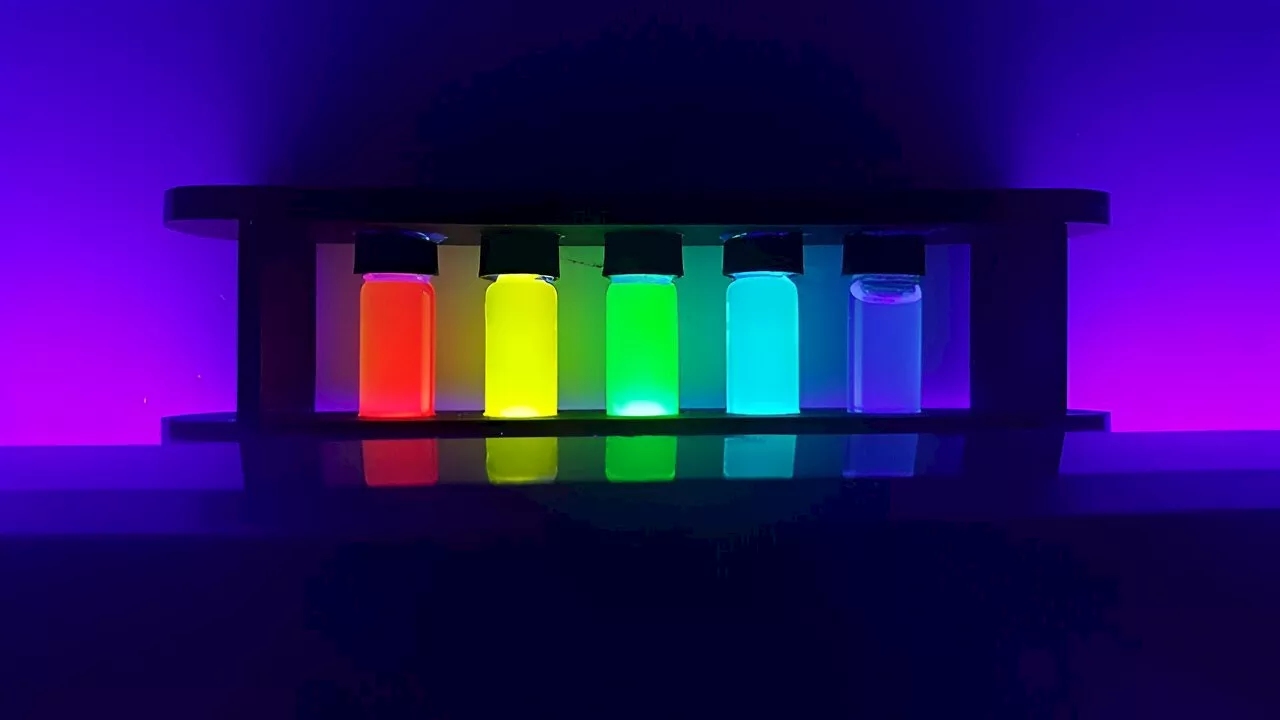 Q&A: Expert discusses past and future of Nobel-winning quantum dots technologyThe world woke up on Oct. 3 to learn that Moungi Bawendi of MIT, Louis Brus of Columbia University, and Alexei Ekimov of Nanocrystals Inc. received the Nobel Prize in Chemistry for their discovery and synthesis of semiconductor quantum dots.
Read more »
 A new way to erase quantum computer errorsResearchers have demonstrated a type of quantum eraser. The physicists show that they can pinpoint and correct for mistakes in quantum computing systems known as 'erasure' errors.
Read more »