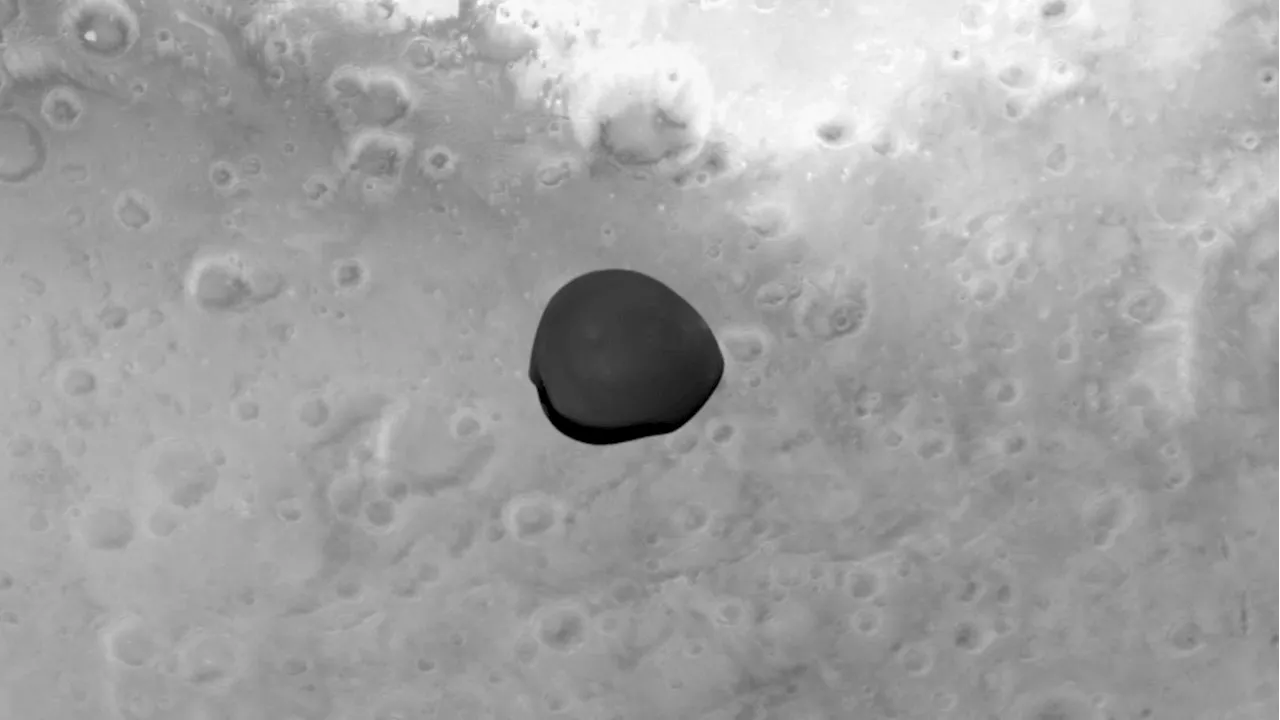
The European Space Agency released a thrilling time-lapse video showing the Hera spacecraft's flyby of Mars and its dainty moon Deimos.
The European Space Agency ’s Hera spacecraft is on its way to visit a now-famous binary asteroid system, but it’s doing some sightseeing as it goes. Hera took athe time-lapse video a “rare view of the red planet and its enigmatic moon” in a release on April 15.
ESA had previously shared images from the flyby, but the video puts Hera’s visit to Mars into motion and into color. The red planet first appears as a small dot and progressively gets bigger as the spacecraft closes in. Craters and surface features come into focus. Hera’s Deimos observations follow a similar path. Deimos is the smaller of the red planet’s two moons. It’s only 9 miles wide at its broadest point. It resembles a misshapen potato. Mars’s other moon Phobos gets a brief cameo at the end of the video. Phobos looks like a tiny sunlit curve in the distance. It measures 17 miles at its widest. Hera practically snuggled Mars and Deimos during the flyby. The spacecraft came within about 3,100 miles of the red planet’s surface. The Deimos encounter was even closer at just 186 miles away. That’s about two-thirds the length of the Grand Canyon.Double Asteroid Redirection Test . In 2022, DART crashed into Dimorphos, a small moonlet in orbit around the larger asteroid Didymos. NASA wanted to test the sci-fi concept of altering an asteroid’s path by smashing into it. It worked. DART’s success means the same smash-it method could potentially alter a dangerous asteroid’s path to steer it away from an Earth impact. This concept came into more focus recently during a brief period of concern over asteroid 2024 YR4. The, discovered in late 2024, was initially calculated to have a small chance of impacting Earth in 2032. Further data ruled out an Earth impact, but the moon still has a slight chance of getting hit.Hera’s job is to “perform a detailed post-impact survey of the target asteroid” in order to “turn the grand-scale experiment into a well-understood and repeatable planetary defense technique.” The spacecraft is scheduled to rendezvous with the asteroid system in late 2026. Hera used the Mars swingby to build velocity to help it along to its ultimate destination while saving fuel in the process. The Mars time-lapse video uses images from Hera’s Asteroid Framing Camera. “The original grayscale images have been color-enhanced based on known surface features,” ESA said. The AFC is a core part of Hera’s asteroid mission. It will capture detailed images of Dimorphos, including the crater created by the DART impact. AFC will also help Hera navigate close to the asteroid. AFC had a successful test run during Hera’s Mars flyby. The spacecraft’s main mission is still ahead, but it’s helping scientists learn more about Mars and its mysterious moon Deimos along the way.
Space Hera ESA European Space Agency NASA DART Asteroid
United States Latest News, United States Headlines
Similar News:You can also read news stories similar to this one that we have collected from other news sources.
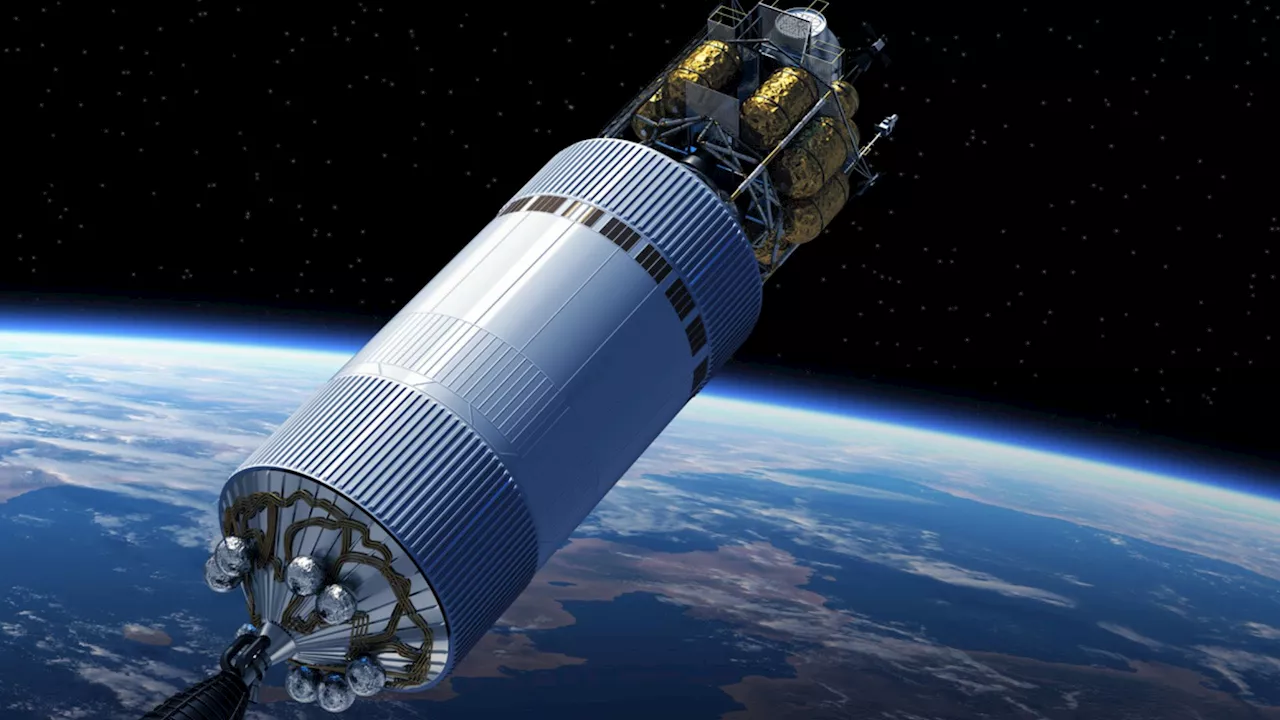 Nuclear-powered spacecraft with 11,000-pound payload planned by US space firmsThe goal of enabling extended deep-space exploration is driving NASA, space agencies, and private players to explore nuclear power solutions.
Read more »
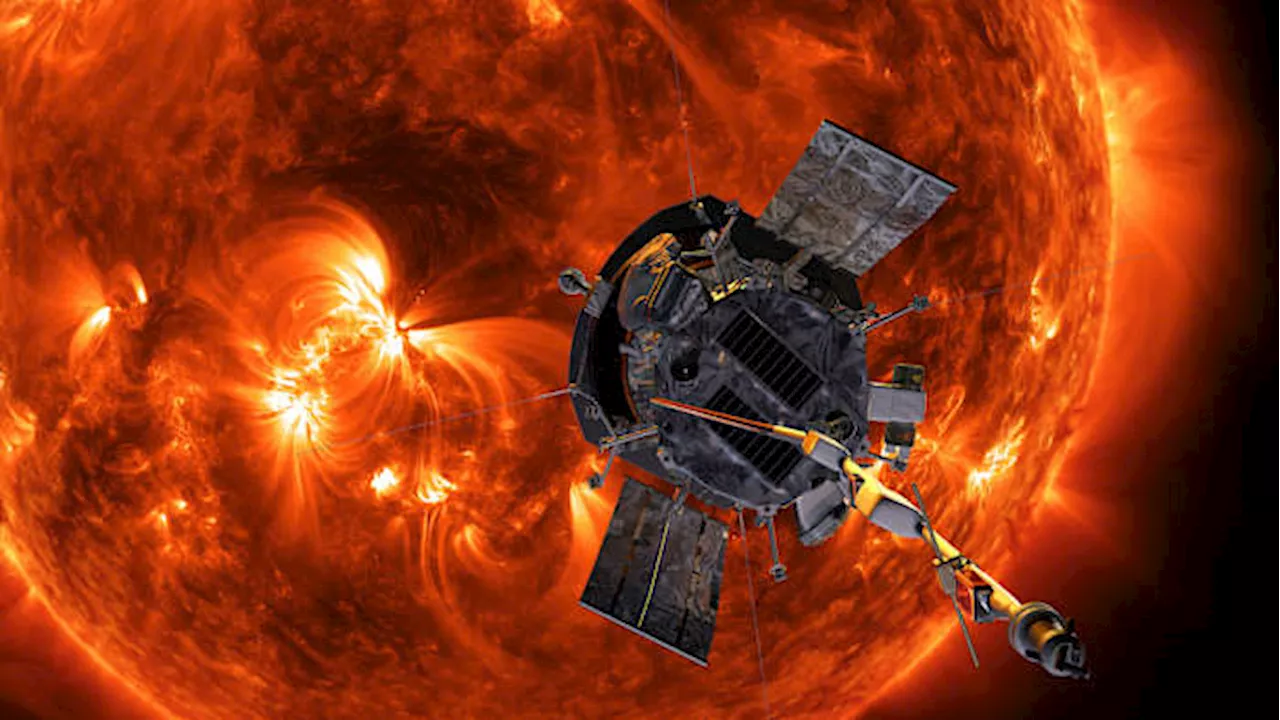 A NASA spacecraft will make another close pass of the sunA NASA spacecraft will make its second close brush with the sun.
Read more »
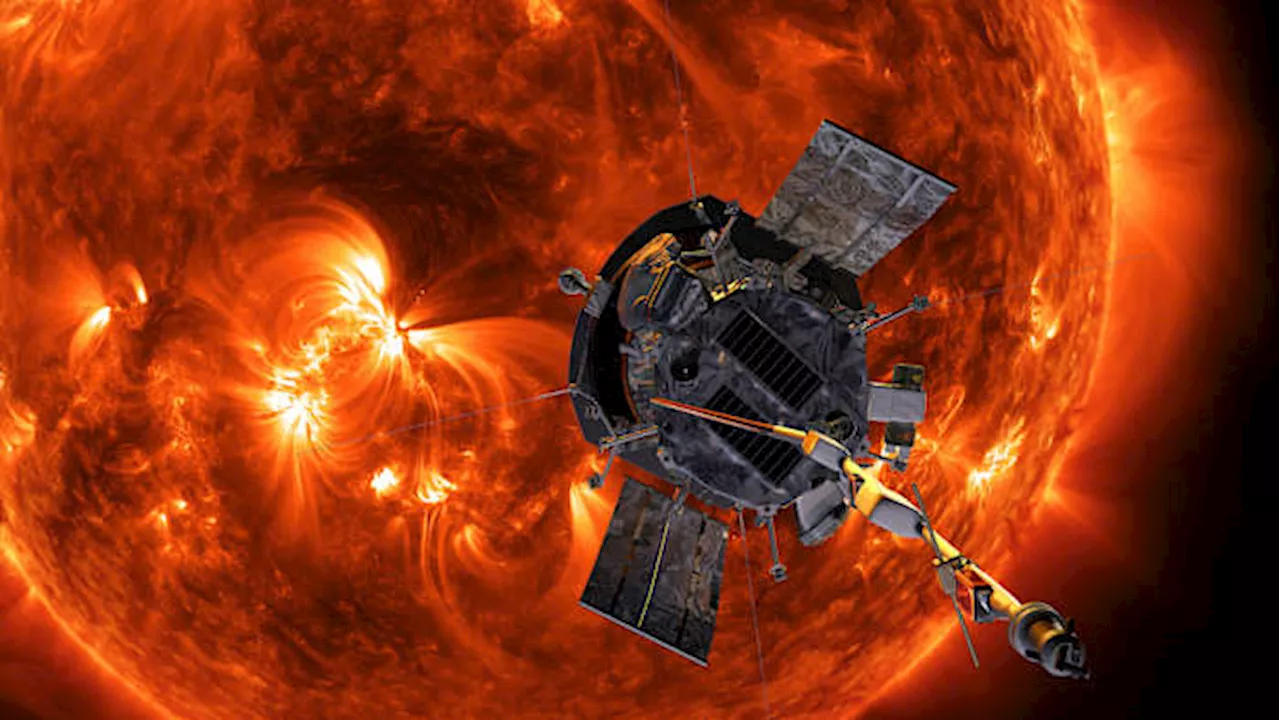 A NASA spacecraft will make another close pass of the sunA NASA spacecraft will make its second close brush with the sun.
Read more »
 Study: Toxic Mars dust poses major risks to astronauts, could damage spacecraftMartian dust could threaten astronaut health and equipment, with toxic particles causing lung damage and mission failures.
Read more »
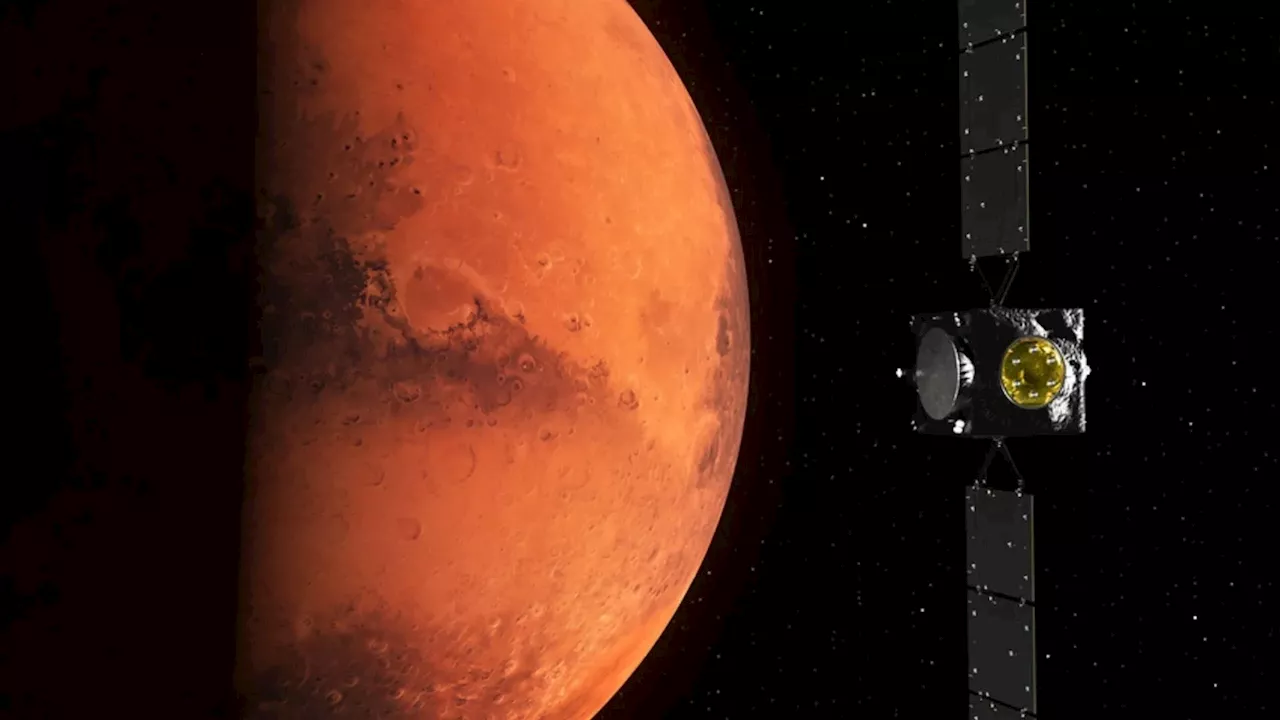 Europe’s Hera spacecraft aces self-driving test at Mars before asteroid missionThe spacecraft captured the Red Planet and its enigmatic moons, Deimos and Phobos, marking its first deep-space imaging operation.
Read more »
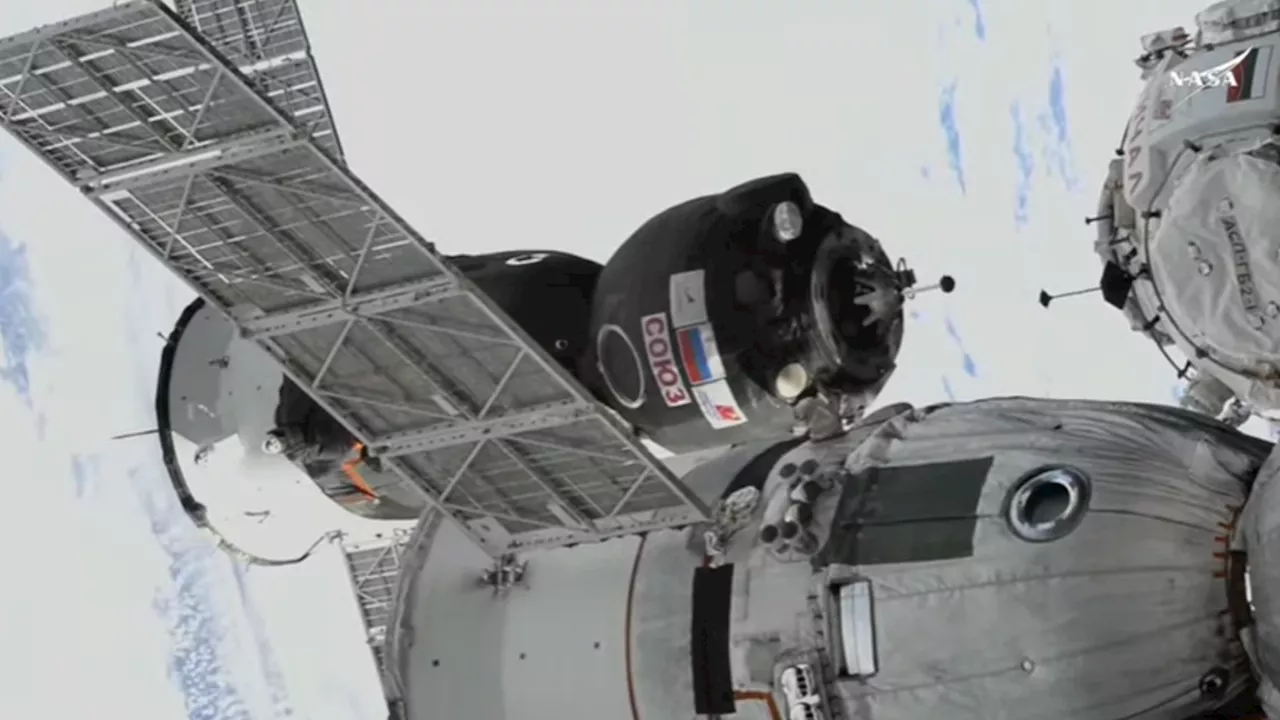 NASA's Jonny Kim and 2 cosmonauts arrive at ISS aboard Russian Soyuz spacecraft (video)Michael Wall is a Senior Space Writer with Space.com and joined the team in 2010. He primarily covers exoplanets, spaceflight and military space, but has been known to dabble in the space art beat. His book about the search for alien life, 'Out There,' was published on Nov. 13, 2018.
Read more »