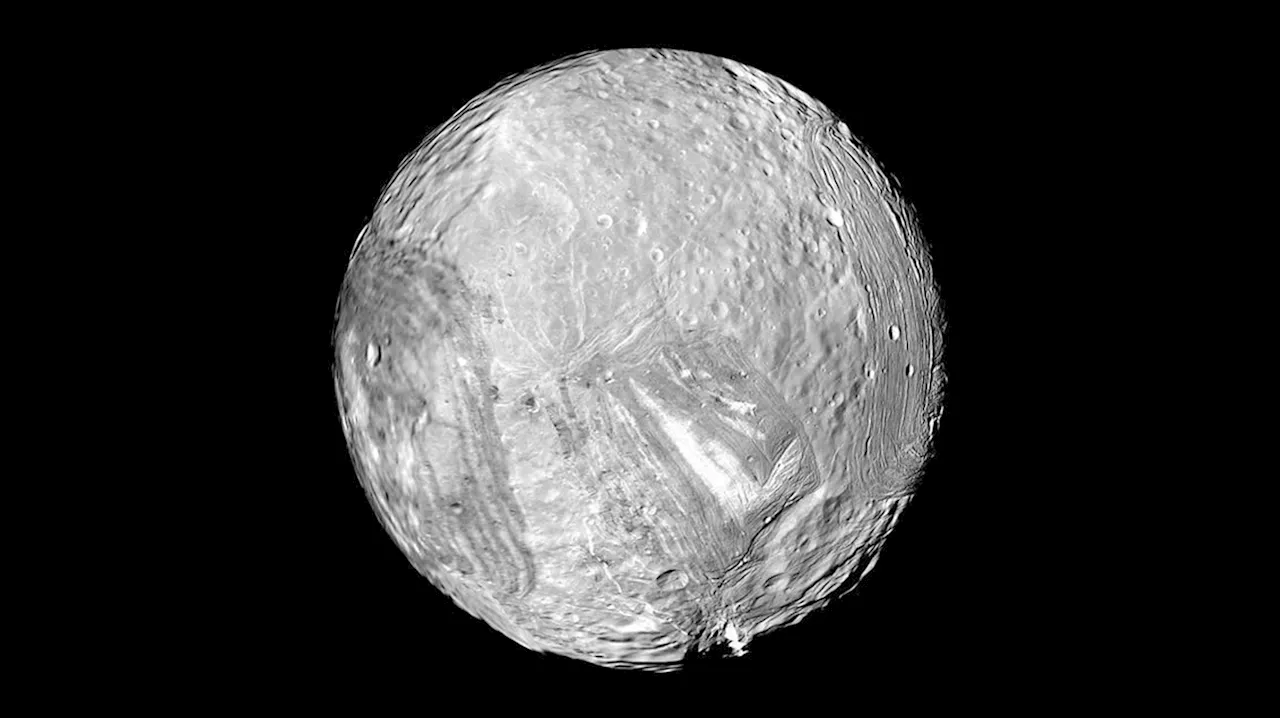
It might be time to add another ocean moon to our Solar System's list. New research suggests Uranus' Miranda has an ocean.
Uranus' fifth-largest moon is Miranda. It's known for its surface features, and new research suggests that a subsurface ocean could be shaping the moon's surface. Image Credit: NASA/Jet Propulsion Laboratory-Caltech The Solar System’s hundreds of moons are like puzzle pieces.
Together, they make a picture of all the forces that can create and modify them and the forces that shape our Solar System. One of them is Miranda, one of 28 known moons that orbit the ice giant Uranus. Miranda is its smallest major moon, at 471 km in diameter. New research shows that this relatively small, distant moon may be hiding something: a subsurface ocean. Miranda stands out from the other moons for one reason: its surface is a bizarre patchwork of jumbled terrain. There are cratered areas, rough scarps, and grooved regions. It may have the tallest cliff in the Solar System, a 20 km drop named Verona Rupes. Many researchers think its surface is deformed by tidal heating from gravitational interactions with some of the Uranus’ other moons.” The lead author is Caleb Strom, a graduate student at the University of North Dakota.Tom Nordheim, co-author and planetary scientist at the Johns Hopkins Applied Physics Laboratory Scientists don’t have much to go on when it comes to Miranda. The only spacecraft to image it was Voyager 2 in 1986. Even then, the flyby was brief, and the spacecraft only imaged the moon’s southern hemisphere. But that was enough to reveal the moon’s bizarre and complex geological surface features. Miranda’s strangeThis figure from the study shows some of Miranda’s surface features. The moon is known for its coronae features, two of which are labelled here. Image Credit: Strom et al. 2024. When the images were first received, scientists were baffled by Miranda’s complexity. Some called it a “patchwork planet,” and there was much healthy speculation about what created it. Attempts to understand the moon are still limited by the amount of data that Voyager 2 provided. However, modern scientists have access to a more powerful tool than scientists did in the 80s: computer models and simulations. Strom and his co-researchers used a computer model to work backward from Miranda’s current surface. They started by mapping Miranda’s surface features, including its cracks, ridges, and unique trapezoidal coronae, and then reverse-engineered it. They tested different models of the moon’s interior to see what could account for the varied surface. This simple schematic shows the four-layer model Strom and his co-researchers worked with. Image Credit: Strom et al. 2024. The model that best matched the surface was one where Miranda had a vast ocean under its surface some 100-500 million years ago. The icy crust is probably 30 km thick or less, and the ocean could be up to 100 km thick. “Our results show that a thin crust is most likely to result in sufficient stress magnitude to cause brittle failure of ice on Miranda’s surface,” the authors explain in their research. “Our results also suggest the plausible existence of a ?100 km thick ocean on Miranda within the last 100–500 million yr.” “To find evidence of an ocean inside a small object like Miranda is incredibly surprising,” said Tom Nordheim, a planetary scientist at the Johns Hopkins Applied Physics Laboratory in Laurel, Maryland, a study co-author, and the principal investigator on the project that funded the study. “It helps build on the story that some of these moons at Uranus may be really interesting — that there may be several ocean worlds around one of the most distant planets in our solar system, which is both exciting and bizarre.” Tidal heating is responsible for this, and it came from gravitational relationships between Miranda and Uranus’ other moons. Moons tug on each other, and when they’re in anwith one another, where each moon’s period around a planet is an exact integer of the others’ periods, those tugs are amplified. These forces can periodically deform the moons, and as they’re squeezed, they heat up, keeping subsurface oceans warm and liquid. Miranda and other moons of Uranus were likely in resonance in the past, which could’ve created surface fractures and related terrain. A digital elevation model of Miranda’s Inverness Coronae. The relative elevation ranges from 0 km to 4 km . Image Credit: Beddingfield et al. 2022. However, resonances don’t last forever, and the researchers think that some time ago, Miranda left orbital resonance, and its interior began to cool. They don’t think it’s completely cooled yet because if the ocean had completely frozen, it would’ve expanded and displayed telltale surface cracks. So, the interior ocean likely still exists but is probably much thinner than in the past. “But the suggestion of an ocean inside one of the most distant moons in the solar system is remarkable,” Strom said. Nobody predicted that Miranda would have an ocean. As far as scientists could tell, it was a frozen ball. But they’ve been wrong about moons before. Researchers used to think that Saturn’s moon, Enceladus, the most reflective object in the Solar System, was just a ball of ice. After all, its surface is smooth and clearly frozen solid. However, the Cassini mission showed us that it may not be totally frozen. There’s a bevy of evidence that Enceladus has a warm ocean under a layer of ice. This false-colour image of the plumes erupting from Enceladus is easily recognizable to many. Enceladus and Miranda are similar in important ways. Could Miranda also be geologically active? Image Credit: NASA/ESA “Few scientists expected Enceladus to be geologically active,” said co-author Alex Patthoff. “However, it’s shooting water vapour and ice out of its southern hemisphere as we speak.” Since both Enceladus and Miranda are roughly the same size and may have similar ice shells, it increases the chances that Miranda also has an ocean. Other moons, like Saturn’s Europa, may also be icy ocean moons. Now, scientists think these moons and their warm oceans are the best targets in the search for life in our Solar System. Other recent research suggests that Miranda could be more like Enceladus than thought. One 2023 study showed that the moon may be releasing material into space like Enceladus does. The ESA and NASA are both sending probes to Jupiter to study Europa and other potential ocean moons. Should we expand that search to distant Uranus and its small moon Miranda? An artist’s impression of Uranus and its five largest moons : Miranda, Ariel, Umbriel, Titania and Oberon. A 2023 paper showed that Ariel and/or Miranda could be releasing material into space. Image Credit: NASA/Johns Hopkins APL/Mike Yakovlev “We won’t know for sure that it even has an ocean until we go back and collect more data,” said study co-author Nordheim. “We’re squeezing the last bit of science we can from Voyager 2’s images. For now, we’re excited by the possibilities and eager to return to study Uranus and its potential ocean moons in depth.” For now, all we have is decades-old Voyager 2 data. However, the data and the computer models the team employed shed new light on Miranda. “We interpret the tidal stress model results to indicate that at some point in Miranda’s geologic past, it experienced an intense heating event that resulted in a thin crust . Such a thin crust would also have resulted in a ?100 km thick ocean to account for the molten part of the hydrosphere. This thin ice crust and thick ocean could have allowed for intense tidal stress leading to significant geologic deformation in the form of brittle deformation at Miranda’s surface,” the authors explain. “In conclusion, our results suggest that Miranda could have had a subsurface ocean in the geologically recent past from an intense heat pulse, consistent with dynamical modelling results of previous studies,” they conclude.
United States Latest News, United States Headlines
Similar News:You can also read news stories similar to this one that we have collected from other news sources.
 November full moon 2023: Full Beaver Moon is joined by Mercury, Venus, Jupiter and SaturnJesse Emspak is a freelance journalist who has contributed to several publications, including Space.com, Scientific American, New Scientist, Smithsonian.com and Undark. He focuses on physics and cool technologies but has been known to write about the odder stories of human health and science as it relates to culture.
Read more »
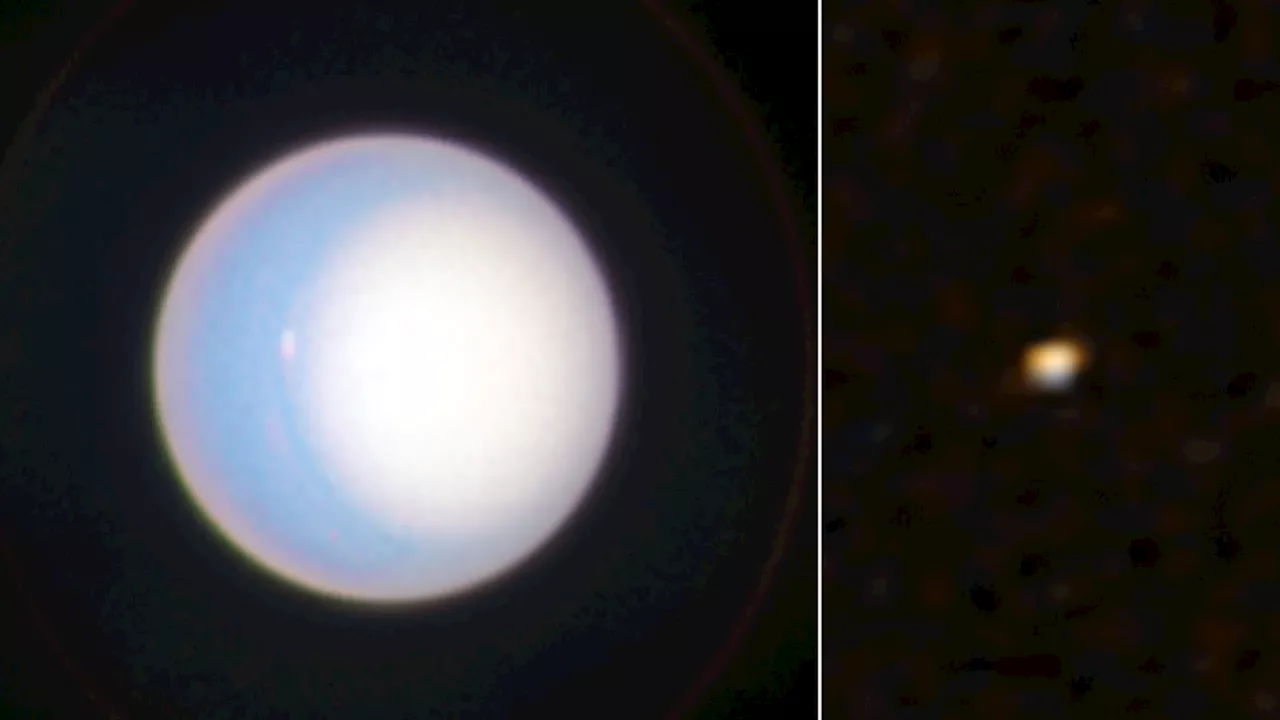 Hubble Telescope and New Horizons Pluto probe team up to image UranusRobert Lea is a science journalist in the U.K. whose articles have been published in Physics World, New Scientist, Astronomy Magazine, All About Space, Newsweek and ZME Science. He also writes about science communication for Elsevier and the European Journal of Physics. Rob holds a bachelor of science degree in physics and astronomy from the U.K.
Read more »
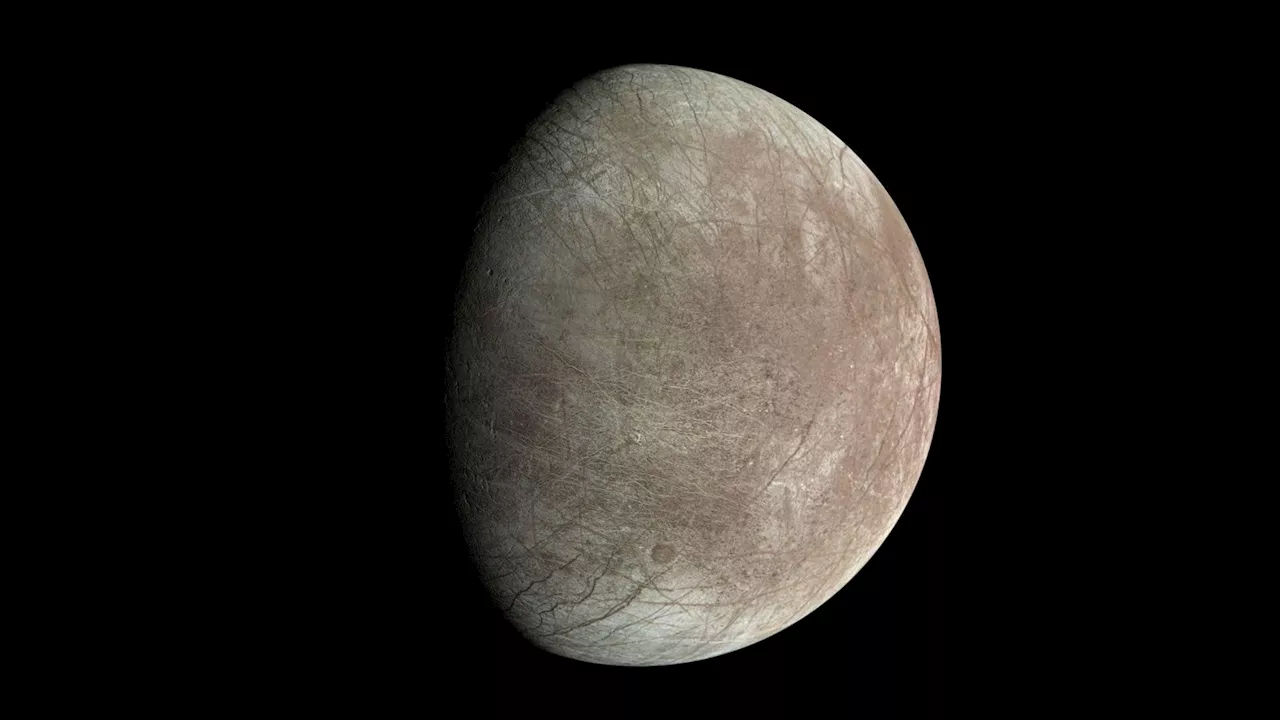 Europa: When to See NASA And SpaceX Blast-Off To Ocean Moon On MondayJamie Carter is an award-winning reporter and experienced stargazer who covers the night sky, astro-tourism, the northern lights and space exploration. He received the 2023 Popular Media Award from the American Astronomical Society's Solar Physics Division and is the author of A Stargazing Program for Beginners. Writing for Forbes.
Read more »
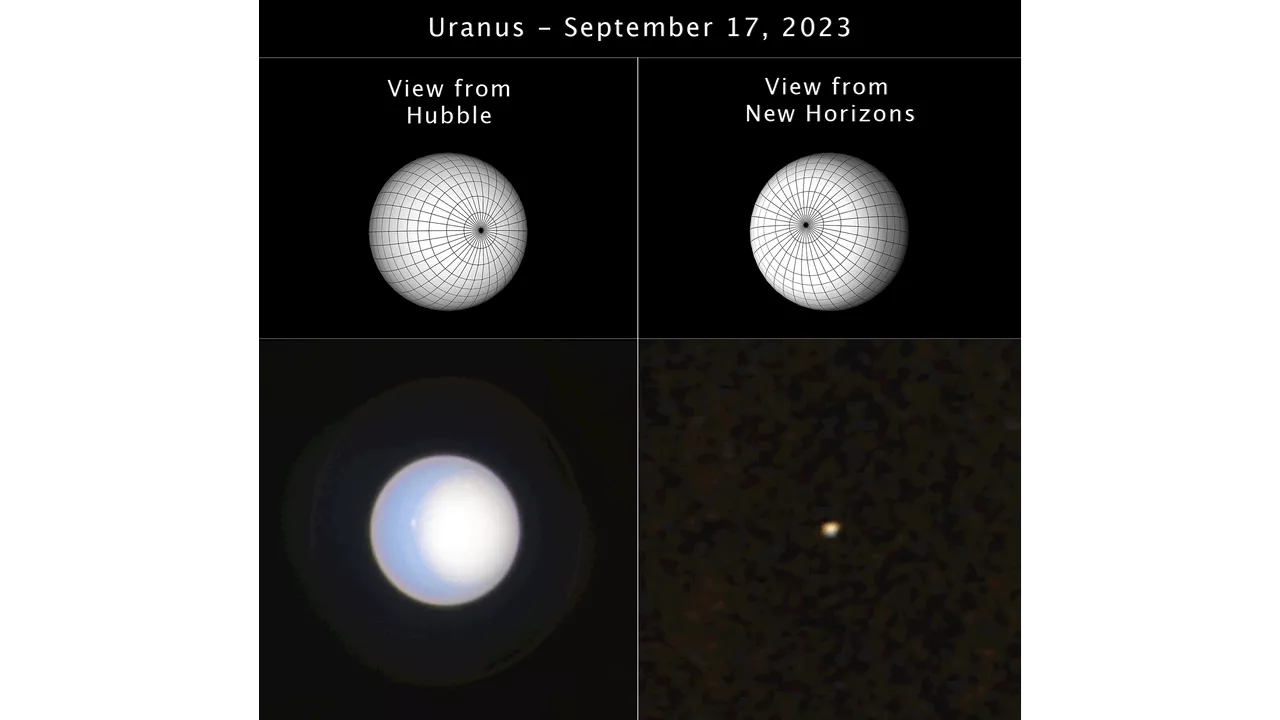 Hubble and New Horizons Look at Uranus at the Same TimeSpace and astronomy news
Read more »
 Sailor Moon's Jimmy Choo Line Sold Out In Record-Breaking TimeSailor Moon giving a peace sign with a moon behind her.
Read more »
 Two Iconic NASA Spacecraft Just Gazed At Uranus — Here’s What They SawJamie Carter is an award-winning reporter and experienced stargazer who covers the night sky, astro-tourism, the northern lights and space exploration. He received the 2023 Popular Media Award from the American Astronomical Society's Solar Physics Division and is the author of A Stargazing Program for Beginners. Writing for Forbes.
Read more »