Space and astronomy news
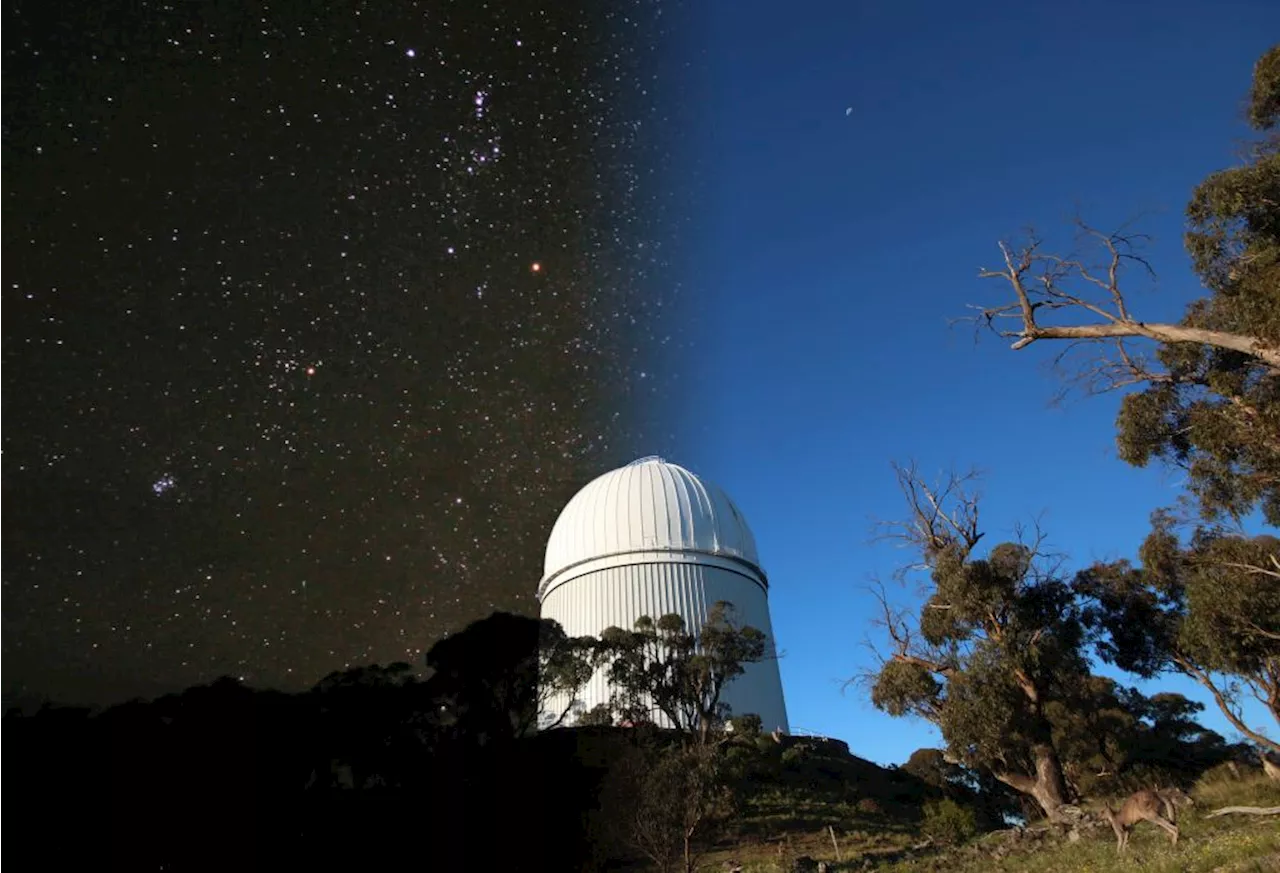
Day and night at the Anglo Australian Telescope. Half right image taken in the late afternoon, the Moon is up. Half left image taken just some few minutes before the beginning of the morning twilight of the same night.
Credit: Dr Ángel R. López-Sánchez/Australian Astronomical Optics/Macquarie University/ASTRO 3DGALactic Archaeology with HERMES project, an international collaboration of more than 100 scientists from institutes and universities worldwide. These observations have led to the highest spectral resolution multi-dimensional datasets for over a million stars in the Milky Way., the GALAH team released the chemical fingerprints for almost 1 million stars. This data is the pinnacle of the 10-year project and was released during the 50th anniversary celebration of the AAT. According to theThe study was led by Sven Buder, a research fellow at ASTRO 3D and the Australian National University . He was joined by an international team of researchers from ANU’s Research School of Astronomy and Astrophysics, ASTRO 3D, ACCESS-NRI, the UNSW Data Science Hub, the Sydney Institute for Astronomy, Astrophysics and Space Technologies Research Centre, Space Telescope Science Institute , the Stellar Astrophysics Centre, the International Space Science Institute, and multiple universities. The paper describing the data release recently appeared in the working in conjunction with the 2-degree field positioner. Both instruments are part of the Anglo-Australian Telescope located at thein Coonabarabran, New South Wales. The 2dF positioner places a fiber at a star’s location in order for the light to pass to the HERMES instrument, which obtains detailed spectra of 392 objects at a time over two degrees of the sky. As Dr. Buder explained in a recent “Our work is focused on collecting as much quality data as we can,” said ASTRO 3D’s Sven Buder, a research fellow at the Australian National University. GALAH has shown us which chemical elements make up the stars of the Milky Way. This dataset now helps further our ability to accurately age the stars in our neighborhood and understand where they came from. This data becomes a powerful tool for astronomers to test new theories and make new scientific discoveries about the Universe.” The project scientists also rely on data from the Gaia, Kepler, and CoRoT missions, which have gathered optical data on countless stars in our galaxy. The GALAH project aims to determine the ages of these stars via their chemical signatures to get a clearer picture of the assembly of the Milky Way. This will allow astronomers to estimate a timeline of the Galaxy’s chemical and dynamical evolution and to investigate changes in the rate of star formation rate over time. “We have measured the elements within these stars, like carbon, nitrogen, oxygen, as well as heavy elements found in our smartphones and electric vehicles,”r. “This data will help us figure out how these elements are produced in stars, which is fundamental to explaining the origins of the building blocks of life.” The spectral data consists of the visible spectrum with overlapping barcodes that indicate at which wavelengths light is being absorbed. These are the “chemical fingerprints” of the star, revealing their overall composition. This data will also help astronomers understand how the elements were formed and distributed throughout the Universe, offering hints about cosmic evolution. As if that wasn’t enough, the spectra can also be used for potentially detecting signatures of planetary systems. The colorful spectra taken at Siding Spring Observatory with the element barcode of the pointer stars alpha Centauri, our Sun, and stars with very little elements. Credit: Sven Buder, ANU/ASTRO 3D“The GALAH survey has detected signs that some stars may have ‘eaten’ planets that were orbiting them. This can be observed by looking at the chemical composition of the star, as the elements from the consumed planet would show up as markers in the star’s spectrum.” The GALAH datasets have had a profound impact on the global astronomical community and led to 290 scientific studies to date. The previous data release paper covered 300,000 stars and became the most cited work of the year for the journal responsible. With data on almost 1,000,000 stars, the scientific impact of this latest release is expected to be tremendous. The GALAH dataset is also expected to play a vital role in training the next generation of machine-learning tools, which are increasingly important to astronomy. “We are really looking towards an incredibly exciting period over the next few years where all of these discoveries about what’s happening in our Universe are going to flow from the data that we’ve collected right here in Australia using Australian telescopes and building on Australian research,”Associate Professor Sarah Martell of UNSW, a key member of the project. Professor Emma Ryan-Weber, the Director of ASTRO 3D,“It helps us understand how galaxies build mass over time. The chemical information the research team has gathered is like stellar DNA – we can use it to tell where each star has come from. We can also determine their ages and movements and gain a deeper understanding of how the Milky Way and other galaxies formed and have evolved. What’s more, as the ASTRO 3D mission comes to a close, the GALAH project will leave a lasting legacy of Australian science informing astronomical discoveries about the Universe’s origins and development for decades to come.”
United States Latest News, United States Headlines
Similar News:You can also read news stories similar to this one that we have collected from other news sources.
 First 'Salem's Lot' Trailer Dares You To Explore a Terrifying New Stephen King Adaptationbr /Alfre Woodard, John Benjamin Hickey, Makenzie Leigh, Lewis Pullman, and Jordan Preston Carterul data-border="0" data-indent="0" data-stringify-type="unordered-list"/ul
Read more »
 Top 7 cryptos supported by Chainlink data streams: EGLD, FIL, ICP, SAND, SEI, stETH, XLMChainlink (LINK) data streams allow data availability offchain.
Read more »
 Goldman makes this stock its top pick for the fourth quarter on AI data center boomThe firm has a buy rating on the stock, as interest remains strong in the AI space.
Read more »
 What to do if your personal data is hacked in a data breachIt seems there’s always news of another data breach. Whether you’ve been a victim or want to proactively protect your personal information, Consumer Reports offers guidance on what you can do before hackers strike.
Read more »
Rackspace says data breach compromised some customers' dataHackers targeted San Antonio-based Rackspace Technology Inc. customers. It hasn't said how many were hit.
Read more »
 'Salem's Lot' Cast & Character Guide - Who Stars in the Max Reboot?br /Alfre Woodard, John Benjamin Hickey, Makenzie Leigh, Lewis Pullman, and Jordan Preston Carterul data-border="0" data-indent="0" data-stringify-type="unordered-list"/ul
Read more »