Science, Space and Technology News 2024
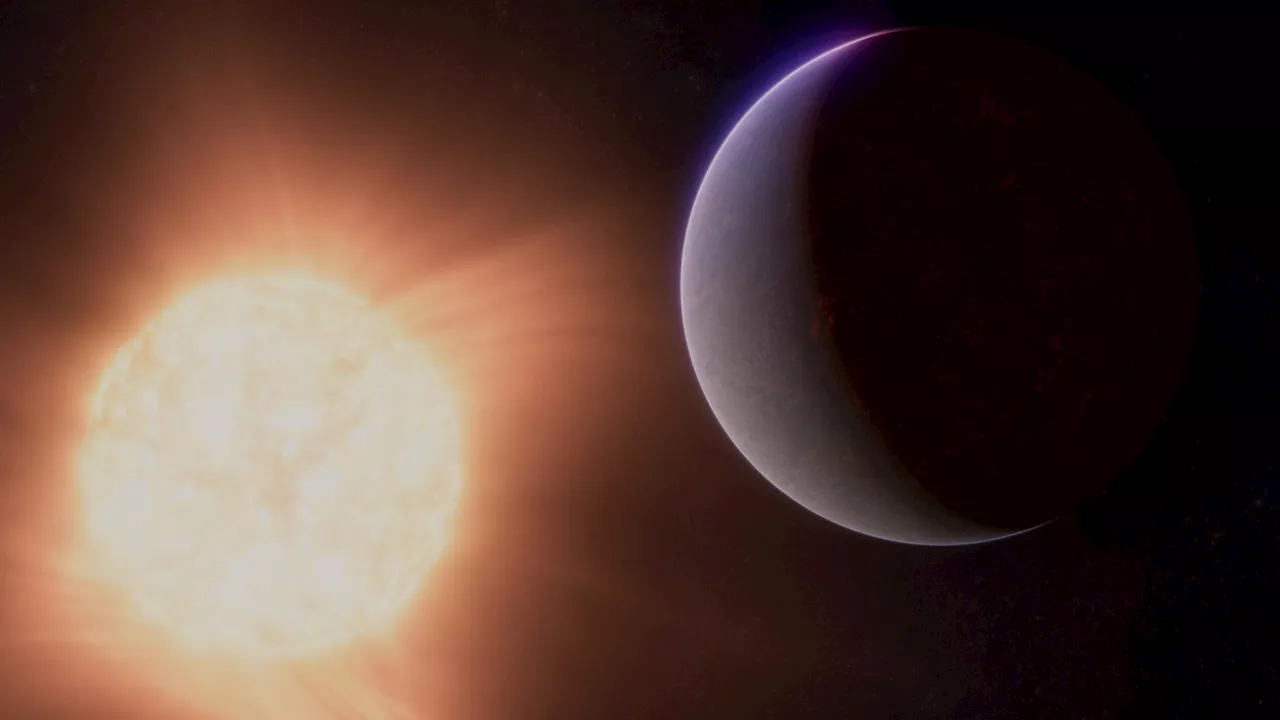
This artist’s concept shows what the exoplanet 55 Cancri e could look like. Also called Janssen, 55 Cancri e is a so-called super-Earth, a rocky planet significantly larger than Earth but smaller than Neptune, which orbits its star at a distance of only 1.
4 million miles , completing one full orbit in less than 18 hours. The system, which also includes four large gas-giant planets, is located about 41 light-years from Earth, in the constellation Cancer. Credit: NASA, ESA, CSA, Ralf Crawford have shed light on the enigmatic super-Earth 55 Cancri e, revealing its likely atmosphere composed of gases like carbon monoxide or dioxide. This discovery highlights the planet’s extreme conditions due to its proximity to its star, and its potential to offer insights into the early atmospheres of rocky planets. 55 Cancri e is one of five known planets orbiting a Sun-like star in the constellation Cancer. With a diameter nearly twice that of Earth and a density slightly greater, the planet is classified as a super-Earth: larger than Earth, smaller thanNature.. Despite enormous amounts of observing time obtained with a dozen of ground and space facilities in the past decade, its very nature has remained elusive, until today, when parts of the puzzle could finally be put together thanks to the Unexpectedly, these observations show that it might be possible for a hot and highly irradiated rocky planet to sustain a, and this bodes well for JWST’s ability to characterize cooler – potentially habitable – rocky planets orbiting Sun-like stars. Renyu Hu fromCHEOPS Space Telescope Delivered Important Findings Demory was invited to the research program by Hu who was one of his colleagues when he was at the Massachusetts Institute of Technology . Demory has been studying 55 Cancri e since the beginning of his career: “As a Postdoc at MIT I led the discovery of the first transit of 55 Cancri e, and in 2016 my team published the first map of a rocky exoplanet, which was 55 Cancri e.” The 2016 result already hinted at the possible presence of an atmosphere around 55 Cancri e. For the current study, Demory conducted an independent analysis of the JWST dataset. He explains: “In the past two years, the space telescope CHEOPS which has been developed and built at the University of Bern, has been key in solving several questions that astrophysicists had about 55 Cancri e. JWST complemented this picture at infrared wavelengths in showing that the super-Earth 55 Cancri e might be surrounded by an atmosphere with a composition consistent with carbon monoxide or carbon dioxide.”Although 55 Cancri e is similar in composition to the rocky planets in our solar system, describing it as “rocky” could leave the wrong impression. The planet orbits so close to its star that its surface must be molten – a deep, bubbling ocean of magma. With such a tight orbit, the planet is also likely to be tidally locked, with a dayside that faces the star at all times and a nightside in perpetual darkness. “The planet is so hot that some of the molten rock should evaporate,” explained Hu. Although JWST cannot capture a direct image of 55 Cancri e, it can measure subtle changes in light from the system as the planet orbits the star. The team used JWST’s NIRCam and MIRI to measure infrared light originating from the planet. By subtracting the brightness during the secondary eclipse, when the planet is behind the star , from the brightness when the planet is right beside the star , the team was able to calculate the amount of infrared light coming from the dayside of the planet at multiple wavelengths simultaneously. The first indication that 55 Cancri could have a substantial atmosphere came from temperature measurements based on its thermal emission, or heat energy given off in the form of infrared light. If the planet is covered in dark molten rock with a thin veil of vaporized rock or no atmosphere at all, the dayside should be around 2200 degrees“Instead, the MIRI data showed a relatively low temperature of about 1500 degrees Celsius,” said Hu. “This is a very strong indication that energy is being distributed from the dayside to the nightside, most likely by a volatile-rich atmosphere.” While currents of lava can carry some heat around to the nightside, they cannot move it efficiently enough to explain the cooling effect. In fact, the dayside looks several hundred degrees cooler than it should, even if heat is spread evenly around the planet. This makes sense if some of the infrared light emitted by the surface is being absorbed by the atmosphere, and never reaches the telescope.The team thinks that the gases blanketing 55 Cancri e are bubbling out from the interior. The primary atmosphere would be long gone because of the high temperature and intense radiation from the star. This would be a secondary atmosphere that is continuously replenished by the magma ocean. Magma is not just crystals and liquid rock, there’s a lot of dissolved gas in it, too. While 55 Cancri e is far too hot to be habitable, it could provide a unique window for studying interactions between atmospheres, surfaces, and interiors of rocky planets, and perhaps provide insights into the early Earth,, which are thought to have been covered in magma oceans far in the past. “Ultimately, we want to understand what conditions make it possible for a rocky planet to sustain a gas-rich atmosphere: the key ingredient for a habitable planet,” said Hu.Reference: “A secondary atmosphere on the rocky Exoplanet 55 Cancri e” by Renyu Hu, Aaron Bello-Arufe, Michael Zhang, Kimberly Paragas, Mantas Zilinskas, Christiaan van Buchem, Michael Bess, Jayshil Patel, Yuichi Ito, Mario Damiano, Markus Scheucher, Apurva V. Oza, Heather A. Knutson, Yamila Miguel, Diana Dragomir, Alexis Brandeker and Brice-Olivier Demory, 8 May 2024,SciTechDaily: Home of the best science and technology news since 1998. Keep up with the latest scitech news via email or social media.Researchers using global robotic telescopes discovered an Earth-sized planet, SPECULOOS-3 b, orbiting an ultra-cool red dwarf within the Milky Way. This planet, tidally locked and…
United States Latest News, United States Headlines
Similar News:You can also read news stories similar to this one that we have collected from other news sources.
 5.3 Million Years of Climate Secrets: Antarctic Currents Reveal Earth’s Climatic PulseScience, Space and Technology News 2024
Read more »
 Young 'cotton candy' exoplanet the size of Jupiter may be shrinking into a super-EarthRobert Lea is a science journalist in the U.K. whose articles have been published in Physics World, New Scientist, Astronomy Magazine, All About Space, Newsweek and ZME Science. He also writes about science communication for Elsevier and the European Journal of Physics. Rob holds a bachelor of science degree in physics and astronomy from the U.K.
Read more »
 Promethium bound: Rare earth element's secrets exposedScientists have uncovered the properties of a rare earth element that was first discovered 80 years ago at the very same laboratory, opening a new pathway for the exploration of elements critical in modern technology, from medicine to space travel.
Read more »
 Webb Telescope’s Breakthrough: First Atmospheric Discovery on a Rocky Super-EarthScience, Space and Technology News 2024
Read more »
 VPR: Secrets Revealed Jokes About James Kennedy's Home Near AirportUs Weekly's exclusive clip from 'Vanderpump Rules: Secrets Revealed' shows Lisa Vanderpump learning about the location of James Kennedy's home
Read more »
 Secrets of radioactive 'promethium' — a rare earth element with mysterious applications — uncovered after 80-year searchVictoria Atkinson is a freelance science journalist, specializing in chemistry and its interface with the natural and human-made worlds. Currently based in York (UK), she formerly worked as a science content developer at the University of Oxford, and later as a member of the Chemistry World editorial team.
Read more »