
The excavator has been jointly developed by NASA backed startup Interlune and industrial equipment manufacturer Vermeer.
Iowa-based industrial equipment manufacturer Vermeer has debuted a full-scale prototype of a lunar excavator as part of a joint development partnership with startup Interlune . The vehicle is intended to mine resources like helium-3 from the moon’s surface.
Such an endeavor could be a game-changer for Earth’s future technology and energy needs. Helium-3 is a rare isotope on Earth but is thought to be abundant on the moon, trapped in lunar soil by billions of years of solar wind.The elemental substance is invaluable for manufacturing of semiconductors, fiber optic technology and superconductors. It could also be pivotal in nuclear fusion, the so-called ‘Holy Grail’ of energy generation.Earth’s helium reserves are finite and shrinking, pushing tech and energy sectors to look elsewhere. Enter the Interlune, a natural resources and lunar mining startup backed by NASA and the US Department of Energy.Moon mining could soon be a realityAs part of the joint venture, Vermeer has developed its first full-scale prototype for a lunar excavator. The machine is designed to dig up 100 metric tons of lunar dirt per hour, sort it, extract helium-3, and prep it for shipment back to Earth. It meets the requirement for an autonomous, highly resilient machinery operating in extreme heat, cold, and vacuum conditions.“When you’re operating equipment on the Moon, reliability and performance standards are at a new level,” said Rob Meyerson, CEO and co-founder of Interlune in a media statement released by the company. “Vermeer has a legacy of innovation and excellence that started more than 75 years ago, which makes them the ideal partner for Interlune,” he added.Other nations, like Japan, are also exploring the potential for lunar excavation equipment. Most notably, Komatsu, a Japanese industrial giant, is developing lunar excavators—fully electric machines suitable for the moon’s environment where combustion engines can’t work as the atmosphere lacks oxygen.Komatsu showcased its prototype at CES 2025, focused on handling extreme temperatures from +110°C to -170°C. The Japanese firm is working on thermal control and electrification systems to make that viable.“On the airless surface of the moon, it would be impossible for an internal combustion engine to operate on the moon’s surface because there is no oxygen for combustion. Electrically powered machines seem the obvious solution, with solar power generation supplying the electricity. But the answer is not that simple,” Komatsu explained.Interlune targets lunar mission by 2030 Interestingly, however, despite Komatsu’s early lead, Vermeer and Interlune seem to have caught up and could be ahead. For example, the new prototype is bigger and full-scale, showing great promise through testing.The Vermeer-Interlune excavator has a larger excavation capacity, more funding and government support. To this end, Interlune is targeting a lunar mission by 2030.“The high-rate excavation needed to harvest helium-3 from the moon in large quantities has never been attempted before, let alone with high efficiency,” said Gary Lai, Interlune co-founder and CTO. “Vermeer’s response to such an ambitious assignment was to move fast. We’ve been very pleased with the results of the test program to date and look forward to the next development phase,” he added.Looking at the bigger picture, Vermeer and Komatsu’s efforts are also part of the beginning of lunar industrialization. This is a new frontier like the deep-sea rush or early oil drilling, but off-world.Whoever controls helium-3 reserves could have a strategic technological advantage, possibly affecting global geopolitics and the energy economy.
Environment Excavation Helium Interlune Inventions And Machines Lunar Space Vermeer
United States Latest News, United States Headlines
Similar News:You can also read news stories similar to this one that we have collected from other news sources.
 Lunar Space Station for NASA’s Artemis Campaign to Begin Final OutfittingHALO will provide Artemis astronauts with space to live, work, and conduct scientific research. The habitation module will be equipped with essential systems
Read more »
 NASA Reveals First-of-Its-Kind Image of Mars Rover Seen From SpaceThe Best in Science News and Amazing Breakthroughs
Read more »
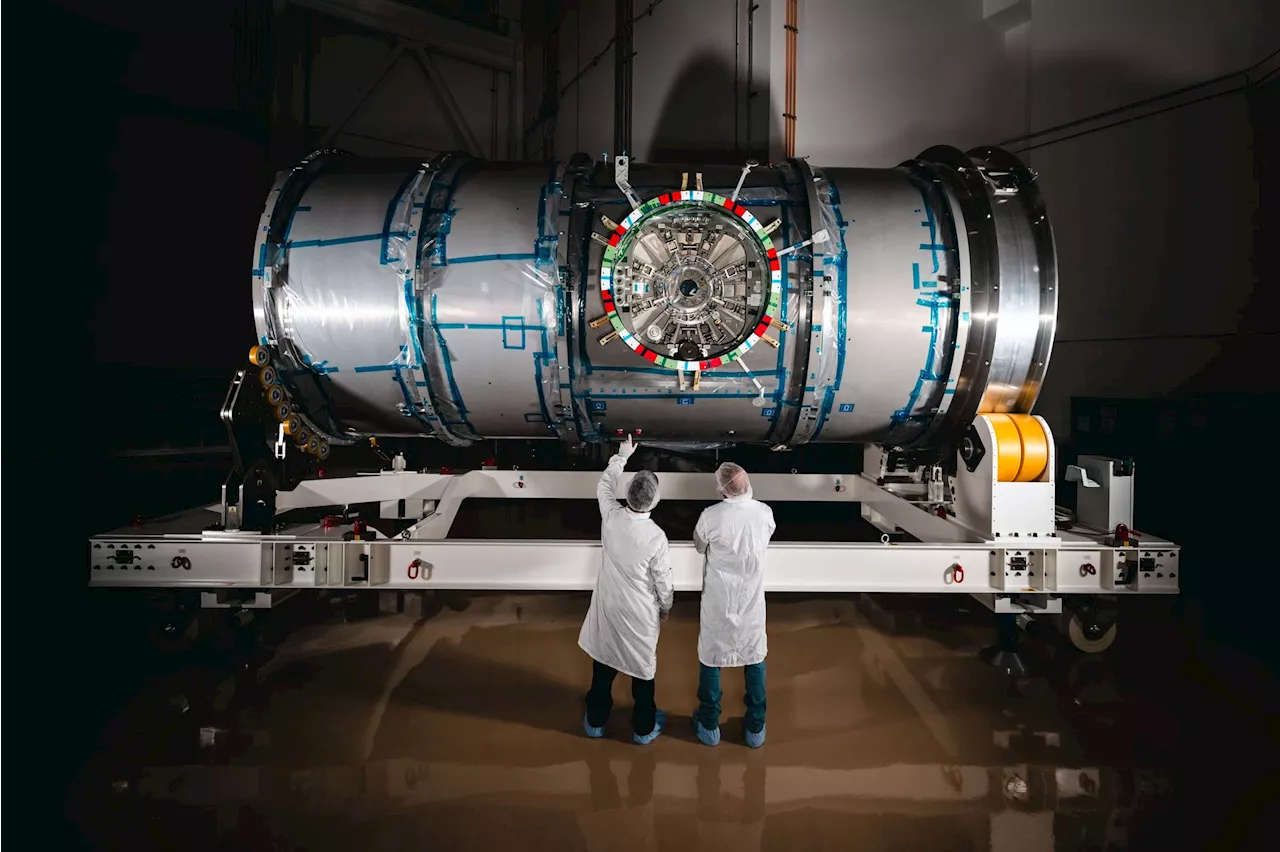 Lunar Space Station Module for NASA’s Artemis Campaign to Begin Final OutfittingHALO will provide Artemis astronauts with space to live, work, and conduct scientific research. The habitation module will be equipped with essential systems
Read more »
 In Photos: NASA Mission Sees Two Solar Eclipses From SpaceNASA’s Solar Dynamics Observatory observed 23% and 2% partial solar eclipses on April 27 and 28, 2025, whil orbiting high above Earth.
Read more »
 Moon mining machine: Interlune unveils helium-3 harvester prototype (photo)Julian Dossett is a freelance writer living in Santa Fe, New Mexico. He primarily covers the rocket industry and space exploration and, in addition to science writing, contributes travel stories to New Mexico Magazine. In 2022 and 2024, his travel writing earned IRMA Awards. Previously, he worked as a staff writer at CNET.
Read more »
 From ‘space kid’ to space traveler: Son of NASA engineer selected for Blue Origin launchThe son of a NASA engineer, Paul Jeris will emulate his heroes John Glenn and Neil Armstrong with a space flight of his own, part of Blue Origin’s latest commercial launch.
Read more »