
A study revealed that a simple thermal reaction of gallium nitride with metallic magnesium results in the formation of a distinctive superlattice structure. This represents the first time researchers have identified the insertion of 2D metal layers into a bulk semiconductor.
A study revealed that a simple thermal reaction of gallium nitride with metallic magnesium results in the formation of a distinctive superlattice structure. This represents the first time researchers have identified the insertion of 2D metal layers into a bulk semiconductor.
By carefully observing materials through various cutting-edge characterization techniques, the researchers uncovered new insights into the process of semiconductor doping and elastic strain engineering. A study led by Nagoya University in Japan revealed that a simple thermal reaction of gallium nitride with metallic magnesium results in the formation of a distinctive superlattice structure. This represents the first time researchers have identified the insertion of 2D metal layers into a bulk semiconductor. By carefully observing the materials through various cutting-edge characterization techniques, the researchers uncovered new insights into the process of semiconductor doping and elastic strain engineering. They published their findings in the journalGaN is an important wide bandgap semiconductor material that is poised to replace traditional silicon semiconductors in applications demanding higher power density and faster operating frequencies. These distinctive characteristics of GaN make it valuable in devices such as LEDs, laser diodes, and power electronics -- including critical components in electric vehicles and fast chargers. The improved performance of GaN-based devices contributes to the realization of an energy-saving society and a carbon-neutral future. In semiconductors, there are two essential and complementary types of electrical conductivity: p-type and n-type. The p-type semiconductor features primarily free carriers carrying positive charges, known as holes, whereas the n-type semiconductor conducts electricity through free electrons. A semiconductor acquires p-type or n-type conductivity through a process called doping, which refers to the intentional introduction of specific impurities into a pure semiconductor material to greatly alter its electrical and optical properties. In the field of GaN semiconductors, Mg is the only known element to create p-type conductivity up to now. Despite 35 years since the first success of doping Mg into GaN, the full mechanisms of Mg doping in GaN, especially the solubility limit and segregation behavior of Mg, remain unclear. This uncertainty limits their optimization for optoelectronics and electronics. To improve the conductivity of p-type GaN, Jia Wang, the first author of the study, and his colleagues conducted an experiment in which they patterned deposited metallic Mg thin films on GaN wafers and heated them up at a high temperature -- a conventional process known as annealing. Using state-of-the-art electron microscope imaging, the scientists observed the spontaneous formation of a superlattice featuring alternating layers of GaN and Mg. This is especially unusual since GaN and Mg are two types of materials with significant differences in their physical properties. "Although GaN is a wide-bandgap semiconductor with mixed ionic and covalent bonding, and Mg is a metal featuring metallic bonding, these two dissimilar materials have the same crystal structure, and it is a strikingly natural coincidence that the lattice difference between hexagonal GaN and hexagonal Mg is negligibly small," Wang said."We think that the perfect lattice match between GaN and Mg greatly reduces the energy needed to create the structure, playing a critical role in the spontaneous formation of such a superlattice." The researchers determined that this unique intercalation behavior, which they named interstitial intercalation, leads to compressive strain to the host material. Specifically, they found that the GaN being inserted with Mg layers sustains a high stress of more than 20 GPa, equivalent to 200,000 times atmospheric pressure, making it the highest compressive strain ever recorded in a thin-film material. This is much more than the compressive stresses commonly found in silicon films . Electronic thin films can undergo significant changes in electronic and magnetic properties because of this strain. The researchers found that the electrical conductivity in GaN via hole transport was significantly enhanced along the strained direction. "Using such a simple and low-cost approach, we were able to enhance the transport of holes in GaN, which conducts more current," Wang said."This interesting finding in interactions between a semiconductor and a metal may provide new insights into semiconductor doping and improve the performance of GaN-based devices."Jia Wang, Wentao Cai, Weifang Lu, Shun Lu, Emi Kano, Verdad C. Agulto, Biplab Sarkar, Hirotaka Watanabe, Nobuyuki Ikarashi, Toshiyuki Iwamoto, Makoto Nakajima, Yoshio Honda, Hiroshi Amano.Researchers have succeeded in creating a 'superlattice' of semiconductor quantum dots that can behave like a metal, potentially imparting exciting new properties to this popular class of ... Researchers have developed a new process that makes use of existing industry standard techniques for making III-nitride semiconductor materials, but results in layered materials that will make LEDs ... Electrical engineers have cleared another hurdle in high-power semiconductor fabrication by adding the field's hottest material -- beta-gallium oxide -- to their arsenal. Beta-gallium oxide is ... In Gallium Nitride implanted with a small amount of magnesium , scientists succeeded for the first time in visualizing the distribution and optical behavior of the implanted Mg at the ...
Spintronics Electronics Graphene Spintronics Research Mobile Computing Distributed Computing Computer Science
United States Latest News, United States Headlines
Similar News:You can also read news stories similar to this one that we have collected from other news sources.
 Nvidia and more: Citi names global stocks to play the semiconductor boomThe global semiconductor industry is set to experience 'groundbreaking changes,' Citi says, naming its top stocks to play the theme.
Read more »
 Are Semiconductor Stocks Targeting Much Higher Prices?Stocks Analysis by Chris Kimble covering: NVIDIA Corporation, VanEck Semiconductor ETF. Read Chris Kimble's latest article on Investing.com
Read more »
 Taiwan Semiconductor Stock: April Sales Soar From Advanced NodesBeth Kindig is the CEO and Lead Tech Analyst for the I/O Fund and delivers weekly in-depth tech stock analysis to her free newsletter subscribers. Sign up here to receive free weekly stock tips. I/O Fund has a cumulative 3-year audited return of 47%, beating Ark and the majority of Wall Street funds over four audit periods in 2020, 2021 and 2022.
Read more »
 A review of progress and outlook for photodetectors based on graphene–semiconductor hybrid structuresA recent review summarizes the progress made in graphene-semiconductor hybrid photodetectors over the past decade. It begins by introducing key photodetector performance indicators, providing the basis for an accurate performance evaluation.
Read more »
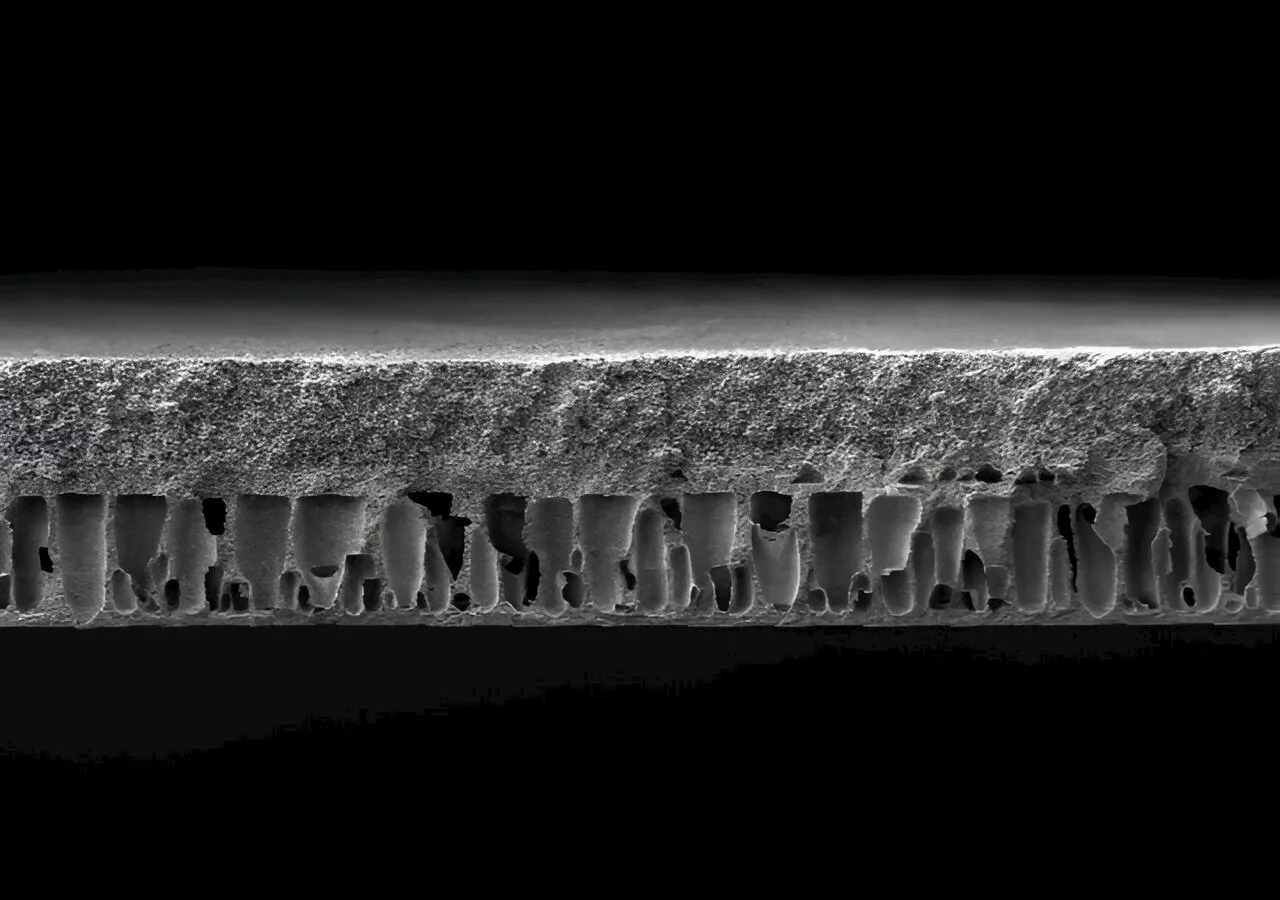 Researchers develop PFAS-free polymer membranes for semiconductor processingDue to their stability and resistance to water and grease, PFAS chemicals (short for per- and polyfluoroalkyl substances) are used in a wide range industries, but they are harmful to health and the environment. Membranes containing PFAS are used in many semiconductor manufacturing processes, for example.
Read more »
 Taiwan's energy crunch could 'throw a wrench' into the global semiconductor industryTaiwan, the world's semiconductor powerhouse, is facing a power crunch — and this could spell trouble for chipmakers.
Read more »