
NASA’s InSight lander listened to Marsquakes for four years. The tremors revealed that Mars may have a solid inner core.
That firm interior, tucked within a liquid outer core, could help researchers better understand Mars’ evolutionary history. When seismic waves travel through Mars’ interior, they can bounce off or bend at the boundaries of different layers, uncovering clues about what lies deep within.
. That firm interior, tucked within a liquid outer core, could help researchers better understand Mars’ evolutionary history.. When seismic waves travel through Mars’ interior, they can bounce off or bend at the boundaries of different layers, uncovering clues about what lies deep within.“We’re building a picture of the inside of the planet, but we hadn’t yet seen evidence of … a solid inner core,” says seismologist Vedran Lekić of the University of Maryland in College Park, who wasn’t involved in the new study. InSight data previouslySeismologist Daoyuan Sun of the University of Science and Technology of China in Hefei and colleagues examined 23 low-frequency Marsquakes whose epicenters — the surface locations at or above the quakes’ origins — were about 1,600 to 2,400 kilometers away from the lander. Some of the Marsquake waves traveled through the planet’s core, reflecting off its far side. Tremors travel more quickly through a hard medium than a fluid one, and the studied waves arrived at InSight around 50 to 200 seconds earlier than they should have if the core was purely liquid. “That gave us some ideas that must be some faster stuff in the very center,” possibly something solid, Sun says. Further analysis revealed waves that had ricocheted off a border between an inner core and an outer core, which could be there only if Mars has a solid heart. Seismic waves from Marsquakes hinted at a solid inner core within the Red Planet. Some waves traveled through Mars’ interior and bounced off the far edge of its core . Other waves ricocheted off a boundary between an inner core and an outer core , which should be possible only with a solid center.Seismic waves from Marsquakes hinted at a solid inner core within the Red Planet. Some waves traveled through Mars’ interior and bounced off the far edge of its core . Other waves ricocheted off a boundary between an inner core and an outer core , which should be possible only with a solid center.Based on various seismic waves’ travel speeds and paths, Sun and his colleagues calculated that the inner core’s radius is roughly 600 kilometers, about one-fifth of Mars’ thickness. Computer simulations considering core density and wave speeds through the planet’s heart hint that the mostly iron-and-nickel core might contain the lighter element oxygen within its hard interior, and certain percentages of sulfur, oxygen and carbon are present in the liquid outer region. “I’m more convinced than I thought I would be,” Lekić says. The authors have “clearly detected something cool.” Still, he questions whether the specified percentages of elements could realistically exist in the core at temperatures consistent with prior knowledge about Mars’ interior. But geophysicist Amir Khan of ETH Zurich is skeptical of the authors’ interpretation of the data. “I was surprised, slightly bewildered” by the results, he says. “It was not what we’re expecting to see.” Previous work suggests that Mars has a large, low-density core, which implies the presence of light elements that would prevent a solid inner core from forming, he says. Even if one had emerged, it would probably be tiny, with a radius of 300 kilometers at most. It’s tricky to distinguish useful waves from other signals within InSight’s seismic data, Khan says. He suggests that other researchers use different methods to search the new paper’s dataset for signs of a solid inner core. A hardened heart could complicate scientists’ understanding of Mars’ history. Early in its lifetime, a magnetic field probably blanketed the planet, like on modern-day Earth. The magnetization of our home planet comes from both liquid core material crystallizing into a solid center and heat flowing out of the core.Many researchers suspect that Mars stopped generating its global magnetic field because it was driven only by heat escape, which weakened as the planet cooled. If the Red Planet contains a solid inner core, Sun says, new ideas would be needed to explain the loss of its widespread magnetization.
United States Latest News, United States Headlines
Similar News:You can also read news stories similar to this one that we have collected from other news sources.
 Rosé Thanks Bruno Mars, Blackpink, Herself for Song of the Year Win at VMAsBlackpink star Rosé took home the MTV Video Music Awards' Moon Person for 'Apt.,' her hit with her 'idol and incredible teacher' Bruno Mars.
Read more »
 NASA’s InSight Lander Reveals Mars’s Lumpy Mantle in New Seismic StudyA common nasal spray shows promise in reducing COVID risk, but vaccine access remains tangled in policy in the U.S.
Read more »
 NASA's AI Doctor May Be The Key To Surviving A Mars MissionTalia has been a professional writer since 2018. She got her start at The Nerd Stash, covering consumer technology and entertainment.
Read more »
 Mars’ Mantle Is Like Rocky Road Ice Cream and Offers a Glimpse to Its Ancient PastLearn how Mars' mantle differs from Earth's and why it seismic signatures of marsquakes act like a time capsule into its past.
Read more »
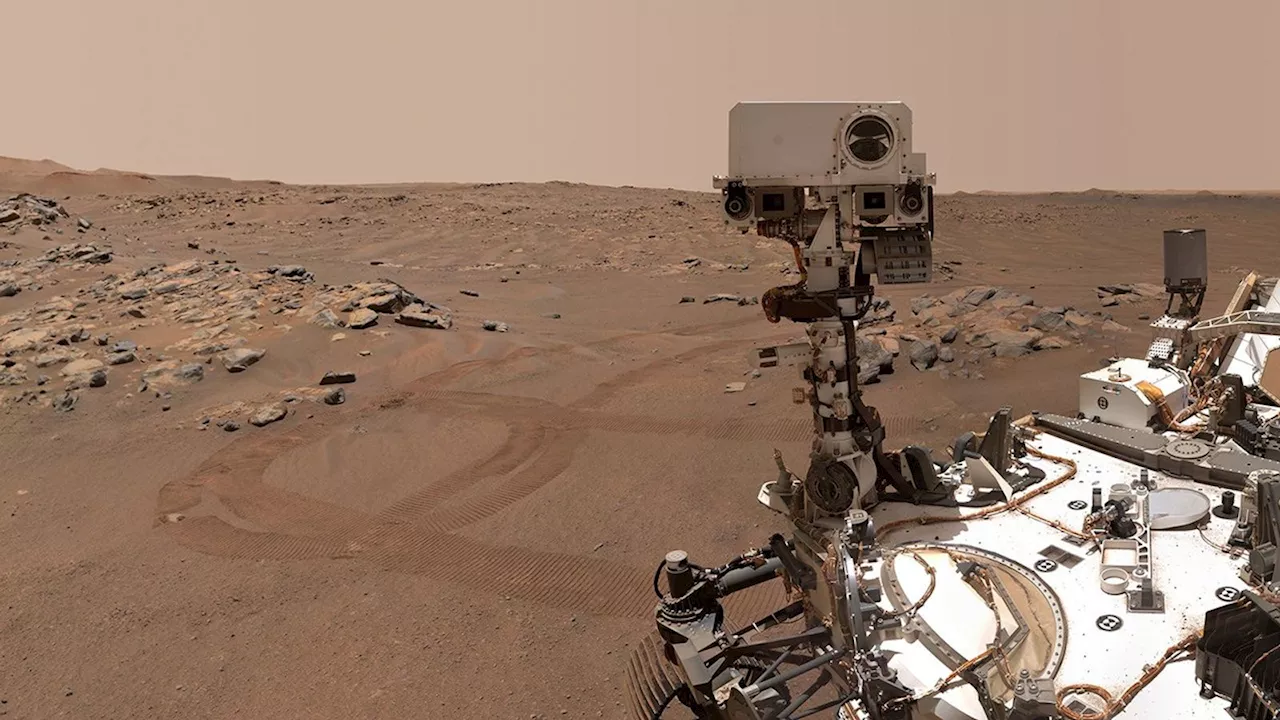 NASA to Share Details of New Perseverance Mars Rover FindingNASA will host a media teleconference at 11 a.m. EDT Wednesday, Sept. 10, to discuss the analysis of a rock sampled by the agency’s Perseverance Mars rover
Read more »
 Four volunteers are about to enter a simulated Mars habitat for a very long timeIt's to prepare for the first crewed mission to the red planet.
Read more »