
Researchers have developed a method for manipulating objects using sound waves, opening new avenues for drug delivery.
The experimental setup, with speakers and microphones at either end of a water tank, and vertical scattering objects at the center. Researchers have successfully manipulated the movement of objects using sound.
They directed floating objects around obstacles in an aquatic environment, unveiling new possibilities for noninvasive, targeted drug delivery and other biomedical applications. Researchers from EPFL’s School of Engineering employed optics-inspired techniques to achieve this object manipulation. “Optical tweezers work by creating a light ‘hotspot’ to trap particles, like a ball falling into a hole. But if there are other objects in the vicinity, this hole is difficult to create and move around,” said Romain Fleury, head of the Laboratory of Wave Engineering in EPFL’s School of Engineering.Optical tweezers are used to manipulate microscopic particles. These require extremely controlled, static conditions to work properly. According to the researchers, the team’s method – wave momentum shaping – is entirely indifferent to an object’s environment or even its physical properties. All the information that’s required is the object’s position, and the sound waves do the rest.“In our experiments, instead of trapping objects, we gently pushed them around, as you might guide a puck with a hockey stick,” “The method is rooted in momentum conservation, which makes it extremely simple and general, and that’s why it’s so promising.”, the method does not require information about the object’s physical properties or the spatial structure of the surrounding medium but relies only on a real-time scattering matrix measurement and a positional guide-star., the ball floated on the surface of a large water tank, with its position tracked by an overhead camera. Audible sound waves emitted from a speaker array at each end of the tank guided the ball along a predetermined path. Simultaneously, a second array of microphones “listened” to the feedback, known as a scattering matrix, as it bounced off the moving ball.and rotate objects, extending the potential of wave-based object manipulation to complex and dynamic scattering media. “We envision new opportunities for biomedical applications, sensing and manufacturing,” the researchers stated.of wavefront shaping, which is used to focus scattered light. However, this marks the first application of the concept of moving an object.is not limited to moving spherical objects along a path. They also used it to control rotations and manipulate more intricate floaters, such as an origami lotus. This method could potentially revolutionize biological analysis or tissue engineering applications where physically manipulating cells would cause damage or contamination.Prabhat, an alumnus of the Indian Institute of Mass Communication, is a tech and defense journalist. While he enjoys writing on modern weapons and emerging tech, he has also reported on global politics and business. He has been previously associated with well-known media houses, including the International Business Times and ANI.
United States Latest News, United States Headlines
Similar News:You can also read news stories similar to this one that we have collected from other news sources.
 Researchers identify the 18 World War II executed civilians of Adele, Rethymnon, using ancient DNA analysisA pioneering, national-level study has been conducted by the research group of Paleogenomics and Evolutionary Genetics of the Institute of Molecular Biology and Biotechnology (IMBB) of the Foundation for Research and Technology–Hellas (FORTH).
Read more »
 Researchers investigate the origin of circatidal rhythms in freshwater snailsOrganisms, including humans, follow a schedule that coordinates important bodily functions such as sleep-wake cycles, metabolism, hormone production, cognitive function, and feeding habits to environmental cycles.
Read more »
 Researchers map networks to regulate gene function within brainThe largest and most advanced maps of gene regulation netwoeks
Read more »
 British Columbia needs a unified response to respond to the biodiversity crisis, say researchersFrom massive kelp forests to monumental old-growth on land, British Columbia's biodiversity—which is unrivaled in Canada—provides an array of cultural, economic, social and other benefits. B.C.'s wide-ranging ecological zones are home to over 70 percent of Canada's mammal, bird and non-vascular plant species.
Read more »
 Scientists sound the alarm on pharmaceutical pollution crisisOur increasing dependency on pharmaceuticals comes at a major environmental cost, researchers have warned.
Read more »
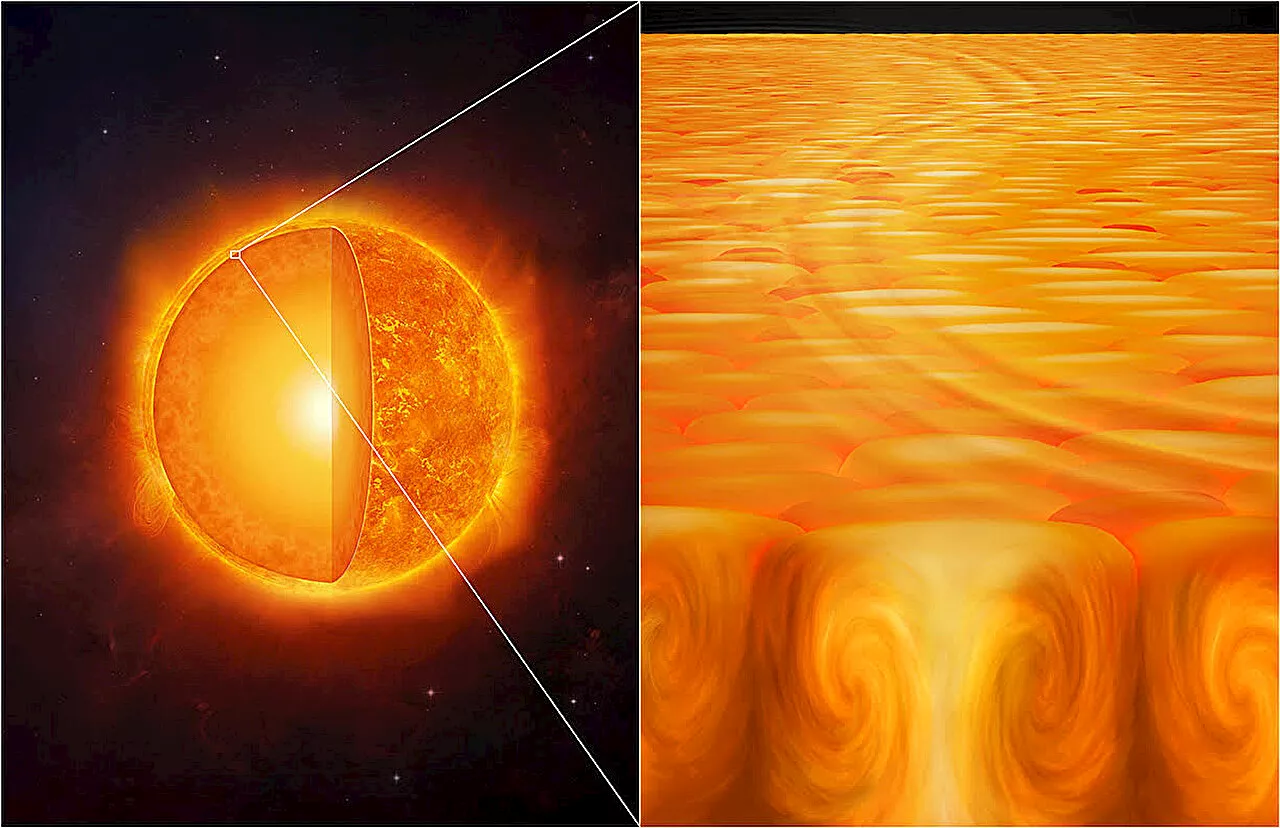 Using sound waves, scientists develop findings that challenge standard theories of solar convectionA team of solar physicists at NYU Abu Dhabi's Center for Astrophysics and Space Science (CASS), led by Research Scientist Chris S. Hanson, Ph.D., has revealed the interior structure of the sun's supergranules, a flow structure that transports heat from the sun's hidden interior to its surface.
Read more »