
The LIGO-Virgo-KAGRA (LVK) detector network has detected a collision between two exceptionally massive black holes, creating a daughter black hole 225 times the mass of our sun. This event challenges current models of black hole formation and sheds light on the nature of these enigmatic objects.
Scientists have detected the most massive merger of black holes ever. This titanic collision,"heard" in ripples in spacetime called gravitational waves, involves black holes so massive that it could challenge current models of the universe.
detector network LIGO-Virgo-KAGRA on Nov. 23, 2023, during the fourth observing run of these three sensitive laser interferometers located in the US, Italy, and Japan.. These two were so massive that when they merged, they created a"daughter" black hole 225 times the mass of our sun, with the missing mass converted to energy, propelling gravitational waves that rippled out from the violent event.What can ripples in spacetime reveal about black holes? Quite a bit, it turns outPrior to GW231123, the most massive black hole created in a merger and detected in gravitational waves had a mass of 140 times that of the sun. This was detected in 2021 as the signal"This is the most massive black hole binary we've observed through gravitational waves, and it presents a real challenge to our understanding of black hole formation," LVK collaboration and Cardiff University researcher Mark Hannam said in a statement."Black holes this massive are forbidden through standard stellar evolution models. "One possibility is that the two black holes in this binary formed through earlier mergers of smaller black holes." The monstrous masses of these black holes are not the only things that make GW231123 so interesting. The signal seems to indicate that prior to the merger, at least one of the progenitor black holes was spinning rapidly. Perhaps as rapidly as the laws of physics allow, in fact.Breaking space news, the latest updates on rocket launches, skywatching events and more!Receive email from us on behalf of our trusted partners or sponsors," LVK member Charlie Hoy of the University of Portsmouth said."That makes the signal difficult to model and interpret. It's an excellent case study for pushing forward the development of our theoretical tools."is no stranger to making history and breaking records. In 2015, its twin detectors based in Livingston, Louisiana, and Hanford, Washington, made theThis detection came exactly a century after Einstein had first predicted the existence of gravitational waves in his 1915 theory of gravity, general relativity. The signal, which would become known as GW150914, was the result of the merger of black holes that created a daughter black hole with a mass around 62 times that ofSince 2015, LIGO has been joined by the gravitational wave detectors Virgo and the Kamioka Gravitational Wave Detector . This resultant collaboration has now detected over 300 black hole mergers.of these instruments. As impressive as that is, the high-mass and rapid spin of the black holes that clashed to create GW231123 have pushed the limits of gravitational-wave detection technology and perhaps the bounds of current theoretical models, too. "This event pushes our instrumentation and data-analysis capabilities to the edge of what's currently possible," LVK member and California Institute of Technology researcher Sophie Bini said."It's a powerful example of how much we can learn from gravitational-wave astronomy — and how much more there is to uncover." 'This is the holy grail of theoretical physics.' Is the key to quantum gravity hiding in this new way to make black holes?Fully unlocking the secrets of this signal and others that LVK detected up until the end of its fourth operating run in January 2024 will require the refinement of analysis and interpretation methods. "It will take years for the community to fully unravel this intricate signal pattern and all its implications," LVK team member Gregorio Carullo of the University of Birmingham said."Despite the most likely explanation remaining a24th International Conference on General Relativity and Gravitation and the 16th Edoardo Amaldi Conference on Gravitational Wavesto keep talking space on the latest missions, night sky and more! And if you have a news tip, correction or comment, let us know at: Robert Lea is a science journalist in the U.K. whose articles have been published in Physics World, New Scientist, Astronomy Magazine, All About Space, Newsweek and ZME Science. He also writes about science communication for Elsevier and the European Journal of Physics. Rob holds a bachelor of science degree in physics and astronomy from the U.K.’s Open University. Follow him on Twitter @sciencef1rst.Black hole dance illuminates hidden math of the universeAstronomers discover most powerful cosmic explosions since the Big Bang Astronomers discover black hole ripping a star apart inside a galactic collision. 'It is a peculiar event' 'This is the holy grail of theoretical physics.' Is the key to quantum gravity hiding in this new way to make black holes?This supermassive black hole is eating way too quickly — and 'burping' at near-light speedsThis Week In Space podcast: Episode 168 —"Survivor: NASA" We've tested loads of space tech and these are the best Amazon Prime Day deals still available — star projectors, model rockets, drones and moreWant a last minute steal? Save $200 on this pro-level Sony A7R IV mirrorless camera as Walmart takes on Amazon
BLACK HOLES GRVITATION WAVES ASTROPHYSICS COSMOLOGY STELLAR EVOLUTION
United States Latest News, United States Headlines
Similar News:You can also read news stories similar to this one that we have collected from other news sources.
 Scientists detect mysterious radio waves coming from beneath Antarctica's iceAntarctic scientists detect unexplained radio waves under the ice while searching for neutrinos, with researcher Stephanie Wissel noting these signals defy physics
Read more »
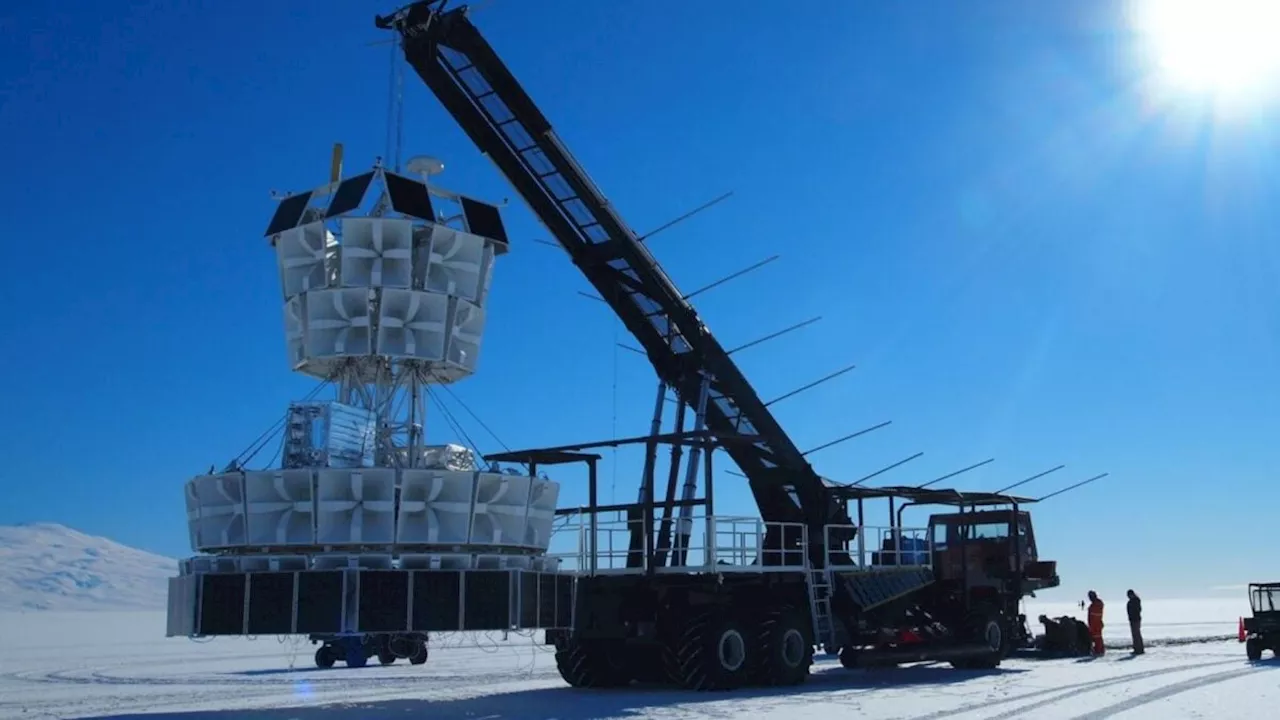 Scientists in Antarctica Detect Deep-Earth Signals That Defy Known PhysicsThe anomalies, which can’t be explained by known particle-based signals, have baffled scientists.
Read more »
 New 'breathalyzer' could detect signs of disease in human breath, scientists sayRitoban is a science and technology journalist based in Kolkata, India. His work covers everything from AI-automated workplace dystopias to Ivy-League research breakthroughs. He has been published in Quartz, OneZero, Eos Magazine, Undark, and Mental Floss.
Read more »
 Researchers Sound Alarm Over Dolphin Bacteria That Causes 'Neurological Issues' in HumansScientists in Hawaii detect a marine strain of bacteria that can be transmitted to humans.
Read more »
 Scientists Detect Deep, Rhythmic Pulse Coming From Inside the EarthScience and Technology News and Videos
Read more »
 Aliens 200 Light-Years Away Could Detect Our Airports, Scientists SayAirport and military radar signals could reveal Earth to alien civilizations up to 200 light-years away, says a study by the University of Manchester.
Read more »