
Scientists have pinpointed the oldest known evidence of humans making tools from whale bone.
Read full article: Hagan Ace Hardware in Orange Park will be rebuilt after devastating fire, spokesperson saysA Florida fisherman was mad that dolphins were ‘stealing’ his catch, so he poisoned at least 24 and shot 5 of them: NOAA Read full article: A Florida fisherman was mad that dolphins were ‘stealing’ his catch, so he poisoned at least 24 and shot 5 of them: NOAAWhy it’s important to set healthy boundaries & how to do itDiscover essentials for home and on the go with these Insider DealsSave 67% on these 8 Japanese Master Chef knives in a gift boxThis image provided by Alexandre Lefebvre shows a projectile made from gray whale bone, dating back to about 18,000 years ago, in Abbaye d'Arthous, France, in March 2021.
This image provided by Jean-Marc Ptillon shows an excavation, in which several dozen whale bone objects were discovered, led by Christian Normand in 2022 in Pyrnes-Atlantiques, France. This image provided by Jean-Marc Ptillon shows photos of a whale backbone fragment that was excavated by Eduadro Berganza in 1995 from a cave in Santa Catalina, Spain. The photos were taken October 2019, in the Traces Laboratory in Toulouse, France. This image provided by Alexandre Lefebvre shows a projectile made from gray whale bone, dating back to about 18,000 years ago, in Abbaye d'Arthous, France, in March 2021. Technological advancements in the past decade have now made it possible to date the oldest of the tools to about 20,000 years ago. Scientists found that the bones came from blue whales, fin whales, sperm whales and other species. “Humans and whales have clearly been encountering one another for a long time,” said Vicki Szabo with Western Carolina University, who studies the history of whaling and was not involved with the latest research. Scientists think that ancient humans were crafting whale bone instruments in places including the Arctic and South Pacific. There’s been solid evidence of whale bone tools dating back to about 5,000 years ago, but the new research published Tuesday in the journal Nature Communications pushes the timeline back. Ancient humans weren't necessarily hunting whales, said study author Jean-Marc Petillon with the French National Centre for Scientific Research. More likely, they were scavenging the bodies of beached whales and fashioning their dense, heavy bones into tools to hunt reindeer or bison. The tools indicate that ancient people in the area took advantage of resources near the sea for survival. They likely also collected seashells and fished. Finding such evidence has been difficult as rising sea levels disrupt coastlines across the globe, scientists said. “It’s one more contribution to the importance of coastal environments for human groups, even in this long past," said Petillon.The Associated Press Health and Science Department receives support from the Howard Hughes Medical Institute’s Science and Educational Media Group and the Robert Wood Johnson Foundation. The AP is solely responsible for all content. Copyright 2025 The Associated Press. All rights reserved. This material may not be published, broadcast, rewritten or redistributed without permission.Discover essentials for home and on the go with these Insider DealsSave 67% on these 8 Japanese Master Chef knives in a gift box
United States Latest News, United States Headlines
Similar News:You can also read news stories similar to this one that we have collected from other news sources.
 Scientists discover massive molecular cloud close to EarthNamed Eos, the cloud of gas would appear huge in the night sky if visible to the naked eye and could shed light on solar system formation.
Read more »
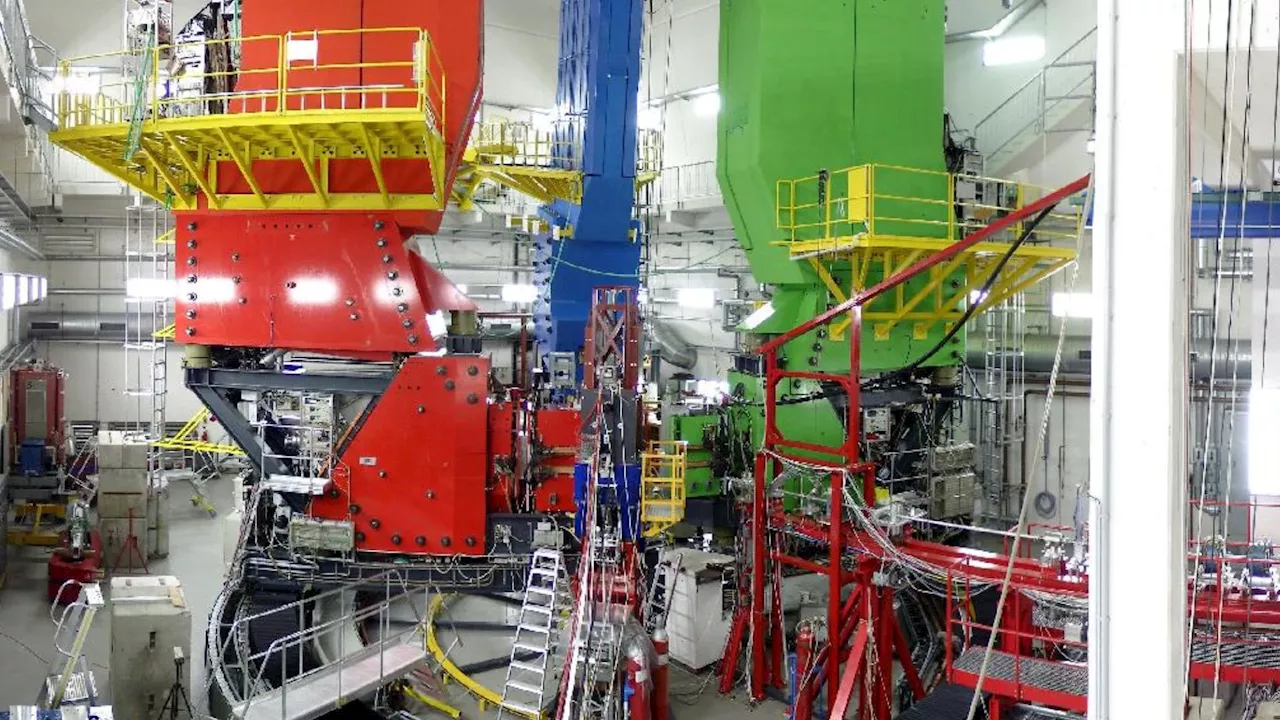 Powerful electron beams create extremely heavy hydrogen isotope for first-time everScientists successfully produced the extremely neutron-rich hydrogen-6 isotope, challenging existing nuclear physics models.
Read more »
 Magnetar 'Starquakes' Could Forge Gold in Space, Scientists DiscoverThe Best in Science News and Amazing Breakthroughs
Read more »
 Sunken coastline and higher flooding risks: Scientists chart a worst-quake scenarioAfter reading this study, I’m no longer a fan of the Cascadia subduction zone.
Read more »
 Scientists Say They May Have Spotted a Huge Hidden Planet Deep in Our Solar SystemScience and Technology News and Videos
Read more »
 Scientists use glowing crystal core in bold experiment to catch elusive dark matterAustralia's SABRE South dark matter experiment reveals full design, aims to confirm DAMA/LIBRA results with data from the Southern Hemisphere.
Read more »