
Research on saber-toothed cat teeth reveals their extreme sharpness for puncturing prey, but also their vulnerability to breakage. This specialization may have made them apex predators but ultimately limited their ability to adapt to environmental changes, leading to their extinction.
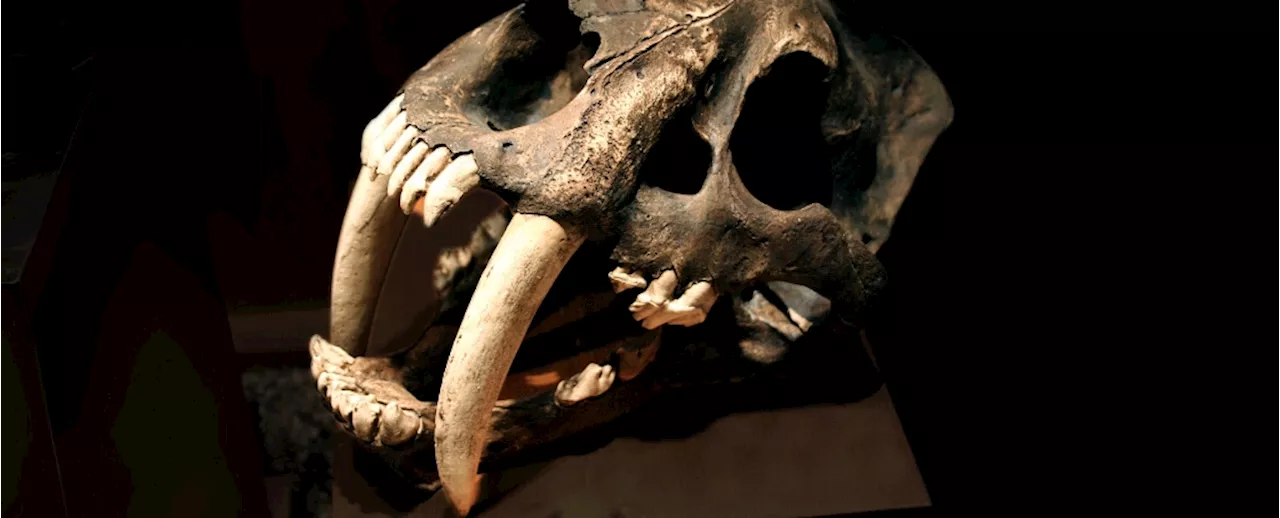
Ice Age skull on stand in research lab at the Page Musuem at the La Brea Tar Pits in Los Angeles.These long, blade-like canines seem almost perfectly optimized to kill prey. They've evolved at least five times in mammals, most notably in the saber-tooth cat, of the University of Bristol.
"In some animals these extremely elongate canines were really sharp, but they're probably also quite prone to breakage.""They need to be sharp enough to puncture and slice things. But on the other hand, they need to be strong enough to avoid breakage when they're doing that job," says Rayfield. Saber teeth took this tradeoff to the extreme, Rayfield and her colleagues report in That peak performance may have ultimately led to the downfall of saber-toothed predators, the researchers suggest. The research team came to this conclusion after analyzing nearly 100 canine teeth that spanned the super-sharp to super-sturdy spectrum, including saber-toothed cats, snow leopards, wolverines and panda bears. First, they tested each tooth's durability using the same sort of computer modeling that engineers use to test the strength of different materials.To measure puncture performance, the team turned to actual experiments. They created a stainless steel 3D model of each tooth, which then"bit" down into gel, allowing them to measure the force required for each bite. "It's kind of like a really stiff Jell-O," says Rayfield."You can imagine that really sharp teeth don't need much force to go through the gel, whereas really blunt teeth need a lot of force to go through the gel." Combined, these data revealed the relative strength and puncture performance of all these teeth. Saber teeth, it turned out, were stretched to extremes for puncture performance "They'd all evolved towards this shape which made them really good at puncturing, but probably to the point where they were as good as they could be, to resist breakage," says Rayfield."Any increase in resisting breakage would mean their puncture performance would got worse." Given saber teeth's strengths and relative weakness, saber-toothed predators likely targeted soft tissues, Rayfield suggests. Those advantages helped saber-toothed cats, including, to become apex predators of their time. But the specialization that brought them to such heights may have ultimately led to their downfall, Rayfield suspects, as no saber-toothed creatures exist today. The results"made us think about whether they'd actually kind of reached a sort of pinnacle in performance that meant that when the environment changed or when there were new predators on the scene, like humans, for example, these animals were simply not able to adapt and change," she says. In some ways, saber teeth represent an evolutionary pinnacle, the optimal design for a canine tooth to puncture prey, says Rayfield. But they also show how getting too good at one thing can sometimes be an evolutionary dead end.Jonathan Lambert is a correspondent for NPR's Science Desk, where he covers the wonders of the natural world and how policy decisions can affect them.Education
SABER-TOOTHED CATS EVOLUTION ADAPTATION PREDATOR CANINE TEETH
Trending
 A gorgeous April afternoon in store across the Denver metro area
  ‘Artemis Mission Cannot Lead To Interplanetary Wild West,’ Astronomer Warns
  Trump says US forces will ‘finish the job’ soon in first prime-time speech since starting Iran war
  Former Wisconsin football player, who left the sport amid mental health struggles, dead at 24
  Drew McIntyre Gives Honest Take About His Recent WWE Title Reign
  U.S. Sen. Bernie Sanders introduces bill that could keep the Padres in San Diego
 United States Latest News, United States Headlines
Similar News:You can also read news stories similar to this one that we have collected from other news sources.
 Study Reveals Why Saber Teeth Evolved Repeatedly in Prehistoric PredatorsThe Best in Science News and Amazing Breakthroughs
Read more »
 Celine Dion Musical 'Titanique' Sinks Its Teeth into Titanic StoryA new musical, 'Titanique', reimagines the Titanic disaster through the lens of Celine Dion's music. The lighthearted show blends elements from the 1997 film 'Titanic' with Dion's hit songs, creating a unique and entertaining experience.
Read more »
 'Nosferatu' Global Box Office Sinks Its Teeth Into Majestic HaulProfessor Albin (Willem Dafoe) and Ellen (Lily-Rose Depp) in a cemetery in the snow in Nosferatu
Read more »
 Could we ever regrow our adult teeth?Harri Elizabeth Weber is a science and tech journalist in Los Angeles, CA. Her work has appeared in TechCrunch, Fast Company, Gizmodo, VentureBeat and The Next Web.
Read more »
 Teeth brushing lessons at Swindon schools amid extraction riseHundreds of Swindon schoolchildren are being taught how to clean their teeth properly.
Read more »
 Saber Teeth: Evolutionary Pinnacle or Dead End?Researchers analyzed nearly 100 canine teeth, including those of saber-toothed cats, to understand the trade-offs between strength and sharpness. They found that saber teeth, while highly optimized for puncturing prey, may have been too specialized for survival in changing environments.
Read more »