
Scientists in China have developed robots with human-like realistic expressions. They used new algorithm for generating facial expressions on humanoid robots.
Researchers devised a specialized motor command mapping network that serves as a conduit between the generated expression images and the robot’s realistic facial responses. Robot development is nowadays one of the top growing sectors as the need for smart machines has surged dramatically from warehouses to homes and even medical surgeries.
Companies across the world are in a tight race to develop the best suitable robot that can give us human-like feel.with highly expressive facial features is developed by Liu Xiaofeng, a professor at Hohai University in east China’s Jiangsu Province, and his research team.robots usually don’t give intricate and authentic facial expressions characteristic of humans, which creates issues in smooth user engagement.images guided by AUs. In the subsequent phase, they actualize an affective robot with multifaceted degrees of freedom for facial movements, enabling it to embody the synthesized fine-grained facial expressions, reportedon Robotics, the study presents an innovative Action Unit driven facial expression disentangled synthesis method, enabling the generation of nuanced robot facial expression images guided by Action Units. By harnessing facial AUs within a framework of weakly supervised learning, the researchers effectively surmount the scarcity of paired training data .“To preserve the integrity of AUs while mitigating identity interference, we leverage a latent facial attribute space to disentangle expression-related and expression–unrelated cues, employing solely the former for expression synthesis,” said researchers in the study. “In the subsequent phase, we actualize an affective robot endowed with multifaceted degrees of freedom for facial movements, facilitating the embodiment of the synthesized fine-grained facial expressions.” Researchers devised a specialized motor command mapping network that serves as a conduit between the generated expression images and the robot’s realistic facial responses.Chinese researchers refined the prediction of precise motor commands from the robot’s generated facial expressions by utilizing the physical motor positions as constraints. Finally, qualitative and quantitative evaluations on the benchmarking Emotionet dataset verify the effectiveness of the proposed generation method. “Results on the self-developed affective robot indicate that our method achieves a promising generation of specific facial expressions with given AUs, significantly enhancing the affective human-robot interaction,” said the researchers.Prabhat, an alumnus of the Indian Institute of Mass Communication, is a tech and defense journalist. While he enjoys writing on modern weapons and emerging tech, he has also reported on global politics and business. He has been previously associated with well-known media houses, including the International Business Times and ANI.
United States Latest News, United States Headlines
Similar News:You can also read news stories similar to this one that we have collected from other news sources.
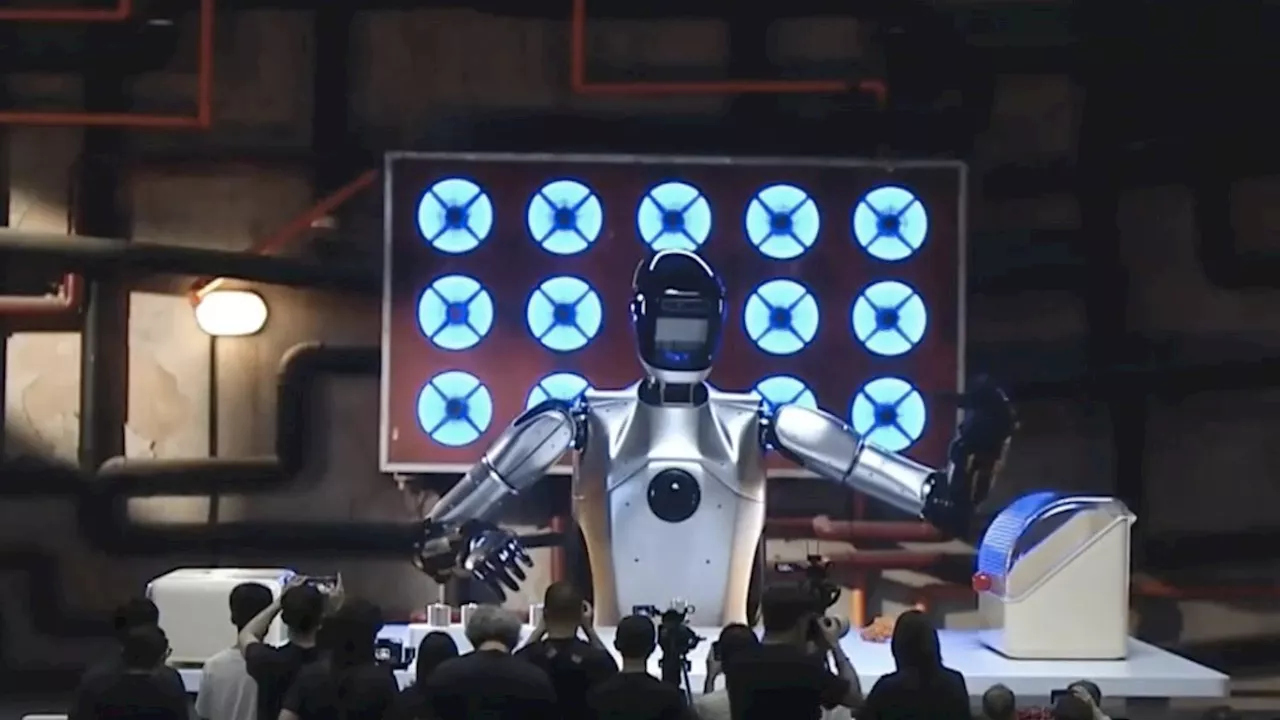 China’s 1st full-sized general-purpose humanoid robot supports multi-modal mobilityUnveiled at the World Artificial Intelligence Conference 2024, Qinglong has human-like motion control and can walk stably on slopes.
Read more »
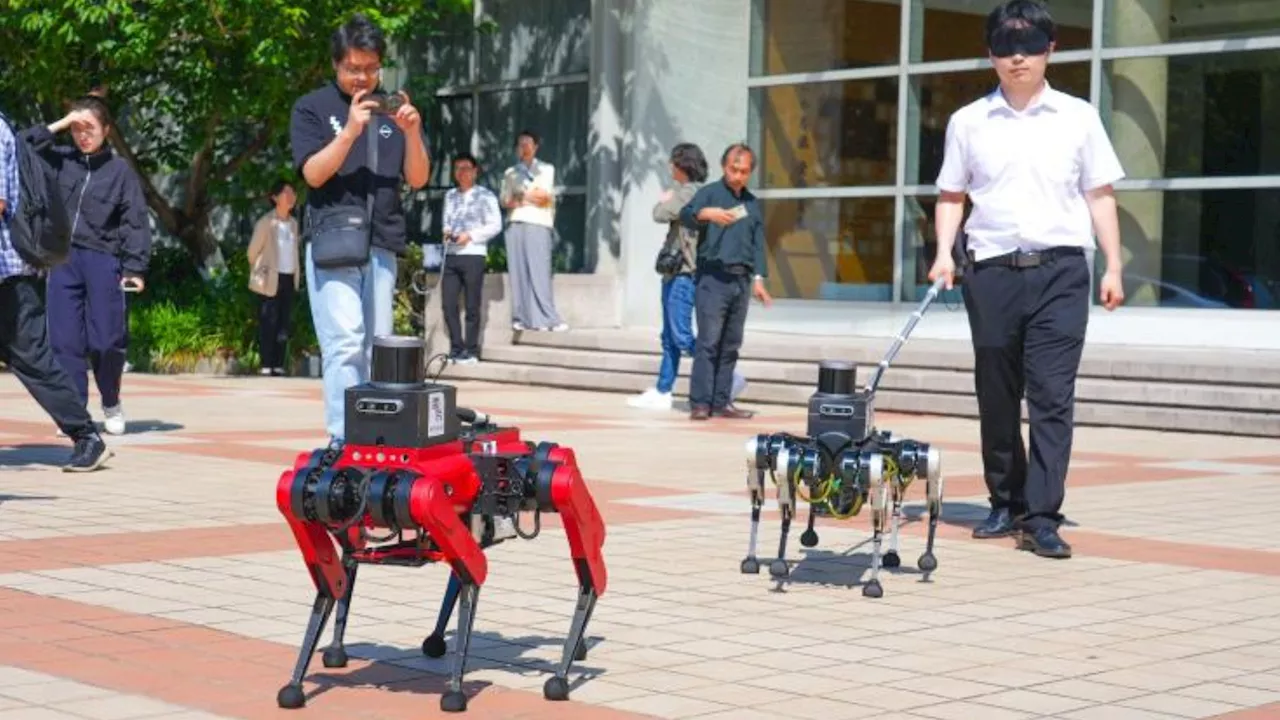 China’s robot dog aids blind people with 90% voice recognition accuracyResearchers develop a six-legged robotic dog for the visually impaired, featuring precise voice recognition and quick navigation assistance.
Read more »
China to ramp up brain chip program after teaching monkey to control robotChina has established what appears to be a roadmapping committee for the development of brain-computer interfaces.
Read more »
 Are you ready to trust your next ride to a robot chauffeur?Scientists at the University of Tokyo have developed a robot that can drive a regular vehicle. Musashi is a humanoid robot that mimics humans.
Read more »
 Now drone swarms, robot dogs join counter-terror exercise in ChinaThe activity was part of Shanghai Cooperation Organization's 'Interaction-2024' joint counter-terrorism exercise.
Read more »
 Scientists identify the predictability limit of oceanic mesoscale eddy tracks in the South China SeaOceanic mesoscale eddies (OMEs) are swirling water structures that play a crucial role in ocean dynamics. These eddies transport heat, salt, nutrients, and other materials across the ocean, significantly influencing marine ecosystems and global climate patterns.
Read more »