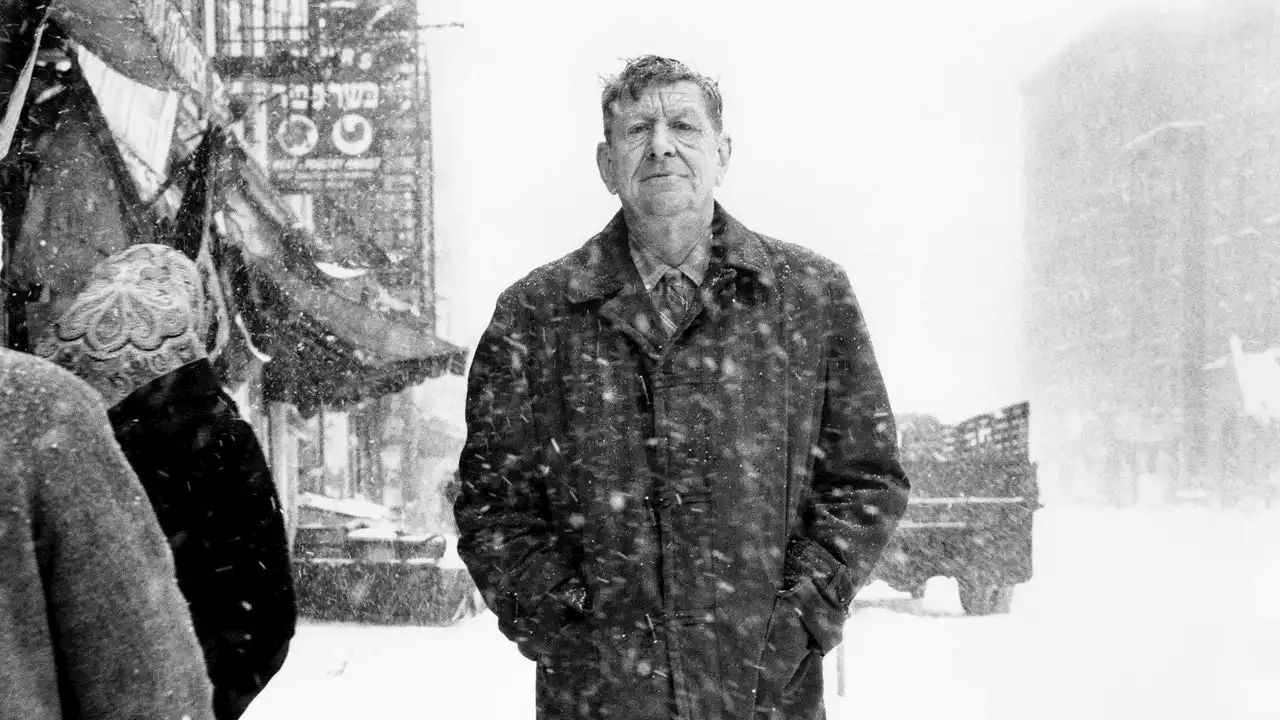
To W. H. Auden, who was born on this day in 1907, all kinds of madness were lack of discipline.
late in his life and mine—at an age when the easy, knowledgeable intimacy of friendships formed in one’s youth can no longer be attained, because not enough life is left, or expected to be left, to share with another.
Thus, we were very good friends but not intimate friends. Moreover, there was a reserve in him that discouraged familiarity—not that I tested it, ever. I rather gladly respected it as the necessary secretiveness of the great poet, one who must have taught himself early not to talk in prose, loosely and at random, of things that he knew how to say much more satisfactorily in the condensed concentration of poetry. Reticence may be theof the poet. In Auden’s case, this seemed all the more likely because much of his work, in utter simplicity, arose out of the spoken word, out of idioms of everyday language—like “Lay your sleeping head, my love, Human on my faithless arm.” This kind of perfection is very rare; we find it in some of the greatest of’s poems, and it must exist in most of Pushkin’s works, because their hallmark is that they are untranslatable. The moment poems of this kind are wrenched from their original abode, they disappear in a cloud of banality. Here all depends on the “fluent gestures” in “elevating facts from the prosaic to the poetic”—a point that the criticin December, 1973. Where such fluency is achieved, we are magically convinced that everyday speech is latently poetic, and, taught by the poets, our ears open up to the true mysteries of language. The very untranslatability of one of Auden’s poems is what, many years ago, convinced me of his greatness. Three German translators had tried their luck and killed mercilessly one of my favorite poems, “If I Could Tell You” , which arises naturally from two colloquial idioms—“Time will tell” and “I told you so”:If I could tell you I would let you know.Time will say nothing but I told you so. . . .Time will say nothing but I told you so. . . .Will Time say nothing but I told you so?I met Auden in the autumn of 1958, but I had seen him before, in the late forties, at a publisher’s party. Although we exchanged not a word on that occasion, I had remembered him quite well—a nice-looking, well-dressed, very English gentleman, friendly and relaxed. I did not recognize him ten years later, for now his face was marked by those famous deep wrinkles, as though life itself had delineated a kind of face-scape to make manifest “the heart’s invisible furies.” If you listened to him, nothing could seem more deceptive than this appearance. Time and again, when, to all appearances, he could not cope anymore, when his slum apartment was so cold that the plumbing no longer functioned and he had to use the toilet in the liquor store at the corner, when his suit was covered with spots or worn so thin that his trousers would suddenly split from top to bottom—in brief, whenever disaster hit before your very eyes, he would begin to more or less intone an utterly idiosyncratic version of “Count your blessings.” Since he never talked nonsense or said something obviously silly—and since I always remained aware that this was the voice of a very great poet—it took me years to realize that in his case it was not appearance that was deceptive, and that it was fatally wrong to ascribe what I saw of his way of life to the harmless eccentricity of a typical English gentleman. I finally saw the misery, and somehow realized vaguely his compelling need to hide it behind the “Count your blessings” litany, yet I found it difficult to understand fully why he was so miserable and was unable to do anything about the absurd circumstances that made everyday life so unbearable for him. It certainly could not be lack of recognition. He was reasonably famous, and such ambition could anyhow never have counted for much with him, since he was the least vain of all the authors I have ever met—completely immune to the countless vulnerabilities of ordinary vanity. Not that he was humble; in his case it was self-confidence that protected him against flattery, and this self-confidence existed prior to recognition and fame, prior also to achievement. It never left him, because it was not acquired by comparisons with others, or by winning a race in competition; it was natural—interconnected, but not identical, with his enormous ability to do with language, and do quickly, whatever he pleased. But even this did not go to his head, for he did not claim, or perhaps even aspire to, final perfection. He constantly revised his own poems, agreeing with Valéry: “A poem is never finished; it is only abandoned.” In other words, he was blessed with that rare self-confidence which does not need admiration and the good opinion of others, and can even withstand self-criticism and self-examination without falling into the trap of self-doubt. This has nothing to do with arrogance but is easily mistaken for it. Auden was never arrogant except when he was provoked by some vulgarity; then he protected himself with the rather abrupt rudeness characteristic of English intellectual life. Stephen Spender, the friend who knew him so well, has stressed that “throughout the whole development of [Auden’s] poetry . . . his theme had been love” , and at the end of the address that Spender gave in memory of his late friend at the Cathedral in Oxford he told of asking Auden about a reading he had given in America: “His face lit up with a smile that altered its lines, and he said: ‘They loved me!’ ” They did not admire him, theyhim: here, I think, lies the key both to his extraordinary unhappiness and to the extraordinary greatness—intensity—of his poetry. Now, with the sad wisdom of remembrance, I see him as having been an expert in the infinite varieties of unrequited love, among which the infuriating substitution of admiration for love must surely have loomed large. And beneath these emotions there must have been from the beginning a certain animalThe desires of the heart are as crooked as corkscrews,The dance’s pattern; dance while you can..” When I knew him, he would not have mentioned the best any longer, so firmly had he opted for the second-best, the “formal order,” and the result was what Chester Kallman has so aptly named “the most dishevelled child of all disciplinarians.” I think it was thisand its “dance while you can” that made Auden feel so much attracted to and almost at home in the famous Berlin of the twenties, wherewas practiced constantly in many variations. He once mentioned as a “disease” his early “addiction to German usages,” but much more prominent than these, and less easy to get rid of, was the obvious influence of Bertolt Brecht, with whom I think he had more in common than he was ever ready to admit. In merely literary terms, Brecht’s influence can easily be traced in Auden’s ballads—for instance, in the late, marvellous “,” the tale of the tumbler who, having grown old and pious, “honoured the Mother-of-God” by tumbling for her; or in the early “little story / About Miss Edith Gee; / She lived in Clevedon Terrace / At Number 83.” What made this influence possible was that they both belonged to the post-First World War generation, with its curious mixture of despair and, its contempt for conventional codes of behavior, and its penchant for “playing it cool,” which expressed itself in England, I suspect, in the wearing of the mask of the snob, while it expressed itself in Germany in a widespread pretense of wickedness, somewhat in the vein of Brecht’s “The Threepenny Opera.” In the case of Auden, as in the case of Brecht, inverted hypocrisy served to hide an irresistible inclination toward being good and doing good—something that both were ashamed to admit, let alone proclaim. This seems plausible for Auden, because he finally became a Christian, but it may be a shock at first to hear it about Brecht. Yet a close reading of his poems and plays seems to me almost to prove it. Not only are there the plays “Der Gute Mensch von Sezuan” and “Die Heilige Johanna der Schlachthöfe” but, perhaps more convincingly, there are these lines right in the midst of the cynicism of “
United States Latest News, United States Headlines
Similar News:You can also read news stories similar to this one that we have collected from other news sources.
 'Rust' Armorer Hannah Gutierrez-Reed, New Job at Tattoo Parlor'Rust' armorer Hannah Gutierrez-Reed is spotted walking into her new job at a tattoo parlor.
Read more »
 Trans child molester Hannah Tubbs gloats over light sentence from Gascón in jailhouse phone callsExplicit jailhouse recordings of Hannah Tubbs, the 26-year-old trans child molester who received a slap on the wrist last month after pleading guilty to molesting a 10-year-old in 2014, depict her admitting it was wrong to attack a little girl but gloating over the light punishment. LA County DA George Gascón's policies allowed for the light sentencing in the 2014 attack.
Read more »
 Gascon Acknowledges Sentence Not Adequate For Convicted Child Sex Abuser Hannah TubbsL.A. District Attorney George Gascon admitted Sunday that a 2-year sentence in juvenile custody for a transgender woman accused of sexually assaulting a 10-year-old girl was likely not adequate.
Read more »