
And how that storm affected Houston when Hurricane Rita moved into the Gulf
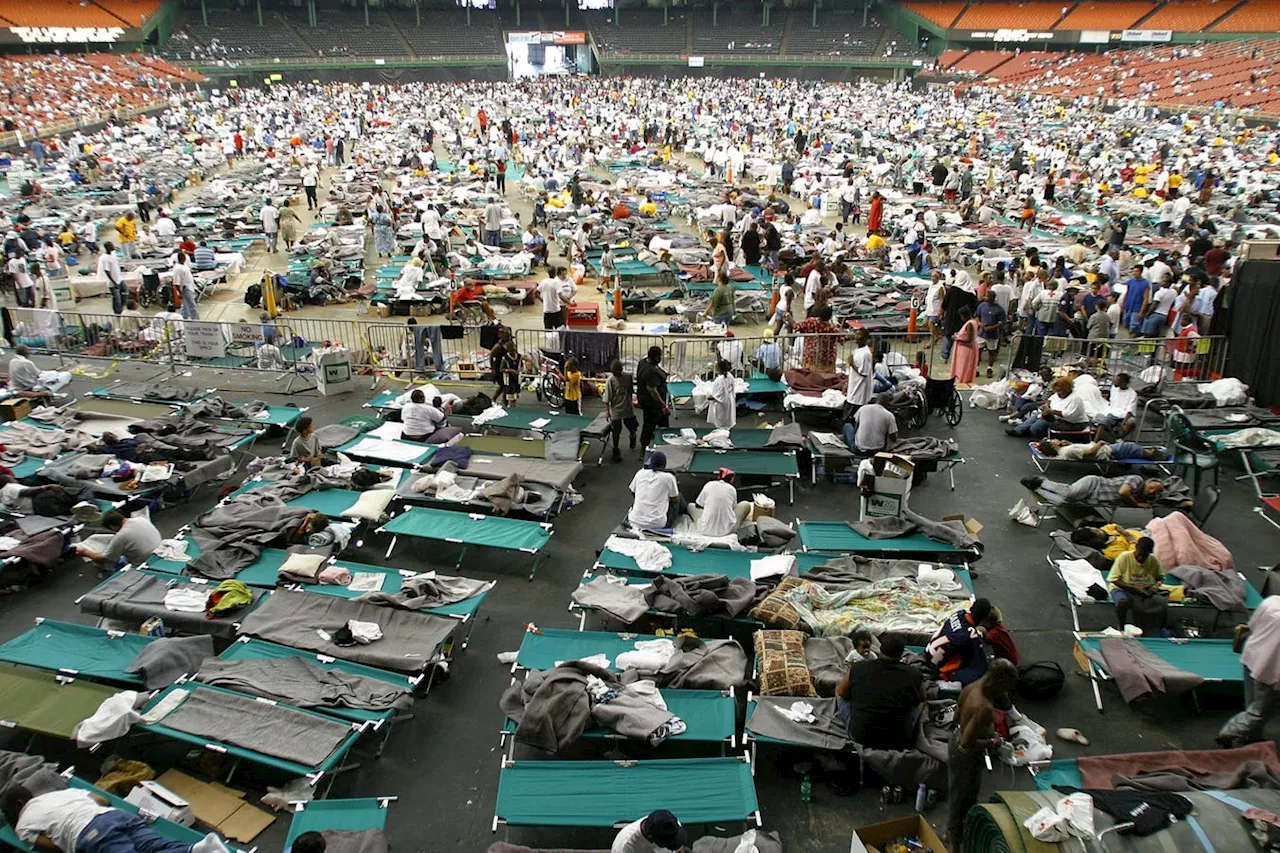
Houston , UNITED STATES: Hurricane Katrina evacuees crowd the fiels at the Astrodome stadium in Houston , Texas, 09 September, 2005. Police closed off the Astrodome stadium in Houston as word spread among Hurricane Katrina evacuees that the American Red Cross was giving handouts of up to 2,000 USD.
The money was given as credits on a debit card that can be used in stores or to get cash from automatic dispensers. AFP PHOTO/MENAHEM KAHANA Read full article: 20 Years after Katrina: How Houston’s Astrodome became a beacon of hopeMan accused of using fake ID to buy nearly $100K in cars in Arlington, caught in Houston Read full article: Man accused of using fake ID to buy nearly $100K in cars in Arlington, caught in Houston SkyWest 6371, operating on behalf of United Airlines, arrives from Seattle-Tacoma. This used to be a mainline trunk route for United Airlines, but during the gutting of United in the 2000's, it was downgauged to regional jets. Alaska Airlines and Virgin America are the mainline aircraft operators on this route today. N745SK, Bombardier CRJ-700Injuries reported on Houston-bound United Express flight that hit ‘severe turbulence,’ diverted to Austin Read full article: Injuries reported on Houston-bound United Express flight that hit ‘severe turbulence,’ diverted to Austin FILE - Debris covers the area of Camp Mystic in Hunt, Texas, Monday, July 7, 2025, after a flash flood swept through the area. Texas House advances bill to levy stricter penalties on camps following the Hill Country floodAt the time, I was working here at KPRC 2. I remember the forecast, the landfall, and the stories that unfolded with striking clarity. I shared those memories on air, and if you have a couple of minutes, I invite you to press play below and watch. While Hurricane Katrina never struck Houston directly, it cast a long shadow over our city. Just one month later, whenForecasting Rita was a challenge, not because of the storm itself, but because of what people had just witnessed in New Orleans. Despite Houston’s very different geography, the images of flooded homes and desperate rescues were impossible to forget. That fear drove an estimated three and a half million people to flee the Houston area. Highways became parking lots, families ran out of gas in the sweltering heat, and tragically, more lives were lost in the evacuation than in the storm itself.Coordinator, who worked both hurricanes, Katrina and Rita. We both agree: Katrina shaped the Rita evacuation, and we lost control of the message.Contra flow when inbound and outbound traffic went the same way out of townIt was 20 years ago. Hurricane Rita, a Category 5 storm in the Gulf of Mexico, was moving north, and for those who remember, it felt like“It was an interesting time, because we had just gone through Katrina and were sheltering thousands of evacuees here,” Sloan recalled. “The traffic… people were reacting to what had happened in New Orleans. They were trying to save themselves. But we created another disaster within a potential disaster.” The images on TV told the story: highways jammed, cars at a standstill, millions trying to leave at once. I asked him what was going through his mind as he saw everything unfold. “We needed to get people to a safe location,” Sloan said. “But we really didn’t have a true hurricane evacuation plan at the time. That was the first time it was implemented, voluntary or mandatory evacuations. But everybody left almost at the same time. Three million people got on the roads, all trying to protect themselves and their families.” It was chaos. People outside of evacuation zones in Katy, Tomball, and The Woodlands also hit the road. “People were running out of fuel,” Sloan added. “Vehicles were stranded. We couldn’t get first responders to those who needed help. The lessons we learned led to changes. By Hurricane Ike, evacuations were staged, calmer, and far more effective. People understood the process, and it worked well.” Looking back 20 years later, the evacuation maps themselves were new and confusing. Residents weren’t sure what their color zones were. That confusion, paired with the fear of Katrina, shaped the largest and most chaotic evacuation in U.S. history!“One of the cue cards showed that if you lived in the blue area, you needed to leave. But defining that blue area hadn’t been done; it was just a visual,” he recalled. “People asked, ‘How far from the coast am I? Do I evacuate?’ And the truth is, we weren’t just evacuating the blue. We evacuated the yellow and purple, too. And many people couldn’t even tell the colors apart. It was a lesson we’ll never forget. Even 20 years later, it’s a reminder for families to have a plan, protect their property, and never forget about their pets.” Because of those lessons from Rita, the system has been completely redesigned. Today, Houston’s evacuation map is based on color-coded ZIP codes, making it much clearer who should leave and when. Evacuation routes are staged, supported with gas stations, traffic control, and emergency responders, ensuring families have a safer, smoother way out when the next storm comes. When Hurricane Ike was headed our way, the evacuation was smoother and safer. Rice University conducted a study after the storm and found, if your neighbor evacuated, you left too. The overall takeaway is simple: know your zone, know your plan, and stay ready. Hurricanes will always come and go, but the lessons of Katrina and Rita remind us that how we respond can save lives. And because history is the greatest teacher, that’s something worth remembering not just 20 years later, but every hurricane season.Chief meteorologist and recipient of the 2022 American Meteorological Society’s award for Excellence in Science Reporting by a Broadcast Meteorologist.
Hurricane Hurricane Katrina Hurricane Rita Weather Hurricane Preparedness Severe Weather Louisiana Houston Texas Weather Anthony's Weather Lab Hurricane Season 2025 Hurricane Season
United States Latest News, United States Headlines
Similar News:You can also read news stories similar to this one that we have collected from other news sources.
 Robin Roberts to revisit New Orleans, Mississippi 20 years after Hurricane Katrina'Hurricane Katrina: 20 Years After the Storm With Robin Roberts' airs Aug. 29.
Read more »
 'Good Morning America's' Robin Roberts returns to Gulf Coast 20 years after Hurricane Katrina'Hurricane Katrina: 20 Years After the Storm With Robin Roberts' will air Friday, Aug. 29, on ABC.
Read more »
 Hurricane Katrina by the Numbers, 20 years laterWith numbers that still stagger today, Hurricane Katrina was one for the record books.
Read more »
 Hurricane Katrina: 20 years later, a legacy of devastation and resilienceTwenty years ago this week, Hurricane Katrina began its catastrophic journey, forming near the Florida coast on August 23, 2005. By the time it reached the cent
Read more »
 20 years after Katrina, hurricane risks to Gulf Coast rising, scientist warnsThe Gulf Coast of the United States is increasingly vulnerable to hurricanes, a scientist has warned in a new study, 20 years after Katrina devastated New Orleans and hundreds of miles of coastline.
Read more »
 Reflections On Forecasting Hurricane Katrina, 20 Years LaterMeteorologist and DTN GM for Weather and Climate Intelligence, Renny Vandewege reflects on reporting Hurricane Katrina and the lessons that apply 20 years later.
Read more »