
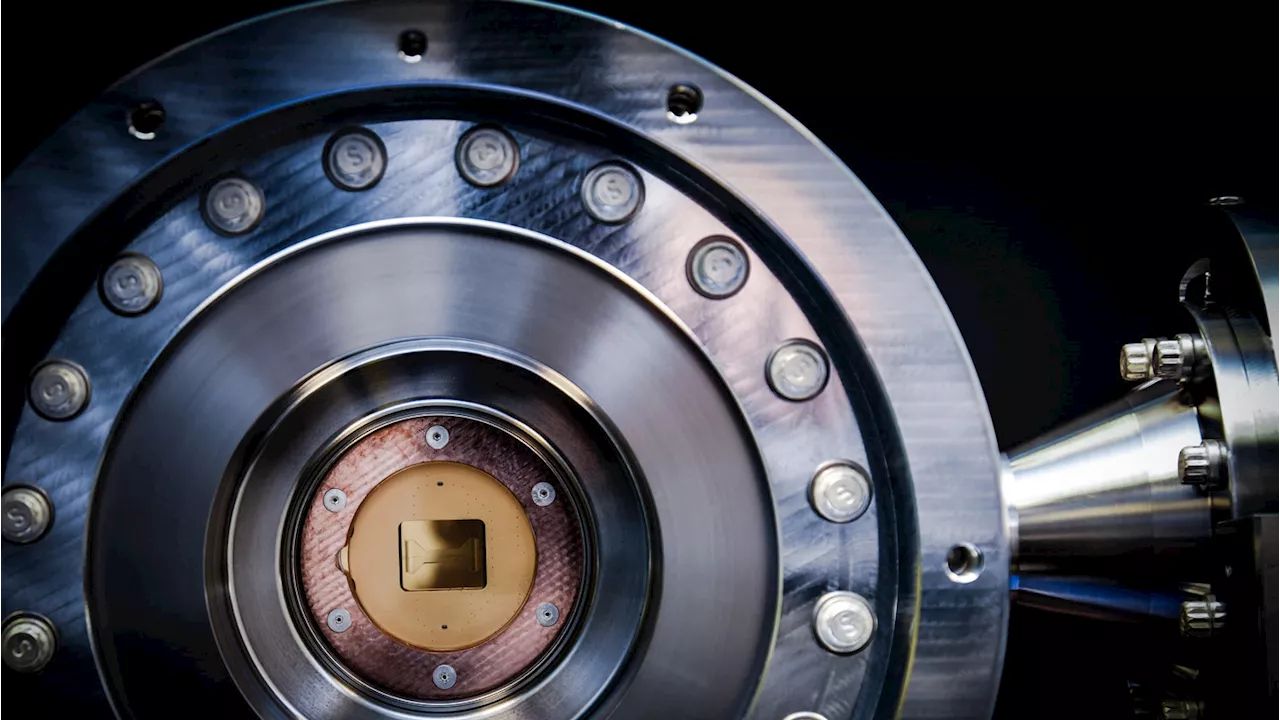
This device works like a universal translator, converting signals between two incompatible energies: microwaves and light.
Imagine if future quantum computers could talk to each other across cities, countries, even continents without losing their spooky quantum connection. A team of researchers from the University of British Columbia has created a device that could help us realize this future.
This device, which is just a tiny chip made of silicon, works like a universal translator, converting signals between two incompatible energies: microwaves and light. This chip can convert up to 95% of a quantum signal in both directions, and with almost zero noise. “It’s like finding a translator that gets nearly every word right, keeps the message intact and adds no background chatter,” lead researchers Mohammad Khalifa, and a graduate research assistant at UBC’s Blusson Quantum Matter Institute, said.Khalifa and his team suggest that this innovation could one day unlock the dream of a quantum internet, making information transfer more secure, faster, and much more powerful than anything we have today.Quantum communication is a tricky gameQuantum computers store and process information using microwave signals, but microwaves can’t travel well through long-distance cables and get absorbed and lost. This is why the internet uses light signals that travel through fibre-optic cables. For a quantum internet to work, we need a way to convert microwave signals into optical ones and back, without disturbing the fragile quantum information they carry. This is harder than it sounds. Even tiny disturbances during this conversion can destroy the quantum link between entangled particles, ruining the data. Many experimental devices have tried to solve this problem, but most add too much noise, don’t work both ways, or only work in complex lab settings. The UBC team has proposed a device that solves this problem using a clever trick inside silicon. Their design involves a silicon chip, similar to those used in everyday electronics, but with tiny magnetic defects intentionally added to it. These defects contain electrons trapped at specific points. When a microwave signal and an optical signal are carefully tuned to match the energy levels of these trapped electrons, the electrons can flip states without absorbing energy. This lets them act as messengers, smoothly converting one type of signal into the other, and they do this very efficiently as well. For instance, the chip can convert up to 95% of the signal with virtually no added noise, a huge improvement over earlier attempts.“Most importantly, this device preserves the quantum connections between distant particles and works in both directions. Without that, you’d just have expensive individual computers. With it, you get a true quantum network,” Khalifa added.It’s also extremely power-efficient, running on just millionths of a watt. To keep everything stable and quantum-friendly, the design uses superconducting materials that conduct electricity with no resistance.The future of the quantum internetThough this approach is still theoretical, the proposed chip design represents a major step forward in building long-distance quantum networks. If realized, it could allow quantum computers in different parts of the world to stay entangled in a way that classical systems can’t match. That could lead to unhackable internet communication, indoor GPS systems, and ultra-powerful computing tools capable of designing new drugs or simulating complex natural systems. However, this isn’t happening overnight. The team’s work lays the foundation, but now comes the challenge of physically building and testing the chip. “We’re not getting a quantum internet tomorrow, but this clears a major roadblock. Currently, reliably sending quantum information between cities remains challenging. Our approach could change that,” Joseph Salfi, one of the study authors and an assistant professor at UBC, said.Obviously, it would take some time before the design is realized. However, the best part is—the proposed device can be built using existing chip-manufacturing technologies. That means it can eventually be mass-produced and integrated into today’s fiber-optic networks without reinventing the entire system.The study is published in the journal npj quantum information.
United States Latest News, United States Headlines
Similar News:You can also read news stories similar to this one that we have collected from other news sources.
 Physicists force atoms into state of quantum 'hyper-entanglement' using tweezers made of laser lightAlan is a freelance tech and entertainment journalist who specializes in computers, laptops, and video games. He's previously written for sites like PC Gamer, GamesRadar, and Rolling Stone. If you need advice on tech, or help finding the best tech deals, Alan is your man.
Read more »
 Light Squeezed Out of Darkness in Surprising Quantum SimulationThe Best in Science News and Amazing Breakthroughs
Read more »
 Quantum Super Hub: Meet the ChatGPT of quantum computing unveiled in CanadaA new facility in Lethbridge, Canada allows people to solve real-world problems by providing access to a quantum computing system.
Read more »
 Afghan translator for U.S. troops detained at immigration hearing in San DiegoAn Afghan national who worked as a translator for U.S. troops and entered the U.S. legally was detained during his immigration hearing in San Diego.
Read more »
 Afghan translator for US troops detained at immigration hearing'I worked in a very dangerous part of Afghanistan with the U.S. military,' he said. He had entered the U.S. legally.
Read more »
 ‘Magic’ states empower error-resistant quantum computingSpecial quantum states allow computers to perform the most difficult class of quantum computing operations.
Read more »