
This article explores the growing recognition in quantum physics of the importance of reference frames. Traditionally, quantum experiments assumed a shared reference frame for observers, but recent research suggests that quantum uncertainty and superposition necessitate a re-evaluation of this concept. The article highlights the implications of incorporating quantum theory into the description of reference frames, potentially leading to new insights into phenomena like superposition and entanglement.
Imagine standing on a railway platform watching a trolley go past. A girl on the trolley drops a bright red ball. To her, the ball falls straight down. But from the platform, you see the ball traverse an arc before hitting the trolley floor.
The two of you observe the same event, but from different reference frames: one anchored to the trolley and the other to the platform. The idea of reference frames has a storied history in classical physics: Isaac Newton, Galileo, and Albert Einstein all relied on them for their studies of motion. A reference frame is essentially a coordinate system that might itself be in motion. Einstein used reference frames to develop his theories of relativity, which revealed that space and time are not fixed backdrops to the universe, but rather elastic entities that can stretch, scrunch, and warp. But quantum physics has for the most part ignored reference frames. Alice and Bob, the fictional observers in many experiments in quantum physics, typically have different physical locations, but they’re assumed to have a common reference frame. This is now changing. Quantum physicists are realizing that they can’t ignore the fact that the reference frame Alice is anchored to might have multiple possible locations at once. Or that the clock Bob is using to measure time might be subject to quantum uncertainty. “In the quantum world, the reference frames should be described by the formalism of quantum theory,” said Renato Renner, a theoretical physicist at the Swiss Federal Institute of Technology Zurich. In a paper this year, the physicist Časlav Brukner at the Institute for Quantum Optics and Quantum Information and the University of Vienna and colleagues showed that quantum reference frames put a new perspective on long-studied quantum phenomena such as superposition and entanglement. The findings lead Renner to suspect that quantum reference frames might help resolve some of the weird paradoxes that arise in quantum thought experiments. Even more ambitiously, Brukner and colleagues hope that thinking through the logic of quantum reference frames might yield new insights about quantum gravity—a research program that attempts to bring gravity into the same theoretical fold as the other fundamental forces. With this new foray into quantum reference frames, Renner said, “we are only at the beginning of something very big.” Fuzzy Locations The notion of quantum reference frames was first introduced in 1984, but multiple groups revived the idea around 2019, triggering a surge of recent study. The arguments challenge us to change how we think about two quintessential quantum properties: superposition, where an object can simultaneously be in multiple possible states, and entanglement, where distinct particles share a single quantum state, such that measuring one of them instantly determines the state of the other, regardless of the distance between them. To see how, consider two reference frames; we’ll label them A and B. Let’s say that A’s origin is anchored to a quantum object that has probabilities of being found in various locations. From the perspective of B, A’s location is smeared over some region. But from the perspective of A, the distance to B is smeared out. It appears as though B is the one in a superposition. It gets better. What if B is also anchored to a quantum object that’s in a superposition of two locations? Then A’s quantum state is now smeared out in two different ways, depending on the possible locations of B. Because determining B’s quantum state determines A’s state, A and B are now entangled. In the above example, two quintessential properties of quantum systems—superposition and entanglement—turn out to depend on the frame of reference. “The main message is that a lot of the properties that we think are very important, and in a way absolute, are relational” or relative, said Anne-Catherine de la Hamette, a coauthor of the recent paper. Even the order of events succumbs to the rigors of quantum reference frames. For example, from one reference frame, we might observe the click of a detector happening at a certain time. But from a different reference frame, the click might end up in a superposition of happening before and after some other event. Whether you observe the click as happening at some particular time or as being in a superposition of different orders of events depends on the choice of reference frame. Stepping Stone to Gravity Researchers hope to use these shifting quantum perspectives to make sense of the puzzling nature of gravity. Einstein’s general relativity, which is a classical theory of gravity, says that gravity is the warping of the fabric of space-time by a massive object. But how will space-time warp if the object itself is in a superposition of two locations? “That’s very hard to answer with usual quantum physics and gravity,” said Viktoria Kabel, a researcher in Brukner’s group and a coauthor of the new paper. Switch to a reference frame whose origin is in a superposition, though, and the massive object can end up in a definite location. It now becomes possible to calculate its gravitational field. “By finding a convenient quantum reference frame, we can take a problem that we cannot solve a problem that we can just use standard known physics for,” Kabel said. Such perspective changes ought to be useful for analyzing future experiments that aim to put extremely small masses in superpositions. For example, the physicists Chiara Marletto and Vlatko Vedral of the University of Oxford have proposed putting two masses each in a superposition of two locations and then studying how this affects their gravitational fields. The burgeoning attempts to formally describe quantum reference frames could help make sense of these investigations of the interaction between gravity and quantum theory—an essential stepping stone to a theory of quantum gravity. Renner thinks quantum reference frames may also be central to elucidating the foundations of quantum physics. A few years ago, he and his colleague Daniela Frauchiger designed a quantum thought experiment that creates a logical contradiction. The resulting paradox seems to imply that physicists must give up at least one of many well-accepted notions about our world—say, that quantum theory is universal and applies to human beings as well as atoms. Renner, however, now suspects that the paradox arises simply because physicists haven’t carefully accounted for reference frames. No one has yet figured out how to rewrite this or other thought experiments using quantum reference frames, but doing so “is very likely to lead us to the solution of the paradoxes,” he said. It’s not going to be easy, because quantum reference frames come with plenty of unsolved problems. For example, with classical reference frames, if you change your point of view from one frame to another, this transformation is reversible: you can revert to your original point of view. It’s not clear that this is currently universally possible with quantum reference frames. Also, at this point, there’s no standard way of defining and translating between quantum reference frames. Different groups of physicists have different approaches. “They all look reasonable first sight, but they are not equivalent to each other,” Renner said. Eventually, though, quantum reference frames might prove essential to making sense of the quantum world. Original story reprinted with permission from Quanta Magazine, an editorially independent publication of the Simons Foundation whose mission is to enhance public understanding of science by covering research developments and trends in mathematics and the physical and life sciences.
QUANTUM PHYSICS REFERENCE FRAMES SUPPOSITION ENTANGLEMENT RELATIVITY
United States Latest News, United States Headlines
Similar News:You can also read news stories similar to this one that we have collected from other news sources.
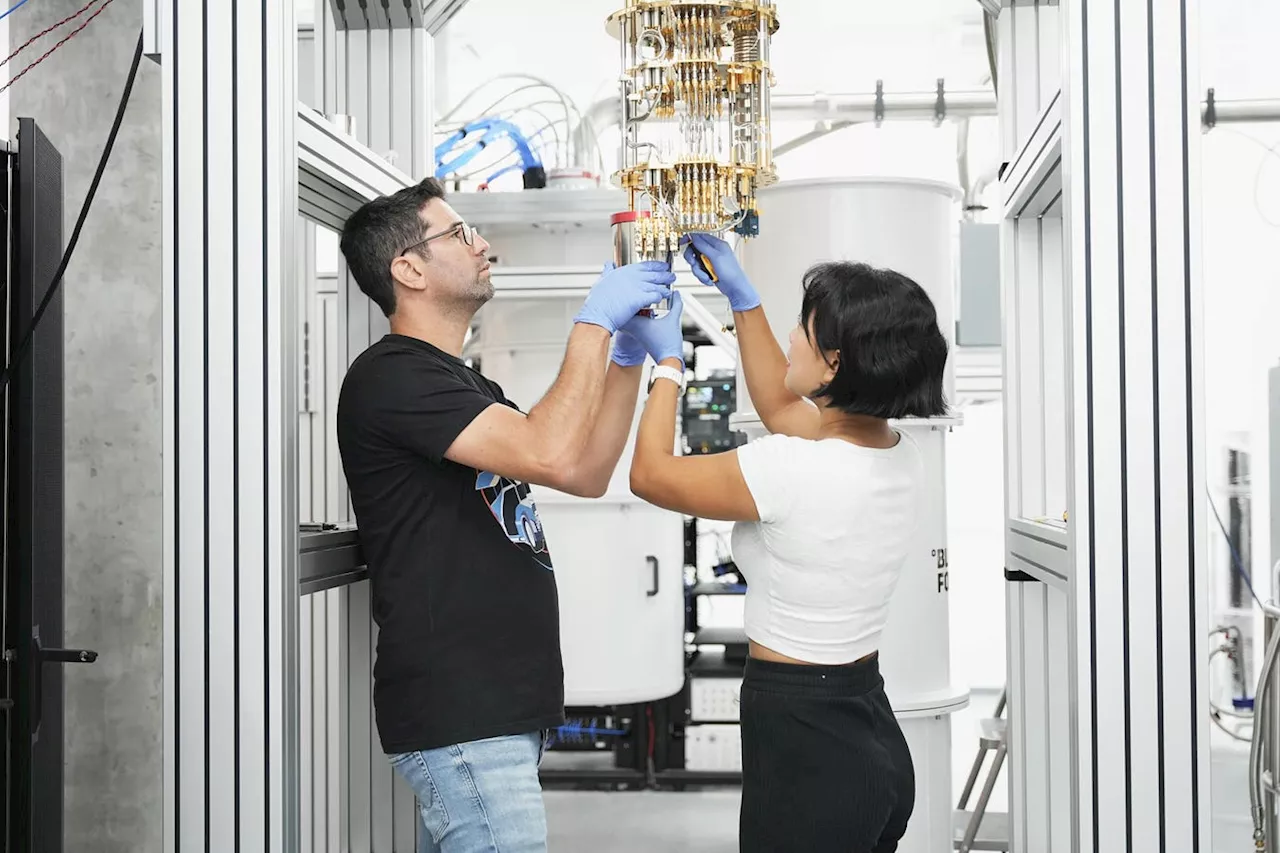 Nvidia, Rigetti, Quantum Machines Deliver AI-Powered Quantum ComputingQuantum Machines, Rigetti Computing, and Nvidia announced the successful application of AI to automate the calibration of a quantum computer.
Read more »
 New algorithm boosts multitasking in quantum machine learningWhen a quantum computer processes data, it must translate it into understandable quantum data. Algorithms that carry out this 'quantum compilation' typically optimize one target at a time. However, a team has created an algorithm capable of optimizing multiple targets at once, effectively enabling a quantum machine to multitask.
Read more »
 Physics: Current generated by the quantum Hall effect has additional magnetic propertiesThe quantum Hall effect, a fundamental effect in quantum mechanics, not only generates an electric but also a magnetic current. It arises from the motion of electrons on an orbit around the nuclei of atoms. These results can potentially be used to develop new types of inexpensive and energy-efficient devices.
Read more »
 Fact Check Team: RFK Jr. leads the charge as America rethinks processed foodsA recent Senate hearing has brought renewed attention to the growing concerns over processed foods and their impact on public health.
Read more »
 Fact Check Team: RFK Jr. leads the charge as America rethinks processed foodsA recent Senate hearing has brought renewed attention to the growing concerns over processed foods and their impact on public health.
Read more »
 Advancing a trustworthy quantum era: A novel approach to quantum protocol verificationThe future of data security depends on the reliable application of quantum technology, but its widespread adoption requires rigorous verification. Researchers have developed a novel approach to verify quantum protocols, ensuring their reliability in safety- and security-critical applications.
Read more »