
When NASA conducts research beyond our world, scientists on Earth prepare as much as possible before sending instruments on extraterrestrial journeys.
Oct 08, 2024This low-angle self-portrait of NASA’s Curiosity Mars rover shows the vehicle at the site from which it reached down to drill into a rock target called “Buckskin” on lower Mount Sharp. When NASA conducts research beyond our world, scientists on Earth prepare as much as possible before sending instruments on extraterrestrial journeys.
One way to prepare for these exploration missions is by using machine learning techniques to develop algorithms with data from commercial instruments or from flight instruments on planetary missions.instruments on Mars missions to analyze surface samples and identify organic molecules. Developing machine learning algorithms before missions can help make the process of analyzing planetary data faster and more efficient during time-limited space operations. In 2022, Victoria Da Poian, a data scientist supporting machine learning research at NASA’s Goddard Space Flight Center in Greenbelt, Maryland, collaborated with NASA’sto run two machine learning-based open science challenges, which sought ideas and solutions from the public. Solvers worldwide were invited to analyze chemical data sampled from commercial instruments located at NASA centers and data from the Sample Analysis at Mars testbed, which is a replica of the instrument suite onboard the Curiosity rover. The challenges encouraged participants to be creative in their approaches and to provide detailed descriptions of their method and code. Da Poian said her team decided to use public competitions for this project to gain new perspectives: “We were really interested in hearing from people who aren’t in our field and weren’t biased by the data’s meaning or our scientific rules.” As a result, more than 1150 unique participants from all over the world participated in the competitions, and more than 600 solutions contributing models to analyze rock and soil samples relevant to planetary science were submitted. The challenges served as proof-of-concept projects to analyze the feasibility of combining data from multiple sources in a single machine learning application. In addition to benefitting from the variety of perspectives offered by challenge participants, Da Poian says the challenges were both time- and cost-efficient methods for discovering solutions. At the same time, the challenges invited the global community to participate in NASA research in support of future space exploration missions, and winners received $60,000 in total prizes across the two opportunities. Da Poian used lessons learned to develop a new challenge with Frontier Development Lab, an international research collaboration that brings together researchers and domain experts to tackle complex problems using machine learning technologies. The competition, titled “Stay Curious: Leveraging Machine Learning to Analyze & Interpret the Measurements of Mars Planetary Instruments,” ran from June to August 2024. Results included cleaning SAM data collected on Mars, processing data for a consistent, machine learning-ready dataset combining commercial and flight instrument data, investigating data augmentation techniques to increase the limited data volume available for the challenge, and exploring machine learning techniques to help predict the chemical composition of Martian terrain. “The machine learning challenges opened the door to how we can use laboratory data to train algorithms and then use that to train flight data,” said Da Poian. “Being able to use laboratory data that we’ve collected for many years is a huge opportunity for us, and the results so far are extremely encouraging.”
Prizes Challenges & Crowdsourcing News Prizes Challenges And Crowdsourcing Program Space Technology Mission Directorate
United States Latest News, United States Headlines
Similar News:You can also read news stories similar to this one that we have collected from other news sources.
 Rolling in the deep: Street flooding can be predicted in seconds with machine learning modelsGetting around on a rainy day often involves dodging puddles—or sloshing through them. But during downpours, shallow pools can quickly become roadway ponds that cripple transportation, threaten safety and undermine emergency response.
Read more »
 Boosting particle accelerator efficiency with AI, machine learning and automationAs particle accelerator technology moves into the high-luminosity era, the need for extreme precision and unprecedented collision energy keeps growing. Given also the Laboratory's desire to reduce energy consumption and costs, the design and operation of CERN's accelerators must constantly be refined in order to be as efficient as possible.
Read more »
 Researchers improve strawberry cultivation with machine learningA Western study could help farmers get out of a potential jam by using artificial intelligence (AI) and passive camera monitoring to enhance strawberry cultivation.
Read more »
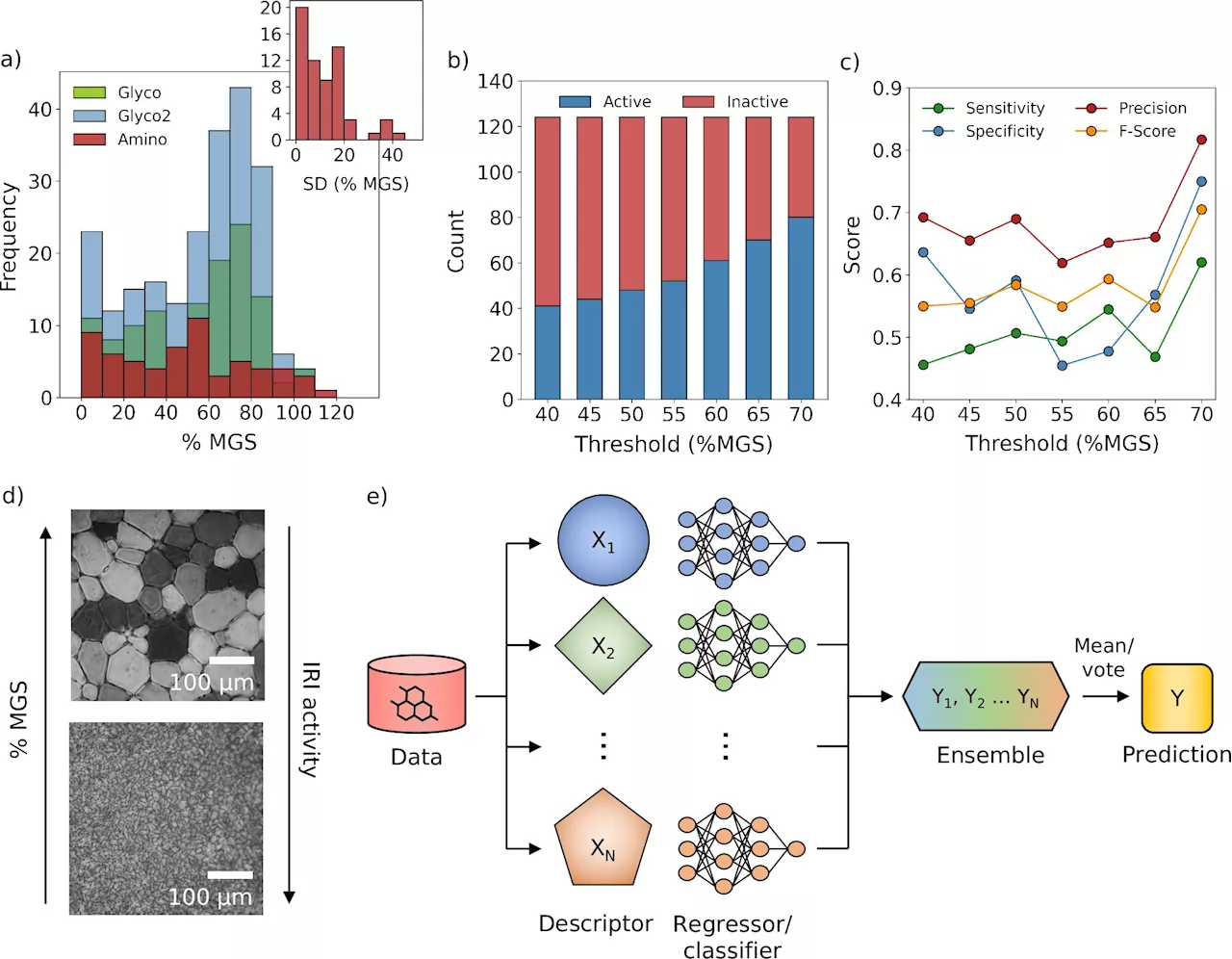 Machine learning powers discovery of new cryoprotectants for cold storageScientists from the University of Warwick and the University of Manchester have developed a cutting-edge computational framework that enhances the safe freezing of medicines and vaccines.
Read more »
 Physicists reveal evolution of shell structure using machine learningA research team has used a machine learning approach to investigate the evolution of shell structure for nuclei far from the stability valley.
Read more »
 – Bioinformatics/Computational Genomics/Machine Learning - Qatar (QA) job with Sidra Medicine QatarWe are seeking a talented and a highly motivated senior research scientist in bioinformatics/statistical genomics/AI to join a large team of the Medical and Population Genomics Lab, Sidra Medicine, Qatar.
Read more »