


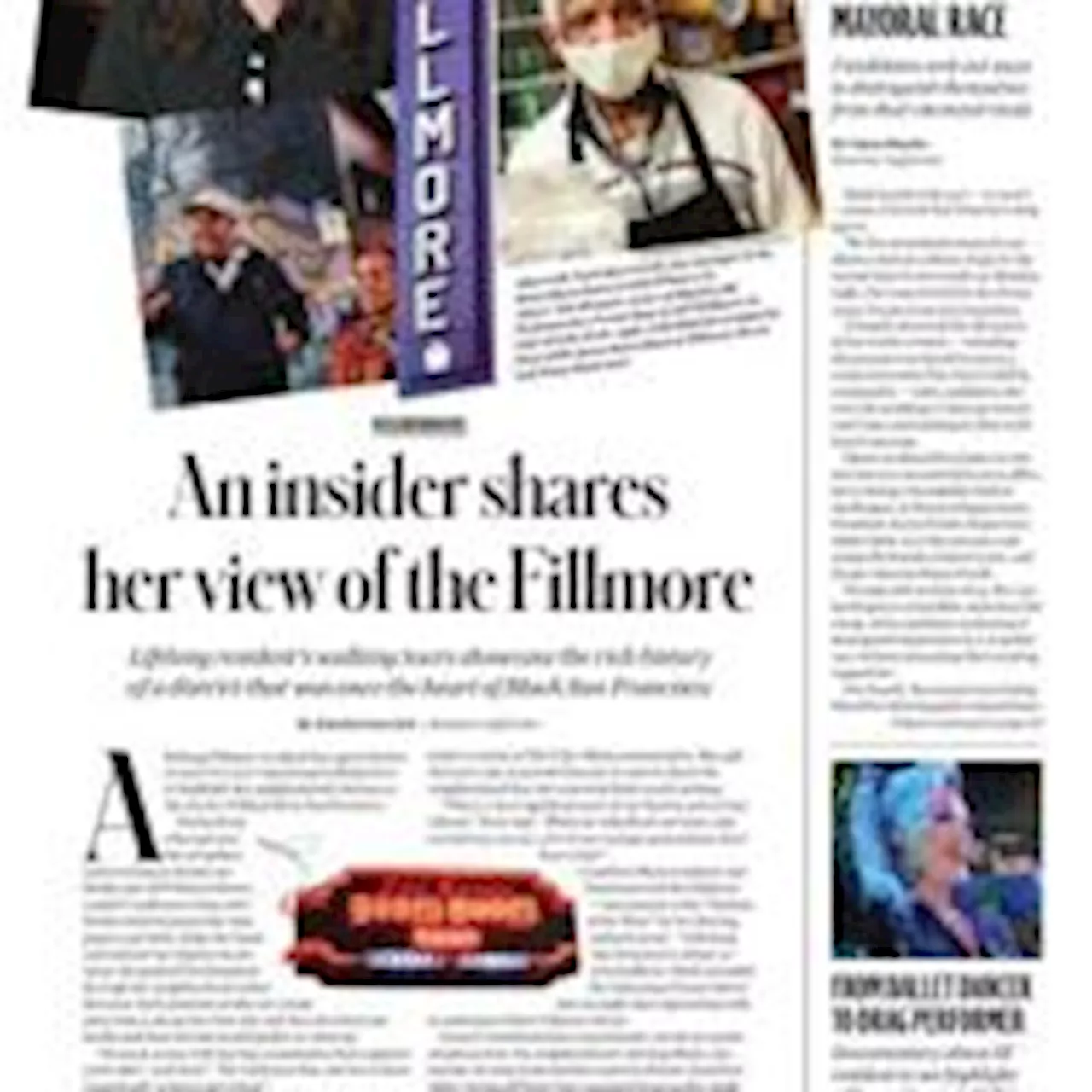
View the San Francisco for Wednesday, June 19, 2024
Ericka Scott, right, stands with Majeid Crawford in front of the Boom Boom Room at Fillmore Street and Geary Boulevard in February 2024. A lifelong Fillmore resident has spent the better part of a year organizing walking tours to highlight the neighborhood’s history as the center of Black life in San Francisco.
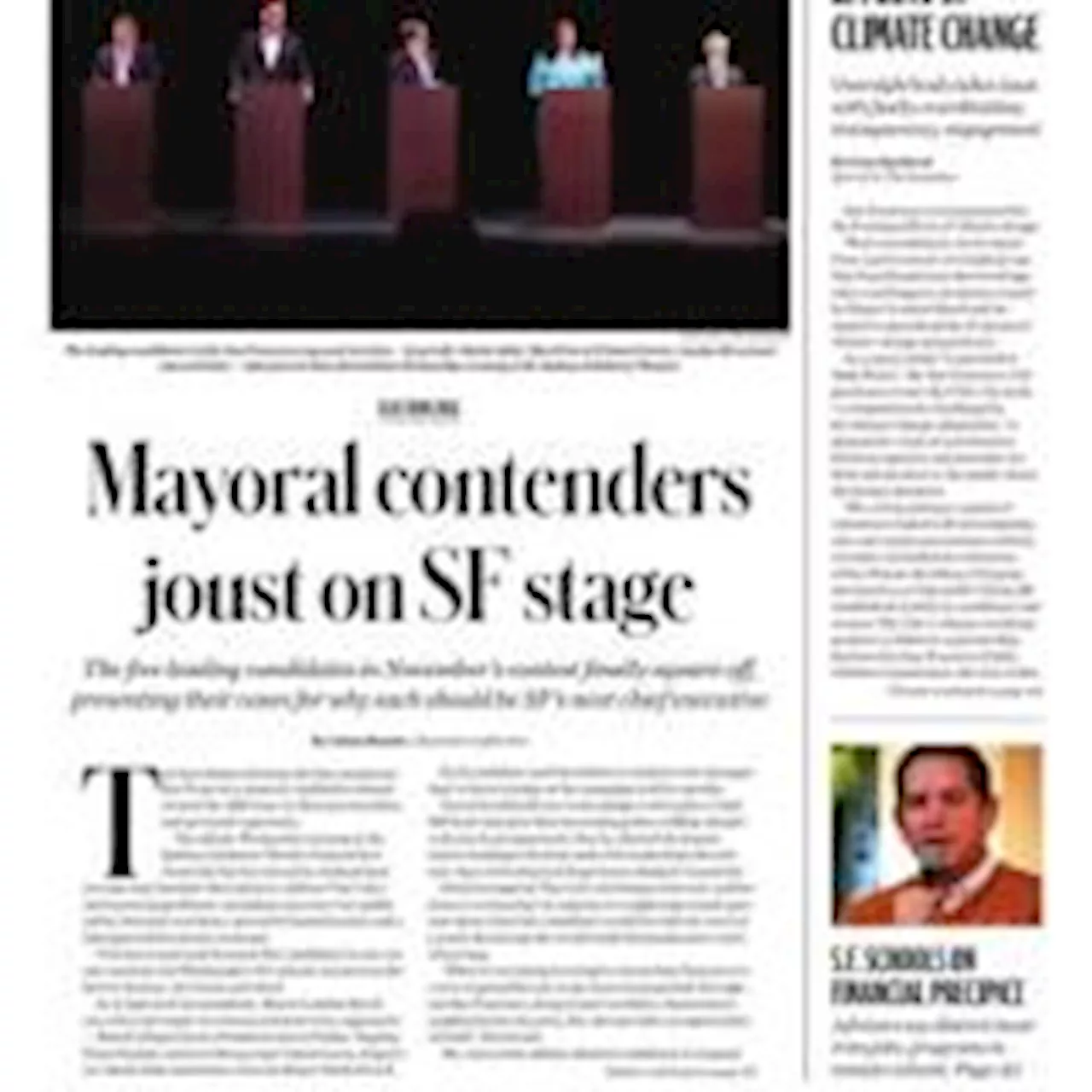
Ericka Scott, who operates the art gallery and event space Honey Art Studio just off Fillmore Street, couldn’t walk more than a few blocks without passersby stopping to say hello, shake her hand and ask how her family was doing as she guided The Examiner through the neighborhood earlier this year. Scott pointed out the ice-cream shop where she got her first job, and the cafe where her family and their friends would gather to catch up. “So much comes with having a community that supports each other,” said Scott. “We really lost that, and we’ve been consistently trying to get it back.” Scott said this month that she submitted her proposal under the San Francisco Dream Keeper Initiative, which seeks to invest in The City’s Black communities. She said the tours aim to provide historical context about the neighborhood that she currently finds sorely lacking. “This is a very significant part of our history, part of our culture,” Scott said. “When we talk about our tours and our history, our art, a lot of our younger generations don’t have a clue.” Countless Black residents and businesses left the Fillmore — once known as the “Harlem of the West” for its thriving cultural scene — following San Francisco’s urban-renewal efforts, which included the widening of Geary Street into an eight-lane expressway with an underpass below Fillmore Street. Geary’s transformation, in particular, served as a point of upheaval for the neighborhood’s thriving Black community, forcing many families and storefronts elsewhere while cutting off those that remained from nearby neighborhoods. Federal transportation officials approved a $2 million Reconnecting Communities grant in March to fund an analysis of “We really created a thriving community that was becoming known around the world as a cultural haven for blues, jazz, food, and just the richness of diversity,” said Majeid Crawford, a Fillmore activist and the executive director at New Community Leadership Foundation, which recently signed onto to support the grant project to begin the steps of reconnecting the Fillmore neighborhood. Scott said she wants her tour to highlight those institutions, one of which is Marcus Books. A Black-owned bookstore founded in the Fillmore in 1960, Scott said urban renewal forced the shop to relocate several times. It ultimately found a home of more than 30 years at 1712 Fillmore St., the Victorian building that once housed the jazz club known as Jimbo’s Bop City. Bop City closed in 1965, right around when Geary Street was widened, but the building remained intact.“It was a great club that was thriving,” Crawford said of Jimbo’s Bop City. “We had people from all over, all the greats, like Billie Holiday, all the greats. They’d perform somewhere else downtown, and then that night, they’d all come play here.” All that remains of the club is a metal marker on the sidewalk along Fillmore close to its original Post Street location, commemorating its name. Marcus Books didn’t make it in the long run either, closing its San Francisco location in 2014. Marcus Books still operates in Oakland at 3900 Martin Luther King Jr. Way. “Through financing and gentrification, it was one of the first businesses that we lost and it was a huge loss,” Scott said of the Fillmore location. Crawford called the bookstore “probably the most important establishment in the neighborhood.” He said its service to the community went far beyond its extensive selection of Black literature.Gamper Drums performing at the Boom Boom Room at 1601 Fillmore Street in San Francisco on Tuesday, Feb. 27, 2024. Down another block, Scott pointed out the Boom Boom Room at 1601 Fillmore St., one of the last old-school clubs in a neighborhood that was once inundated with live music. You can still hear music outside the front door on many nights, as was the case during The Examiner’s walk through the neighborhood. The sounds in the small space are bright and enthusiastic amid the dark lighting, with Chris Gamper and his jazz band rocking out, even with only a few customers in the room. “We are surviving. We are behind on a lot of bills,” said Scott Karczewski, the bar manager at the Boom Boom Room. “We’re doing our best. We’re a very tight family.” Scott said the Boom Boom Room’s vibe and music make it one of the closest things the Fillmore still has to the clubs that were once so ubiquitous, making it a no-doubt stop on the eventual tour.Scott Karczewski, bar manager at the Boom Boom Room at 1601 Fillmore Street in San Francisco on Tuesday, Feb. 27, 2024. Some destinations will have deeply personal connections to Scott, which she said she hopes to to sprinkle in for tourists and visitors. Miyako Old Fashioned Ice Cream Shop at 1470 Fillmore St. is one such stop. Scott said she worked there as a preteen after begging the shop’s owner, Tom Bennett, to let her work there along with her older cousins and sisters. “Every time I come now, he won’t let me pay for anything,” she said of Bennett, who still sells ice cream. His shop might be one of the last places in The City where customers can buy a sandwich for $4. “Anything she does is great,” Bennett said of Scott. who first opened Miyako in the 1980s. He said that working behind the counter of his closet-sized shop was his favorite part of the Fillmore. Bennett’s business has managed to stay afloat due to community support. After his shop was broken into during the first few months of the COVID-19 pandemic, aTom Bennett, owner of Miyako Old Fashioned Ice Cream Shop at 1470 Fillmore Street in San Francisco during a tour of the Fillmore District on Tuesday, Feb. 27, 2024. Scott said she wants her tour to convey this sort of camaraderie and togetherness, as well as the sadder parts of the neighborhood’s history. She said she intends to recruit others with different backgroundsUltimately, Scott said, the tour is meant for those who don’t know the Fillmore’s history, and the tour guides will be people who want to share their connection to it. “I’m always wanting people to understand the contributions that we make to their city, and to our community, and pointing those kinds of things out,” Scott said.As the excited CEO of a new women’s soccer franchise, Bay FC’s Brady Stewart arrives early to matches at PayPal Park in San Jose, helping people navigate the stadium and answering questions. “The Bay area is such a diverse tapestry of people,” she said. “You’ve got a group of guys coming together just because the game is gonna be really exciting and really fun ... you’ve got the dads and the daughters, you’ve got the LGBTQIA+ community coming in, all together.” Bay FC has filled seats by the thousands, ranking near the top of the National Women’s Soccer League in attendance in the team’s inaugural seats. It has done so by bringing in fans from every background and corner of the Bay Area despite a record that, as of this week, stands at four wins and nine losses. The team’s inclusivity has already drawn positive feedback from fans for producing a unique atmosphere at home games — beyond the sight of a plane landing at the adjacent airport. Manal Sinha, a San Jose-based soccer fan, said he had been interested in becoming a season ticketholder of a local sports team after moving to the Bay Area from India in 2017. He passed on the Earthquakes, the men’s Major League Soccer team thatBut when he learned about Bay FC’s imminent arrival earlier this year, Sinha said, he made the leap. Now, he’s even a member of Bridge Brigade, the team’s supporters group. “I have attended a couple of Quakes games in the past — not too many — and I did not find the crowd to be as diverse as I would like,” Sinha said. It’s not that there was rampant hooliganism in the Quakes crowd, but there’s just “a lot more diverse crowd — more women and more kids, more parents, families, being part of the crowd at the stadium” when Bay FC is playing, Sinha said. Of course, being inclusive doesn’t matter much if hardly any fans show up to games. But Bay FC continues to pack the house despite what has thus far been sporadic on-field performance.Bay FC has been meticulous about cultivating its fanbase and experience, which the team says it is building for the long-term and not just a single season. The team averaged about 15,000 fans through six games at PayPal — which has a stated capacity of 18,000 fans — through the first 10 weeks of the season. That was good enough to position Bay FC as theCrystal Cuadra-Cutler, vice president of Bridge Brigade, said she has followed women’s soccer since 2014. She attended the 2015 FIFA Women’s World Cup in Vancouver and helped organize Los Angeles fans behind Angel City FC, which joined the NWSL. With that experience, she said, she’s not surprised at Bay FC’s success. “There was a hunger here,” said Cuadra-Cutler, who said that the women’s national team games in the Bay Area have been “some of the hardest tickets to get.”are from marginalized communities and “people who come in who maybe haven’t felt welcome in other places,” Cuadra-Cutler said. “There’s been a lot of people that I’ve met over the course of this that have said they have not felt welcome in other places, but they feel like they belong ,” Cuadra-Cutler said. Stewart attributes some of the team’s success thus far to “muscle memory for the Bay Area for how to support a team.”“I do think that there is something unique about women’s soccer in that so many people can look and see themselves represented on the field, and so they feel automatically connected to the team” Stewart said. The team boasts players from around the world. Forward Asisat Oshoala’s hometown is in Nigeria, while goalkeeper Katelyn Rowland was born a short drive away in Vacaville.Bay FC has filled seats by the thousands, ranking near the top of the National Women’s Soccer League in attendance in the team’s inaugural seats. Surging interest in women’s sports is also undoubtedly a boon. But Stewart stressed that the team aims to make women’s sports a movement, not a moment. Fans’ desire to support women’s sports because of its underdog status in America would only get the team so far, but the competition on the field is elite. One only need witness Bay FC forward Racheal Kundananji collide with a desperate defender as she sprints toward the opponents’ goal to verify the quality of play.At home games, Bay FC fans will catch a PSA played on the video board for Lyft’s Women + Connect program, which increases the odds that women and nonbinary rideshare drivers are matched with women and nonbinary riders. In honor of AAPI Heritage Month in June, midfielder Maya Doms was featured in a Visa-sponsored video in which she introduced her teammates to boba, the drink now nearly ubiquitous in the Bay Area that she said “shows how much Asian culture has influenced food preferences in NorCal.” Bay FC has been meticulous about cultivating its fan base and experience, which the team says it is building for the long term and not just a single season. That includes the lines for the bathrooms, which — like at other sporting events — tend to be longer for women than for men. Stewart attributes this conundrum to the “flow through the stadium,” which was built in the shape of a horseshoe that naturally funnels fans to its ends. “We want to solve it and we want our fans to have a great experience, but it’s also a reflection of the power of the team and the fact that so many women want to come to the game,” Steward said. “It’s a good problem, but it’s a problem nonetheless.” But problems have been few and far between thus far, as reflected by the 10,000 season tickets the team sold. “I do think we have an incredibly special fan base that it is inclusive,” Stewart said. “It is diverse, and it — what unites all of us is our excitement about the team and our want, desire to be in the stadium cheering for the team together.”“They’re ready to run through a wall for this team,” Cuadra-Cutler said. “They’re here for it. They’re so excited they have a team.”From left, Mark Farrell, Ahsha Safai, Daniel Lurie, Mayor London Breed and Aaron Peskin share the stage for a mayoral debate at UC Law San Francisco on Monday. Mark Farrell still can’t — or won’t — name a favorite San Francisco drag queen. The five prominent mayoral candidates shared aon Monday night, this time hosted by the Democratic County Central Committee. It largely mirrored the discourse of last week’s contest — including the pressure on Farrell to prove a connection with The City’s LGBTQ community — with candidates rhetorically nodding to their perceived voter base and sticking to their well-honed message. Mayor London Breed aims to win election to a second full term in office but is facing a formidable field of challengers in Board of Supervisors President Aaron Peskin, Supervisor Ahsha Safai, Levi Strauss heir and nonprofit founder Daniel Lurie, and former interim Mayor Farell. Though still months away, the race has begun to crystallize and enter full swing, with candidates jockeying to distinguish themselves in a crowded race without alienating their existing supporters.In other words, one could argue that if you’ve watched just one debate, you’ll have seen ’em all. Still, here are a few key takeaways from Monday’s debate.Though polls indicate a majority of San Franciscans still feel The City is heading in the wrong direction, Breed is banking her reelection on the assumption that enough voters will believe things are turning around. It wasn’t long ago thatat nearly every other corner of city government for San Francisco’s failings. But on Monday, she defended her administration’s aggressive curtailment of open-air drug dealing and use, its plans to promote downtown’s economic recovery and the recent reduction in The City’s crime rate. Not only did she defend her record, she consistently accused her opponents of trying to take The City “backwards.”Farrell has built his entire campaign on public safety, almost as if it is the single issue in San Francisco — so it’s no surprise that he would again focus on it on Monday. The debate format allowed Farrell and Breed to directly spar on the subject. Farrell blasted Breed for allowing the ranks of The City’s police force to decline by more than 600 since his heyday as a supervisor and chair of the Budget Committee. He referenced Breed’s 2020 decision to redirect $120 million from the police department to fund investments in the Black community, promising to “restore” the police budget Breed had slashed. Breed — whothis year, including one strongly opposed by the ACLU — seemed like a dyed-in-the-wool progressive by comparison. “This is not the Republican National Convention, where every answer to public safety is police,” Breed told Farrell. Breed touted awhich is now at an all-time high. Farrell acknowledged the police department budget has grown by $200 million, but said “that’s not enough” compared to the $5 billion growth of the total budget. “That type of growth is an embarrassment,” Farrell said. “I will make sure our police department is fully funded”At times, it felt as though Peskin’s opponents weren’t even on the stage with him. Instead, he directed much of his ire at Donald Trump, whom he implored San Franciscans to unite and rally against in the upcoming election. It’s totally believable that Aaron Peskin really, truly, deeply loathes Donald Trump. It’s also totally possible that Peskin is trying to appeal to voters who normally don’t pay much attention to local San Francisco politics but will be voting this fall because it’s also a national election. Thanks to a2, mayoral elections now coincide with presidential elections, which political observers suggest could bring a whole new set of voters into the mix.Peskin is hardly courting the pro-housing vote. But on Monday, he used a question on housing to riff on why he thinks the belief that increasing market-rate housing supply will lower rents is a “bunch of horse pucky.” And yes, that is a direct quote. The studies shared on X by apoplectic housing advocates after the debate say Peskin is wrong, but he’s doubling down on his message that The City can — and should — build affordable housing that doesn’t destroy neighborhood character. “We know how to do this without” Peskin said. On the opposite side of the housing spectrum, Breed referenced the destruction of the Western Addition and Fillmore neighborhood in which she was raised and acknowledged the historical pain caused by redevelopment in San Francisco in the 20th century. But she pleaded with San Franciscans not to be afraid of moving forward. “San Francisco is not a museum, it is a living, breathing thing because of its people,” Breed said. Lurie is a man with a planLurie really, really wants voters to go to his website. As he did in the first debate, Lurie again directed voters to a plan on his website on Monday. Lurie is quick to point out he’s not a “city hall insider.” He’s alsohe’s developed to address any number of The City’s chronic problems — drug overdoses, corruption, thorny permitting processes, etc. They’re dense, and one can’t help but wonder how many voters will actually pore over them, but Lurie clearly wants to dispel any notion that he doesn’t understand policy just because he’s never been in politics. Lurie’s opponents have chided him not only for his lack of experience but also for his abundance of wealth. On Monday, Safai asked Lurie directly about the $1 million Lurie’s mother donated in support of his campaign for mayor. Lurie didn’t actually address his mother’s donation, but he did concede that voters should consider his personal background. On Monday — as he’s done throughout the campaign — he argued that San Franciscans should judge him not on what he inherited but on what he’s done with it . Still, for Lurie, his family history is something he’s forced to address. For other candidates, personal identity is a key talking point. Safai, for example, referenced being an immigrant — like much of San Francisco’s population — in both his opening and closing statements.Click and hold your mouse button on the page to select the area you wish to save or print. You can click and drag the clipping box to move it or click and drag in the bottom right corner to resize it. When you're happy with your selection, click the checkmark icon next to the clipping area to continue.This is the name that will be displayed next to your photo for comments, blog posts, and more. Choose wisely!Create a password that only you will remember. If you forget it, you'll be able to recover it using your email address.Forgot Password An email message containing instructions on how to reset your password has been sent to the email address listed on your account.
United States Latest News, United States Headlines
Similar News:You can also read news stories similar to this one that we have collected from other news sources.
 Page A1View the San Francisco for Thursday, May 30, 2024
Read more »
 Page A01View the San Francisco for Sunday, June 2, 2024
Read more »
 Page A01View the San Francisco for Thursday, June 6, 2024
Read more »
 Page A1View the San Francisco for Sunday, June 9, 2024
Read more »
 Page A1View the San Francisco for Thursday, June 13, 2024
Read more »
 Page A1View the San Francisco for Sunday, June 16, 2024
Read more »