
Science, Space and Technology News 2024
EPFL researchers have created a groundbreaking device that operates efficiently at millikelvin temperatures required for quantum computing, potentially revolutionizing cooling systems for advanced technologies.
The LANES lab’s 2D device made of graphene and indium selenide. Credit: Alain Herzog Engineers at EPFL have developed a device capable of transforming heat into electrical voltage efficiently at temperatures even colder than those found in outer space. This breakthrough could significantly advanceTo perform quantum computations, quantum bits need to be cooled to temperatures in the millikelvin range to reduce atomic motion and minimize noise. However, the electronics used to control these quantum circuits generate heat, which is challenging to dissipate at such low temperatures. Consequently, most current technologies must separate the quantum circuits from their electronic components, resulting in noise and inefficiencies that impede the development of larger quantum systems beyond the laboratory., led by Andras Kis, in the School of Engineering have now fabricated a device that not only operates at extremely low temperatures, but does so with efficiency comparable to current technologies at room temperature. “We are the first to create a device that matches the conversion efficiency of current technologies, but that operates at the low magnetic fields and ultra-low temperatures required for quantum systems. This work is truly a step ahead,” says LANES PhD student Gabriele Pasquale.with the semiconductor properties of indium selenide. Only a few atoms thick, it behaves as a two-dimensional object, and this novel combination of materials and structure yields its unprecedented performance. The achievement has been published inThe device exploits the Nernst effect: a complex thermoelectric phenomenon that generates an electrical voltage when a magnetic field is applied perpendicular to an object with a varying temperature. The two-dimensional nature of the lab’s device allows the efficiency of this mechanism to be controlled electrically. The 2D structure was fabricated at the EPFL Center for MicroNanoTechnology and the LANES lab. Experiments involved using a laser as a heat source, and a specialized dilution refrigerator to reach 100 millikelvin – a temperature even colder than outer space. Converting heat to voltage at such low temperatures is usually extremely challenging, but the novel device and its harnessing of the Nernst effect make this possible, filling a critical gap in quantum technology. “If you think of a laptop in a cold office, the laptop will still heat up as it operates, causing the temperature of the room to increase as well. In quantum computing systems, there is currently no mechanism to prevent this heat from disturbing the qubits. Our device could provide this necessary cooling,” Pasquale says. A physicist by training, Pasquale emphasizes that this research is significant because it sheds light on thermopower conversion at low temperatures – an underexplored phenomenon until now. Given the high conversion efficiency and the use of potentially manufacturable electronic components, the LANES team also believes their device could already be integrated into existing low-temperature quantum circuits. “These findings represent a major advancement in nanotechnology and hold promise for developing advanced cooling technologies essential for quantum computing at millikelvin temperatures,” Pasquale says. “We believe this achievement could revolutionize cooling systems for future technologies.” Reference: “Electrically tunable giant Nernst effect in two-dimensional van der Waals heterostructures” by Gabriele Pasquale, Zhe Sun, Guilherme Migliato Marega, Kenji Watanabe, Takashi Taniguchi and Andras Kis, 2 July 2024,SciTechDaily: Home of the best science and technology news since 1998. Keep up with the latest scitech news via email or social media.Researchers have developed a breakthrough method for quantum information transmission using light particles called qudits, which utilize the spatial mode and polarization properties to enable…
United States Latest News, United States Headlines
Similar News:You can also read news stories similar to this one that we have collected from other news sources.
 Vortex Power: The Swirl of Light Revolutionizing Quantum ComputingScience, Space and Technology News 2024
Read more »
 China’s quantum computing dilution fridge boasts 1,000 microwatts of coolingChina's Anhui Quantum Computing Engineering Research Centre rolled off the production line of the Origin SL1000 dilution refrigerator.
Read more »
 Femtosecond Lasers Spearhead the Quantum Computing RevolutionScience, Space and Technology News 2024
Read more »
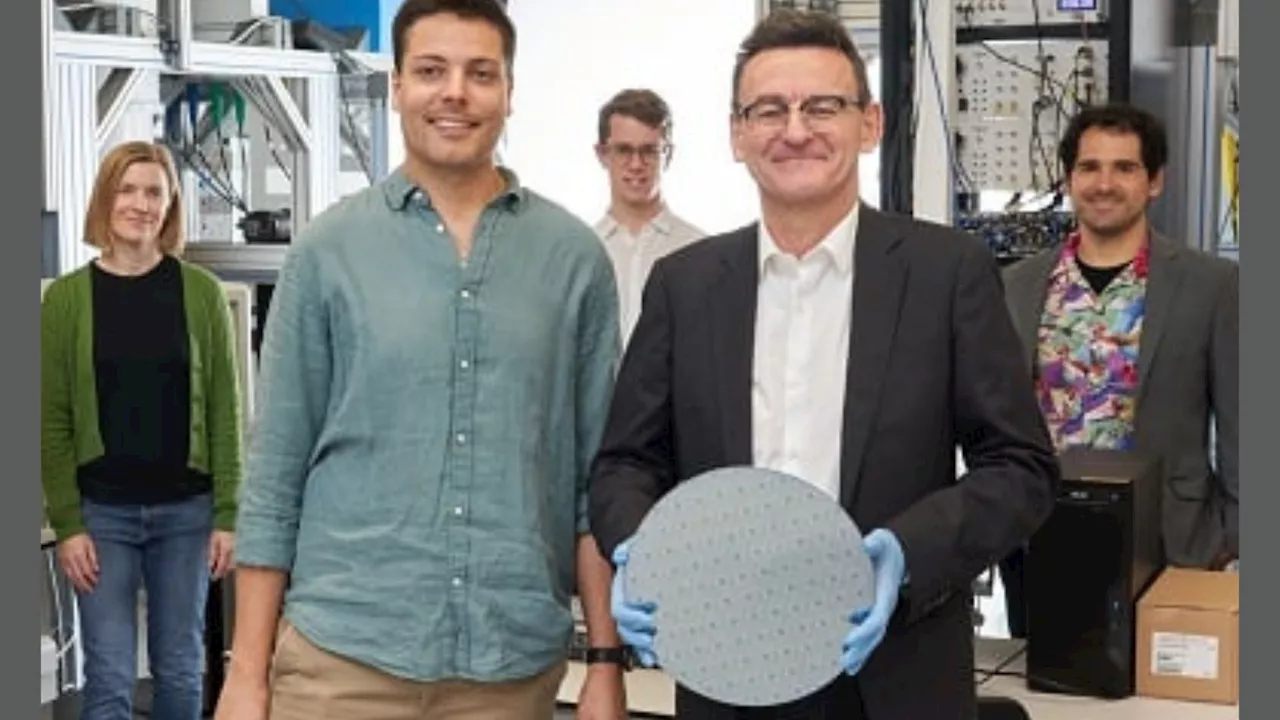 Record 99.9% quantum computing accuracy achieved on existing silicon chipsDiraq's use of silicon-based qubits has led to a quantum leap in accuracy, marking a significant milestone in quantum computing research.
Read more »
 From Bits To Quibits: The Future Of Quantum ComputingMark Johnson is Co-Founder and Managing Partner at Michigan Software Labs. Read Mark Johnson's full executive profile here.
Read more »
 Physicists propose time crystal-based circuit board to reduce quantum computing errorsA trio of physicists, two with Uniwersytet Jagiello&324;ski in Poland and one with Swinburne University of Technology in Australia, are proposing the use of temporal printed circuit boards made using time crystals as a way to solve error problems on quantum computers.
Read more »