
Astronomers have discovered 2017 OF201, a dwarf planet candidate in an extremely wide orbit, potentially challenging the existence of the hypothesized Planet X.
An award-winning reporter writing about stargazing and the night sky.Astronomers have found a distant celestial body — potentially a dwarf planet — orbiting the sun from more than twice as far as Pluto .
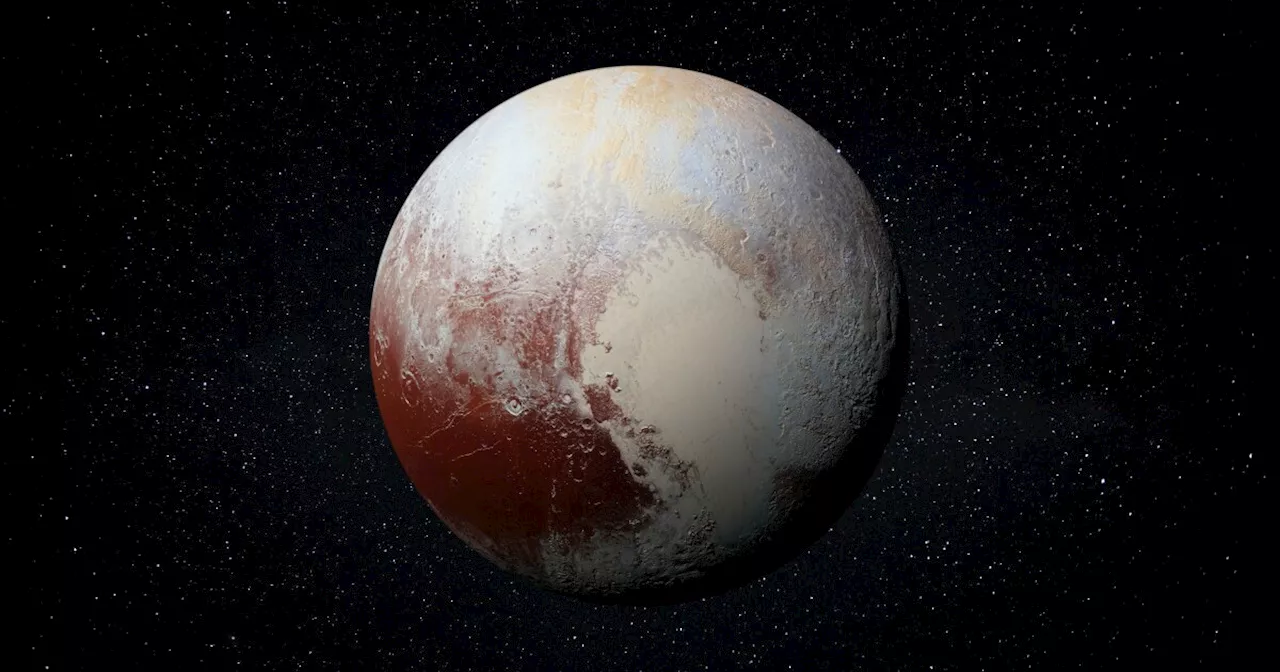
Found by astronomers at the Institute for Advanced Study in Princeton, New Jersey, it’s one of the most distant solar system bodies observed with optical telescopes. It takes 25,000 years to orbit the sun — and it could be the first of many new objects to be found in the outer solar system.... MoreNASA, ESA, and G. Bacon ; Science: NASA, ESA, and C. Fuentes 2017 OF201 is estimated to be 435 miles in diameter. That’s smaller than Pluto’s 1,477 miles , but if its size is confirmed using radio telescopes, 2017 OF201 will become the largest object in the outer solar system found in more than a decade. It’s classed as an “extreme” trans-Neptunian object, which is an icy body orbiting beyond Neptune in the solar system. The largest TNOs known are Eris, followed by Pluto, Haumea, Makemake and Gonggong. Researchers identified it in 19 different exposures captured over seven years by the Dark Energy Camera and the Canada France Hawaii Telescope .Why 2017 Of201 Is So Special— the farthest point on the orbit from the sun — is more than 1,600 times that of the Earth’s orbit,”perihelion — the closest point on its orbit to the sun — is 44.5 times that of the Earth’s orbit, similar to Pluto's orbit.” It takes 2017 OF201 about 25,000 years to complete one orbit of the sun, which suggests a chaotic past. “It must have experienced close encounters with a giant planet, causing it to be ejected to a wide orbit,” said Yang. "It’s possible that this object was first ejected to the Oort cloud, the most distant region in our solar system, which is home to many comets, and then sent back."2017 OF201 exists at the edge of the solar system in what’s known as the Kuiper Belt, a vast ring-shaped region beyond the orbit of Neptune. It was thought that the Kuiper Belt was largely empty of large objects — but 2017 OF201 indicates that is not the case. That’s underscored by the fact that 2017 OF201 spends only 1% of its orbital time close enough to the inner solar system to be detectable. “The presence of this single object suggests that there could be another hundred or so other objects with similar orbit and size; they are just too far away to be detectable now,” said Cheng. “Even though advances in telescopes have enabled us to explore distant parts of the universe, there is still a great deal to discover about our own solar system.”that they had uncovered 11 new objects beyond the accepted edge of the Kuiper Belt. They were found in alcluster while using the 8.2-meter Subaru Telescope in Hawaii to find new targets for NASA’s New Horizons spacecraft, which left Earth in 2006 and conducted the only ever flyby of Pluto in 2015 before entering the Kuiper Belt.
Dwarf Planet Pluto Planet 9 Planet X Planet Nine Neptune Solar System Trans-Neptunian Object Oort Cloud
United States Latest News, United States Headlines
Similar News:You can also read news stories similar to this one that we have collected from other news sources.
 New Minor Planet Spotted Past Pluto, One of the Largest Distant Objects in the Solar SystemThe surprisingly large world has a massive orbit—about 838 times Earth’s distance from the Sun.
Read more »
 Scientists Discover New Dwarf Planet in Solar System, Far Beyond PlutoThe Best in Science News and Amazing Breakthroughs
Read more »
 Our Solar System May Have a New Dwarf Planet Orbiting Even Farther Than PlutoLearn about the recently discovered trans-Neptunian object that may eventually join Pluto as a dwarf planet, found at the edge of our solar system.
Read more »
 Scientists discover potential dwarf planet, dubbed 'extreme cousin' of PlutoJustin Boggs is a writer for the E.W. Scripps company. Justin covers anything from politics to sports and entertainment.
Read more »
 Scientists found a possible new dwarf planet — it could spell bad news for Planet 9 fansKeith Cooper is a freelance science journalist and editor in the United Kingdom, and has a degree in physics and astrophysics from the University of Manchester.
Read more »
 Pluto's hazy skies are making the dwarf planet even colder, James Webb Space Telescope findsKeith Cooper is a freelance science journalist and editor in the United Kingdom, and has a degree in physics and astrophysics from the University of Manchester.
Read more »